
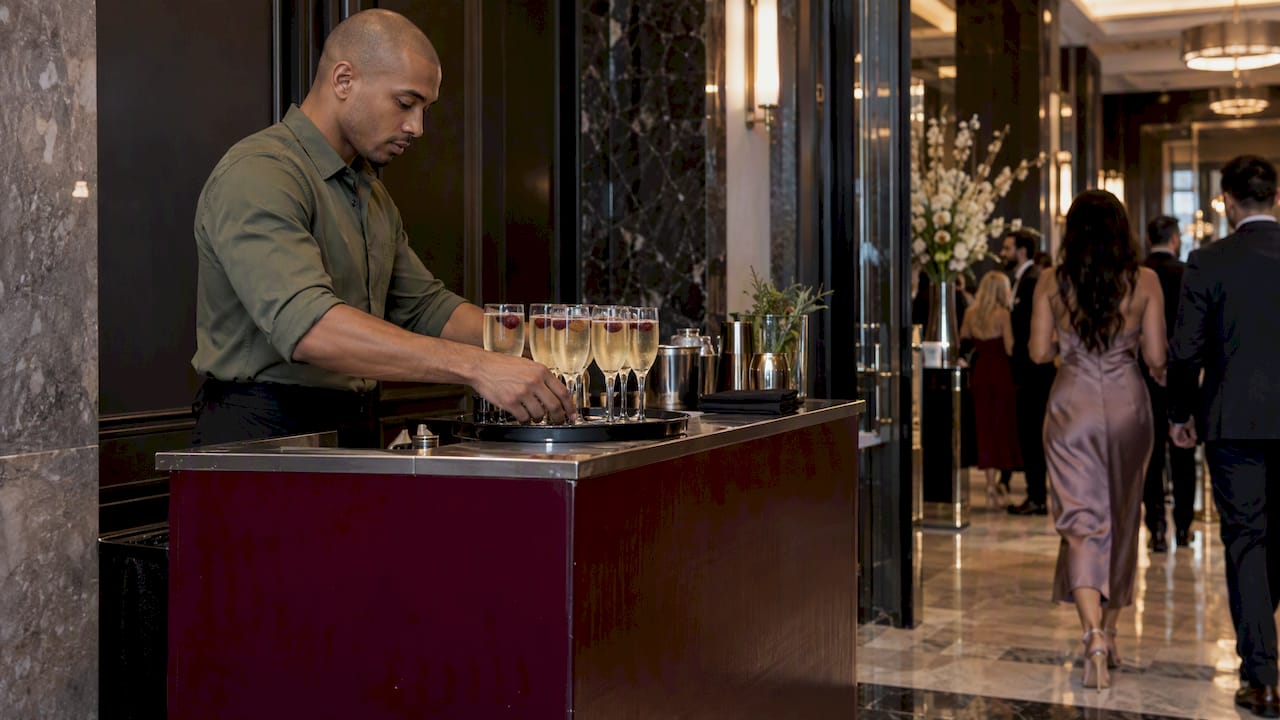
A welcome drink works when every guest has a glass in hand within a few minutes of arriving, nobody waits in a line, and the host never touches a shaker. That takes four decisions made early: when service starts and stops, how many drinks you need, where the station sits, and who is legally and practically allowed to pour. This guide walks through each one, with extra detail for weddings and corporate events in Las Vegas and Henderson, Nevada.
TL;DR
- Open the welcome drink 30 to 45 minutes before guests move to the next part of the evening, and close it when they do.
- Estimate with simple math (drinking guests × (hours + 1)), then add a buffer and keep a non-alcoholic option in the same glassware.
- Offer one or two drinks, batch everything in advance, and leave a single finishing step (ice, bubbles, garnish) for the bar.
- In Las Vegas, alcohol service needs either a city-licensed alcohol beverage caterer or a special event alcohol permit applied for at least 20 days ahead. Henderson has its own permit process.
- Put the bar where guests naturally slow down, not in the doorway, and give it enough staff for the peak first ten minutes.
Table of Contents
- What a welcome drink actually has to do
- Timing: when to serve and when to stop
- Quantities: how many welcome drinks to pour
- Menu design that keeps service fast
- Station setup: placement, flow and staffing
- Non-alcoholic welcome drinks done properly
- Alcohol rules to check in Las Vegas and Henderson
- Perspective: what we see on the ground
- Wedding versus corporate: what changes
- A planning checklist you can copy
- Let us run the welcome drink for you
- FAQ
- Sources
What a welcome drink actually has to do
A welcome drink is a transition tool. Guests arrive at different times, they are dressed up, they do not know where to stand, and they are often hot. Hand them something cold and the first ten minutes sort themselves out. Skip it, or serve it badly, and the line for the first drink becomes the first impression.
That is why logistics matter more than the recipe. The search results for this topic are mostly drink ideas, but a mediocre drink served instantly beats a brilliant cocktail that takes four minutes each. Think of the welcome drink as a service system with four parts: a clock, a headcount, a layout and a legal basis.
Timing: when to serve and when to stop
Build the window around the next event
A welcome drink has a start (when the first guest arrives) and a hard end (when guests are called to the ceremony, dinner or program). A real venue example shows the shape: one Charleston venue’s sample rehearsal dinner timeline allows a 30 to 45 minute arrival cocktail period before guests are invited into the dining room. That range is a good default for most events.
Work backward from the moment you want everyone seated or in position:
- Decide the call time for dinner, the ceremony or the first speech.
- Subtract 30 to 45 minutes for the welcome drink.
- Set bar staff arrival at least an hour before that, so ice, glassware and batches are in place before the first car pulls up.
- Tell the venue coordinator and the photographer when the window opens and closes.
Plan for staggered arrivals
Guests do not arrive on the minute. At a wedding, expect a trickle for the first 15 minutes, a surge in the middle, and stragglers at the end. At a corporate reception, the surge often comes right after a session lets out. Staff for the surge, not the average. If 120 people can arrive in a ten minute span, one person pouring cannot cover it.
Close it cleanly
When the window ends, the welcome drink should end too. Switch to the full bar or to table service so guests do not drift into the ceremony with a half-finished drink. At weddings, plan a place to set glasses down and have staff collect them. At corporate events, stop circulating trays when a speaker begins, then restart. Service moves best in waves, and a lead bartender or captain should have the authority to pause and resume based on what is happening in the room.
Quantities: how many welcome drinks to pour
The simple math
For a full event, a commonly used rule from America’s Test Kitchen is drinking guests × (hours + 1). In the same guide, a 750-ml bottle of wine yields 5 drinks and a 750-ml bottle of spirits yields 12. Some experts advise two bonus drinks instead of one, which is worth doing for a hot, thirsty crowd.
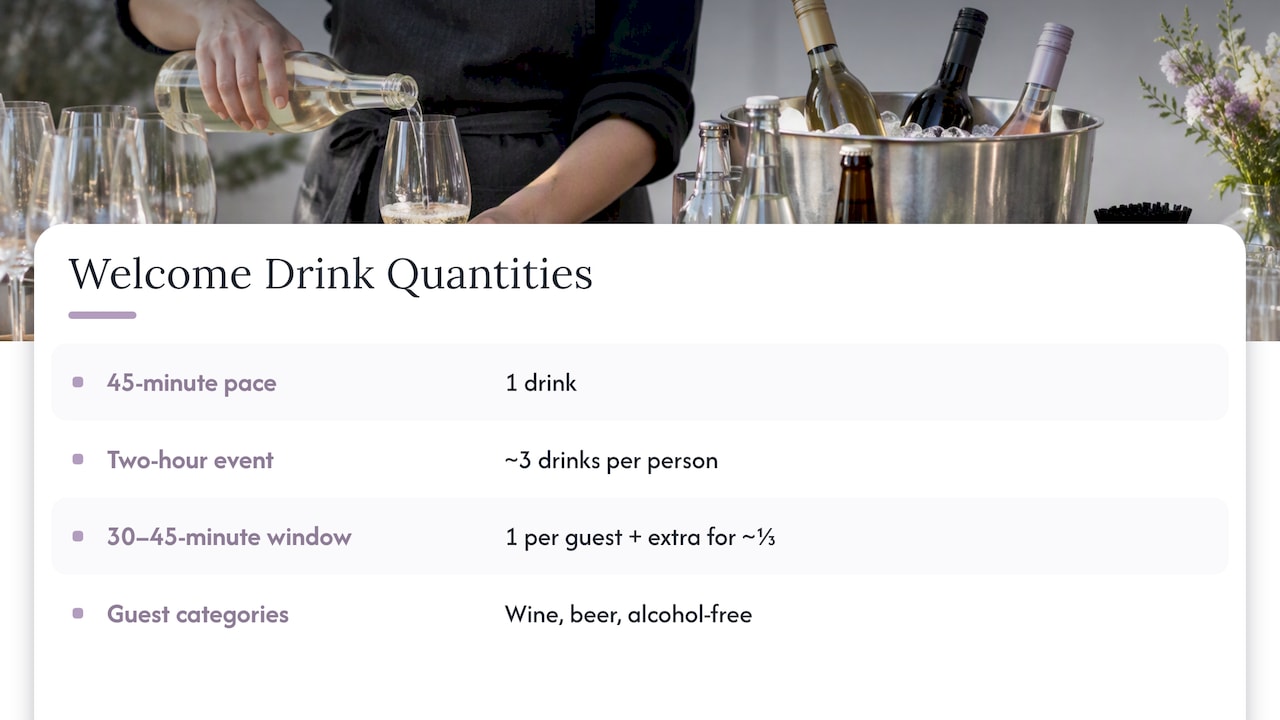
For the welcome drink on its own, the math is shorter. Montgomery County, Maryland’s beverage serving planning guide suggests estimating one drink every 45 minutes, which is about three drinks per person for a two-hour event, then dividing guests among wine, beer and alcohol-free categories. For a 30 to 45 minute welcome window, plan one drink per guest as the base and one extra for roughly a third of them.
A worked example
Say you are hosting 100 guests and expect about 85 to drink alcohol.
| Item | Calculation | Result |
|---|---|---|
| Drinking guests | 100 × 85% | 85 |
| Base welcome drinks | 85 × 1 | 85 |
| Seconds for about a third | 85 × 0.33 | about 28 |
| Alcohol-free drinks | 15 guests × 1, plus a few seconds | about 25 |
| Total pours before buffer | 85 + 28 + 25 | about 138 |
| Add a 15% buffer | 138 × 1.15 | about 159 |
The 15% buffer is in line with common planning advice to add 15 to 20 percent for variable consumption. If the welcome drink is sparkling wine poured at 5 glasses per bottle, 85 to 113 alcoholic pours means roughly 17 to 23 bottles. If it is a spirit-based cocktail at 12 pours per bottle of spirit, the spirit count drops sharply, though you need mixers, citrus and ice in volume.
Adjust for the crowd and the climate
- Heat: Las Vegas and Henderson summers push consumption of cold, light drinks up. Expect guests to finish the first drink fast and ask for water.
- Time of day: Daytime events skew toward lighter drinks and more water.
- Age and mix: A mixed group with many non-drinkers means more of your total should be alcohol-free.
- Open bar to follow: If an open bar opens right after, the welcome drink can be smaller. If dinner is served with wine, keep the welcome drink light.
Ice is the item hosts underestimate most in the desert. Order more than the math suggests, and keep it in sealed tubs away from the sun.
Menu design that keeps service fast
Fewer choices, faster line
The fastest welcome service has the shortest menu. Event beverage planners at Margaritas Express argue that limiting offerings, for example two signature cocktails, two wines and two beers, speeds service and cuts waste more than broad variety does. For the welcome window specifically, we would go further: one signature drink, one sparkling or wine option, one alcohol-free drink and water.
Match the drink to the season and format
The Gourmet Host suggests matching the drink to the setting: a cucumber-lime or elderflower spritz for summer, spiced apple cider for winter, mimosas or peach Bellinis for brunch, and a single signature cocktail such as an Aperol Spritz or French 75 for a formal event. In Southern Nevada, that translates to something like:
- Summer outdoor wedding: a spritz or a citrus-forward batched cocktail over plenty of ice.
- Winter or desert evening event: a warm spiced cider, or a sparkling option for guests who want something cold.
- Corporate reception: one branded signature drink plus wine and beer, so executives and clients can grab what they know.
- Daytime brunch or pool party: mimosas, a bubbly cocktail and chilled water.
Prep so only one step is left
The cleanest rule we have seen is that a welcome drink should need just one final move before guests arrive, such as adding ice, bubbles or garnish, a principle laid out in this welcome drink prep guide. Batch the base, chill it, pre-cut the garnish, and keep the freshness-sensitive step for the moment of service. Anything that needs shaking, muddling or a flame belongs to a later bar, not the first ten minutes. Theatrical touches such as smoke or cloche reveals are better saved for VIP arrivals than used on a whole crowd, a point made by a cocktail studio’s guide to welcome mocktails.
Station setup: placement, flow and staffing
Where the bar goes
The bar should sit where guests naturally slow down: just past the entrance, in a visible spot with room to queue off the main path. Avoid doorways, narrow hallways and any place that blocks the route to the ceremony or seating. If you are using a bar rental, measure the footprint, check that it fits through the venue’s doors, and confirm where power is available for any equipment.
Frozen drink machines need a stable table near an outlet and a visible, conversational position, per the same Margaritas Express guide. In outdoor Las Vegas venues, check both outlet distance and shade.
Lay it out in the order guests move
The same guide describes a flow that mirrors a guest’s natural path: glassware first, then ice, then beverages, with garnishes and napkins at the end. Behind the bar, the bartender’s own workflow should match: glassware within reach, ice in a tub at hip height, batches in dispensers, garnishes in front.
Two setups prevent most lines:
- Pre-poured trays for the first wave, so the first 30 or 40 guests have a drink before they reach the bar.
- Two service points (or a bar plus a roaming tray) for groups above about 100.
Staffing
A useful reference point: one bartender for every 30 to 50 guests is a common planning ratio, and we explain how it changes with a VIP area in our guide to a VIP bar setup. For a welcome window, where demand arrives all at once, lean toward the lower number. Add a runner for ice, glassware and restocking so the bartender never leaves the station.
The supply checklist
The Montgomery County guide’s checklist is a good baseline: cups or glassware, napkins, a corkscrew, a bottle opener, a Champagne stopper, a jigger, a shaker, ice, ice buckets and tubs, plus mixers, water, juices, garnishes and alcohol-free drinks. Add a trash and recycling plan, towels, a place for empties, and a back-up cooler. If the welcome drink sits near a pool or lawn, ask about glass rules with the venue ahead of time.
Non-alcoholic welcome drinks done properly
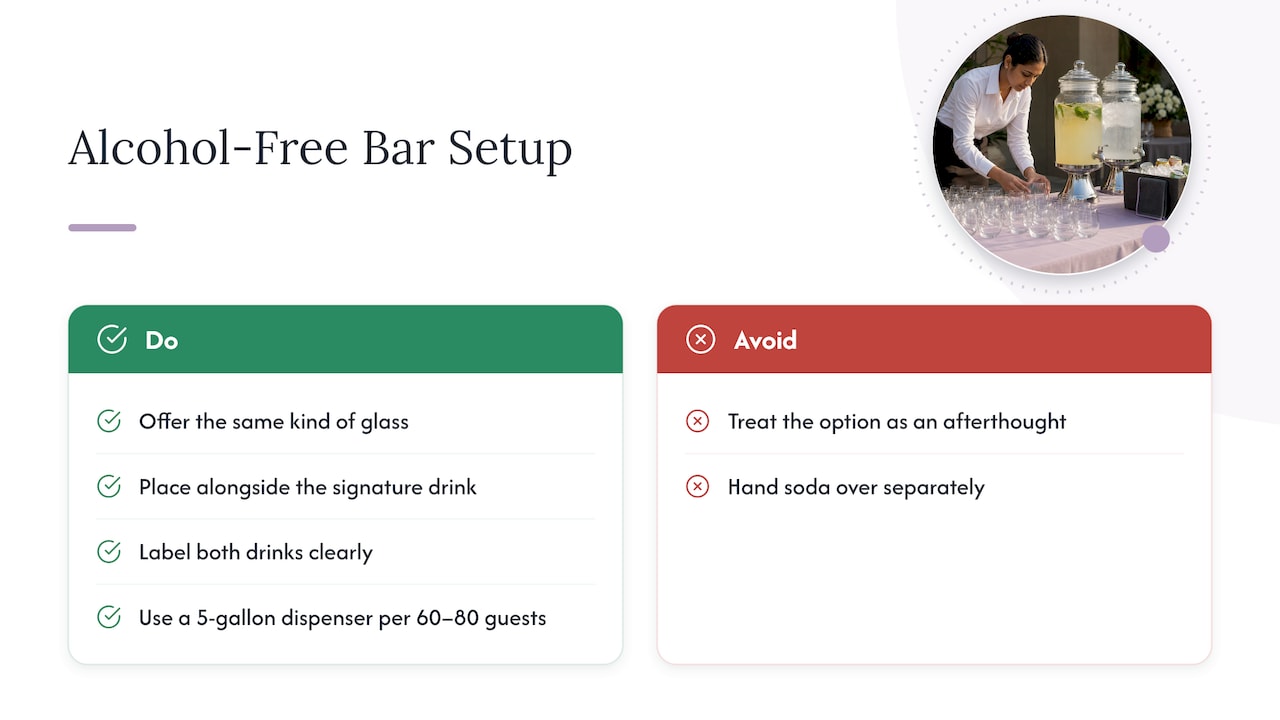
Offer a real alcohol-free option in the same kind of glass, and do not treat it as an afterthought. That is the advice from the Cocktail Chemistry mocktail guide, and it holds up in practice. Guests who are driving, pregnant, in recovery or just not drinking notice when their option is a can of soda handed over separately.
The Gourmet Host names sparkling hibiscus coolers, virgin mojitos, cucumber-ginger sparklers and rose lemonade as attractive options and says they deserve the same presentation care as cocktails. For winter events, a warm spiced drink such as a non-alcoholic glögg gives guests who skip alcohol something that feels seasonal.
For volume, Margaritas Express recommends one 5-gallon dispenser per 60 to 80 guests, which is more efficient than a single massive container. Put the alcohol-free drink on the same tray or the same end of the bar as the signature drink, and label both clearly so nobody has to ask.
Alcohol rules to check in Las Vegas and Henderson
Logistics fall apart if the service itself is not permitted. The rules differ by jurisdiction, so confirm where your venue sits (City of Las Vegas, City of Henderson or unincorporated Clark County) before anything is ordered.
- City of Las Vegas: per the city’s special event permit sheet, alcohol may be served at an event if a city-licensed alcohol beverage caterer is used, or if the applicant applies for and receives a special event alcohol permit at least 20 days before the event. The permit application requires a detailed site plan marking alcohol serving stations and bars, which is one more reason to settle your bar location early.
- City of Henderson: the city’s business licensing FAQ says that when alcohol will be sold or served for consumption on the premises, a Special Events Liquor Permit must be obtained from Business Licensing before the event, and that public street events need a separate special events permit through the police department.
- Unincorporated Clark County: Clark County’s temporary events office says temporary events involving liquor must apply for a liquor caterer permit under CCC 8.20.240.
- City of Las Vegas parks: the parks special events handbook requires $1 million in general liability coverage for qualifying events, and vendors selling alcohol must carry separate $1 million liquor liability coverage.
Fees, lead times and forms change, so confirm the current requirements with the issuing office before you commit. For a plain-language walkthrough, see our guides to event alcohol permits in Las Vegas and what insurance a Las Vegas event needs. If the venue limits where liquor can be kept before service, read how to verify alcohol storage at your venue.
One more transport detail: if guests arrive by limo or party bus, vehicles have their own rules. A short read on alcohol policy checks for limos helps you avoid surprises when the welcome drink starts at a pickup point.
Perspective: what we see on the ground
Most welcome drink problems we are called in to fix are not drink problems. They are timing and placement problems. The bar is in the one spot guests have to walk past to reach their seats, the ice arrived late, or the permit question was left to the week before the event.
Our view is simple. Choose the window first, then the headcount, then the drink. Pick a menu your bartenders can pour at speed in a crowd. Keep the alcohol-free option as polished as everything else. And treat licensing and venue coordination as part of the logistics, not paperwork to tackle later. We work only in Las Vegas and Henderson, so we handle venue rules, load-in routes and desert heat as routine parts of the job.
— Brennon
Wedding versus corporate: what changes
| Factor | Wedding | Corporate event |
|---|---|---|
| Arrival pattern | Trickle, then a surge before the ceremony | Waves after sessions or doors opening |
| Best format | One signature drink plus bubbly and an alcohol-free option | Signature drink, wine, beer, and soft drinks |
| Tone | Personal: a drink that reflects the couple | Branded: cups, napkins or a menu card with the company’s look |
| Hard stop | Ceremony or first dance | Keynote, presentation or dinner |
| Service style | Pre-poured trays and a bar | Roaming trays plus a staffed bar |
For weddings, the ceremony start is the hard stop, so build in a buffer for late guests. For corporate events, the program is the hard stop, and the best practice is to brief the bar team on the agenda so they pause when the speaker begins. Our corporate cocktail reception best practices cover that side in more detail.
A planning checklist you can copy
- Confirm the venue’s jurisdiction and alcohol policy.
- Choose a licensed caterer or file the right permit with enough lead time.
- Set the welcome window and the hard stop.
- Count drinking and non-drinking guests.
- Calculate pours, add a buffer, convert to bottles and ice.
- Choose one signature drink, one sparkling or wine option, one alcohol-free drink and water.
- Decide the batch and the single finishing step.
- Mark the bar location on the floor plan and confirm power, shade and access.
- Set staffing: bartenders by peak arrivals, plus a runner.
- Confirm insurance requirements with the venue.
- Brief the venue coordinator, photographer and host on the timeline.
- Plan the end of service: collection of glasses and the move to the main bar.
Let us run the welcome drink for you
If you would rather not manage this list yourself, our team handles mobile bartending, liquor catering and bar setup for events across Las Vegas and Henderson, including venue coordination and custom menus. For couples, see our wedding bartending services. For company events, see our corporate event bartending. Or start with the Liquid Courage home page to describe your event.
FAQ
How long should a welcome drink service last?
Plan on 30 to 45 minutes, ending when guests are called to the ceremony, dinner or program. Start staff setup at least an hour before the first guests arrive. A fixed end keeps the next part of the schedule on time.
How many welcome drinks do I need per guest?
Plan one drink per guest as the base, then extra for about a third of them in a 30 to 45 minute window. For a whole event, use drinking guests × (hours + 1), then add a 15 to 20 percent buffer. Order extra ice and water in hot weather.
Do I need a permit to serve welcome drinks in Las Vegas?
In the City of Las Vegas, you either hire a city-licensed alcohol beverage caterer or apply for a special event alcohol permit at least 20 days before the event. Henderson and unincorporated Clark County have their own permit processes, so confirm which one covers your venue.
What non-alcoholic welcome drink works best?
Choose something that looks as good as the signature cocktail, such as a sparkling hibiscus cooler, a cucumber-ginger sparkler or rose lemonade. Serve it in the same type of glass and on the same tray. A dispenser of about 5 gallons covers roughly 60 to 80 guests.
Sources
- Rehearsal Dinner/Welcome Party Sample Timeline
- How Much Alcohol Should I Buy for a Party?
- Beverage serving planning guide, Montgomery County, Maryland
- Catering Quantity Calculator
- Event beverage prep: 5 steps to seamless party planning
- Welcome Drink Ideas (10 Easy Party Recipes)
- The Welcome Drink Rule
- 9 Best Welcome Mocktails for Stylish Events
- City of Las Vegas Special Event permit sheet
- City of Henderson Business Licensing FAQs
- Clark County Temporary Events and Film Permits
- City of Las Vegas Parks Special Events Policies Handbook