
“Dry hire” in Las Vegas means you rent the raw space and bring in your own bartender, caterer, and rentals separately, but the phrase itself guarantees nothing about alcohol. The single thing to verify before you book is the venue’s written alcohol and vendor policy, plus which jurisdiction, City of Las Vegas or Clark County, governs that address. Permits and insurance requirements often narrow what a “dry hire” contract actually permits.
TL;DR:
- Confirm whether outside alcohol is permitted and who is responsible for obtaining and paying for the necessary permits, especially for events involving fees or large crowds.
- Verify the venue’s jurisdiction and specific insurance, licensing, and responsible-service training requirements for vendors and staff before signing any contract.
- Assess the venue’s existing infrastructure, load-in procedures, and included amenities to determine if you prefer a fully dry-hire space or one with in-house services that reduce vendor coordination.
- Be aware that liquor permits cost around $10 per day per station in Clark County, with late applications doubling that fee, making early permit filing essential.
- Hiring a licensed mobile bar service simplifies permit management, staff training, and compliance, offering a reliable alternative to managing alcohol rules independently.
Table of Contents
- What Does Dry Hire Actually Mean for Las Vegas Event Venues?
- How to Evaluate a Dry-Hire Space vs. a Semi-Inclusive Venue
- Alcohol Rules and Permits in the Las Vegas Area
- Logistics and Vendor Coordination
- Cost Expectations and Booking Timeline for BYO Spaces
- Local Planner Guidance From Liquid Courage LV
- Planner Perspective: Common Pitfalls and Fast Fixes
- Skip the Permit Guesswork With a Licensed Mobile Bar
- Sources
- FAQ
What Does Dry Hire Actually Mean for Las Vegas Event Venues?
Ask ten venues what “dry hire” means and you will get ten slightly different answers. Some genuinely hand you an empty room with a loading dock and a light switch. Others use the term loosely while still requiring you to buy alcohol through their in-house bar. The Space in Las Vegas notes that dry hire generally means renting the space and arranging vendors independently. However, policies on outside alcohol vary from venue to venue. Treat the checklist below as your first call script, not an afterthought for the contract review.
- Confirm the alcohol policy in writing: can you bring your own, or must alcohol come from the venue’s bar?
- Identify jurisdiction (City of Las Vegas vs. Clark County) so you know which permit office to call.
- Ask what insurance limits and additional-insured language the venue requires from you and your vendors.
- Verify bartenders need current licensing and responsible-service training documentation.
- List what’s actually included: tables, chairs, kitchen prep space, AV, and parking.
- Nail down load-in, setup, and teardown windows in exact hours, not “the day of.”
- Measure usable square footage against your real floor plan, not the marketing photo.
- Get fees for cleaning, security deposits, and overtime spelled out before you sign.
Pro Tip: Ask the venue coordinator to email you their alcohol and vendor policy before your first walkthrough. A verbal “yeah, that’s fine” from a sales rep means nothing once the contract lands.
How to Evaluate a Dry-Hire Space vs. a Semi-Inclusive Venue
Choosing between a blank-canvas space and a venue that bundles in production gear comes down to how much coordination you’re willing to own versus how much you’re willing to pay someone else to own.
- Match capacity to layout, not just headcount. A room rated for 150 seated guests might hold only 90 comfortably with a dance floor and bar station added. Ask for a floor plan, not just a number.
- Inventory what’s already there. Venues like The Industrial advertise built-in staging and production infrastructure, which cuts down on rental trucks and vendor handoffs compared to a true empty shell.
- Weigh convenience against cost. In-house kitchen and AV usually cost more upfront but eliminate a dozen small coordination headaches. A pure dry-hire space is cheaper but puts every detail, from generators to linens, on your vendor list.
- Walk the site and ask pointed questions. Where do trucks load in? Is there a freight elevator? What time can vendors access the space, and does that window overlap with another event breaking down?
The real comparison isn’t cheap versus expensive. It’s how many vendor handoffs you’re willing to manage yourself.
Alcohol Rules and Permits in the Las Vegas Area
Renting a dry-hire space does not override local alcohol law or the venue’s own policy; it just means the venue isn’t the one supplying the liquor. Clark County advises that a temporary-event permit is likely required when an event includes admission fees, live music, additional vendors, alcohol, or more than 5,000 attendees. The county also provides a jurisdiction locator, since the City of Las Vegas and Clark County run separate permitting processes for the same general area.
If you’re hiring a licensed caterer to serve alcohol, the liquor-caterer permit application lays out the documentation needed and the fee structure.
Fee to know: Clark County charges $10 per day per liquor service station, and late applications get charged double.
Before signing anything, request these three items in writing:
- The venue’s exact alcohol policy, including whether outside alcohol is allowed at all.
- Which party (you, the venue, or your caterer) holds the actual permit.
- Who eats the cost if a permit is filed late or a fine gets issued.
Our alcohol-sponsorship guide breaks down how to structure sponsorship deals so you’re not paying for the same permit twice.
Logistics and Vendor Coordination
Bringing outside vendors into a dry-hire space shifts responsibility for insurance, licensing, and scheduling onto you as the organizer. Most venues, including Renowned Events, require outside vendors to carry their own insurance and add the venue as additional insured, even when the venue happily allows outside catering.
Build these into every vendor contract:
- General liability insurance with the venue named as additional insured, not just a certificate on file.
- Current licensing and, for bartenders, documented responsible-alcohol-service training.
- A firm load-in schedule that accounts for parking, freight access, and elevator availability if the venue has multiple floors.
- A teardown window that covers rental pickup and trash removal, not just your event’s end time.
Venues like CME Event Studio spell out fixed setup and cleanup windows and require all vendor activity, including rental pickups, to happen inside the contracted rental period. Miss that window and you’re often looking at hourly overtime charges. Our event insurance guide covers what coverage limits venues typically expect from outside vendors.
Cost Expectations and Booking Timeline for BYO Spaces
Pricing on Las Vegas dry-hire spaces spans a wide range depending on size, location, and what’s bundled in. Tagvenue’s listings show typical hourly rates for BYO venues running roughly $60 to $250 per hour, with day rates on larger spaces climbing into the thousands.
- Small BYO spaces (under 50 guests) sit at the low end of that hourly range.
- Mid-size venues with a kitchen or basic AV push toward the middle and often add flat day rates for weekend bookings.
- Larger venues with in-house staging or production support command the highest rates in the listing data.
Budget beyond the base rental for cleaning fees, security deposits, bar staffing, permit fees, and insurance. Permit timing matters, too: Clark County’s liquor-caterer fee schedule doubles fees for late applications, so filing early isn’t optional if you want to avoid it. For events with tighter alcohol-permit windows, our Nevada sampling permit timeline is worth a read even for standard service, since the lead times run parallel.
Local Planner Guidance From Liquid Courage LV
A licensed mobile bartending company spends its time inside exactly these gaps between what a venue allows and what a permit requires. Liquid Courage LV coordinates permit paperwork, staffs trained bartenders, and confirms venue compliance before the event date, so the organizer isn’t the only one tracking deadlines.
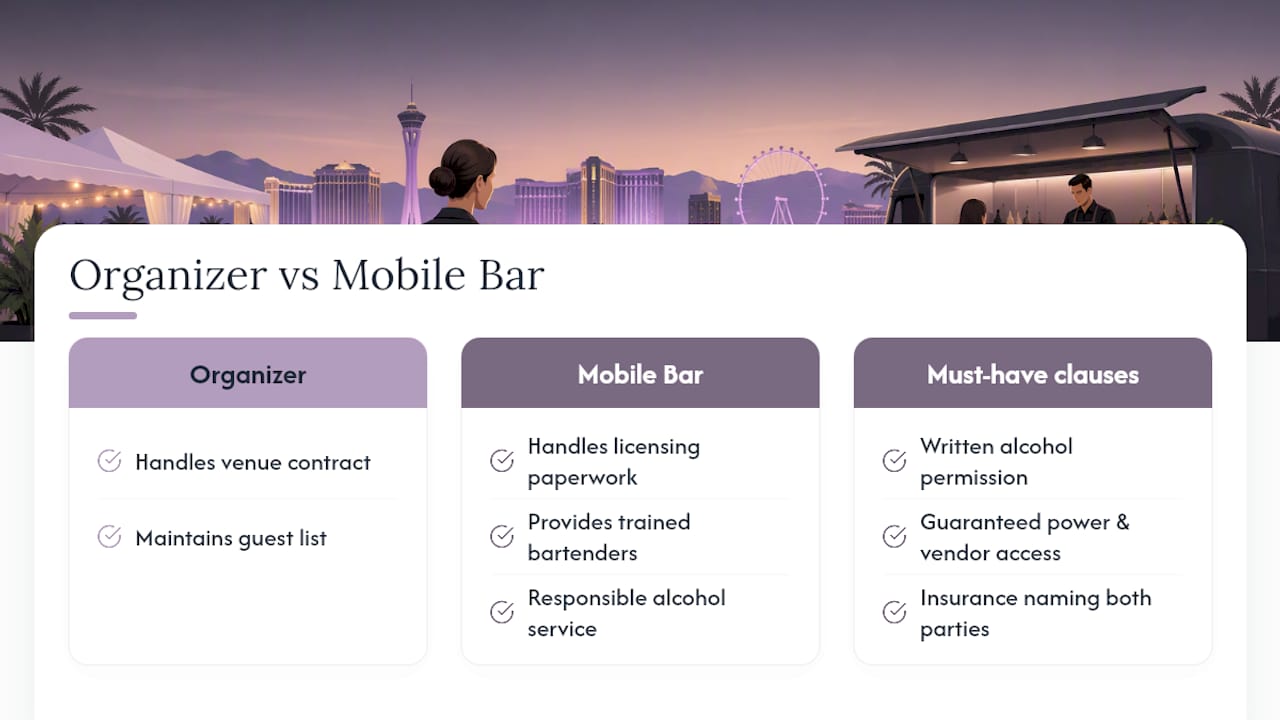
We advise every planner to secure three contract clauses before booking: written alcohol permission, guaranteed power and vendor access during load-in, and an insurance clause naming both the venue and the bar service as additional insured. A clean division of labor usually looks like this: the organizer handles the venue contract and guest list, while the mobile bar service handles licensing, staffing, and responsible service. For venues that historically resist outside bars, our Henderson venue guide shows what contract language tends to change their minds.
Planner Perspective: Common Pitfalls and Fast Fixes
The mistake I see most: planners assume “dry hire” automatically means BYOB, then find out at the walkthrough it doesn’t. Second most common: ignoring the load-in window until the vendor truck shows up with nowhere to park. Fix both in the negotiation stage, in writing, before deposit. And file permits the moment your date is locked. Clark County processes faster when applications arrive complete the first time, not after a follow-up call.
— Brennon
Skip the Permit Guesswork With a Licensed Mobile Bar
There are other routes to a compliant open bar: hiring a standalone caterer, running the bar yourself with a day-of permit, or leaning entirely on the venue’s in-house service. A licensed mobile bartending company offers a more direct path for planners who’d rather not become permit experts overnight. Such services handle the liquor-caterer paperwork, staff licensed and trained bartenders, and build the insurance and additional-insured language directly into service agreements, so venue requirements and local rules are covered before the event date.

We serve weddings, corporate events, and private parties across Las Vegas and Henderson, with customizable bar packages and dedicated dry hire staffing built for exactly the kind of BYO venues this article covers. Planning a wedding at a dry-hire space? Our wedding liquor catering checklist pairs well with your venue contract review.
Check your event date and get a bar package quote through our services page before you finalize the venue booking.
Sources
FAQ
Does “Dry Hire” Mean I Can Bring My Own Alcohol?
Not automatically. Dry hire means you rent the raw space and arrange vendors yourself, but each venue sets its own alcohol policy, and some still require alcohol to come through their in-house bar.
Do I Need a Permit for a Small Private Party With Alcohol?
It depends on scale and features. Clark County generally requires a temporary-event permit when alcohol, admission fees, live music, or added vendors are involved, so check the jurisdiction locator for your address.
How Much Does a Liquor-Caterer Permit Cost in Clark County?
Clark County charges $10 per day per liquor service station, with late applications billed at double that rate.
How Much Do Dry-Hire Venues Cost in Las Vegas?
Rates vary widely by size and amenities. Listing data from Tagvenue shows hourly rates roughly between $60 and $250, with day rates on larger venues reaching several thousand dollars.
What Does Liquid Courage LV Charge for Bartending Services?
Pricing depends on event size, package, and bar setup, so current rates are listed directly on the Liquid Courage LV services page rather than as a flat number here.