
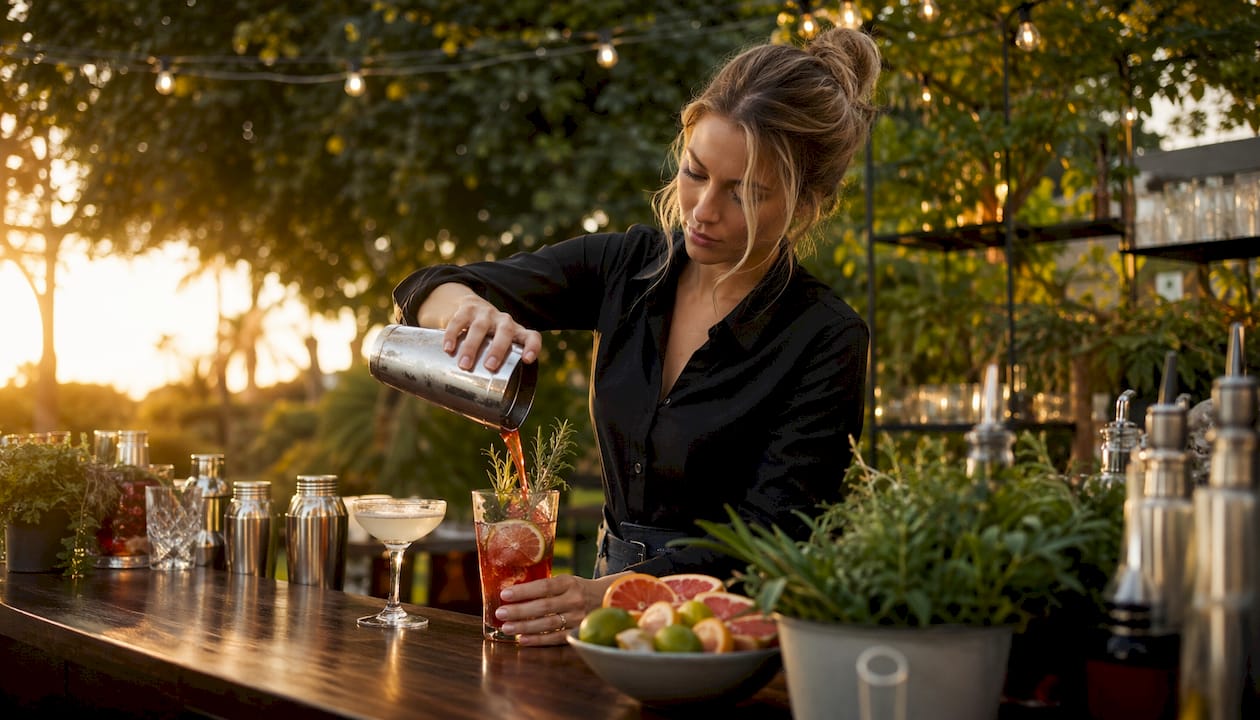
Event bartending is a mobile, staffed bar service brought directly to your private party, corporate function, or wedding, handling everything from setup and drink service to breakdown. Specifically for Las Vegas and Henderson events, Liquidcouragelv provides premium mobile bartending and liquor catering. Furthermore, we deliver this with contract-ready proposals, custom menus, and fully insured staff to ensure a seamless experience.
Before you request a quote, have these three things ready:
- Your confirmed event date and venue address
- Estimated guest count
- Preferred service style (dry hire staffing-only vs. full liquor catering)
Table of Contents
- What does event bartending actually mean?
- Dry hire vs. full liquor catering: which model fits your event?
- How many bartenders do you need, and how much should you stock?
- How is event bartending priced?
- What to ask before you sign a bartending contract
- Licenses, insurance, and safety: what you must confirm
- What to expect on the day of your event
- Why Liquidcouragelv is the right choice for Las Vegas and Henderson events
- Key Takeaways
- The part most planners overlook
- Book Liquidcouragelv for your Las Vegas or Henderson event
- Useful sources
What does event bartending actually mean?
Event bartending is a professional mobile service where certified staff handle bar setup, drink service, and breakdown for private or corporate events. That is a fundamentally different arrangement from a venue’s built-in bar, and the distinction matters when you are budgeting and planning.
With a venue bar, the venue controls the liquor selection, pricing, and staffing. You pay per drink or a flat beverage minimum, and you have little say over the menu or who is pouring. Mobile event bartenders flip that model: you hire the staff and, depending on the service type, control the liquor purchasing and menu entirely.
What mobile bartending typically includes:
- Portable bar setup (bar unit, tools, and equipment)
- Certified bartenders and, for larger events, barbacks
- Drink menu planning and custom cocktail creation
- Consumption monitoring and responsible service
- Breakdown and cleanup at the end of service
What it does not always include (varies by service type):
Liquor, beer, wine, glassware, and ice. Those inclusions depend on whether you book dry hire or full liquor catering, covered next.
Mobile bartending fits best when your venue has no built-in bar, when you want signature cocktails the venue cannot provide, or when you are hosting off-site at a private home, rooftop, or outdoor space.
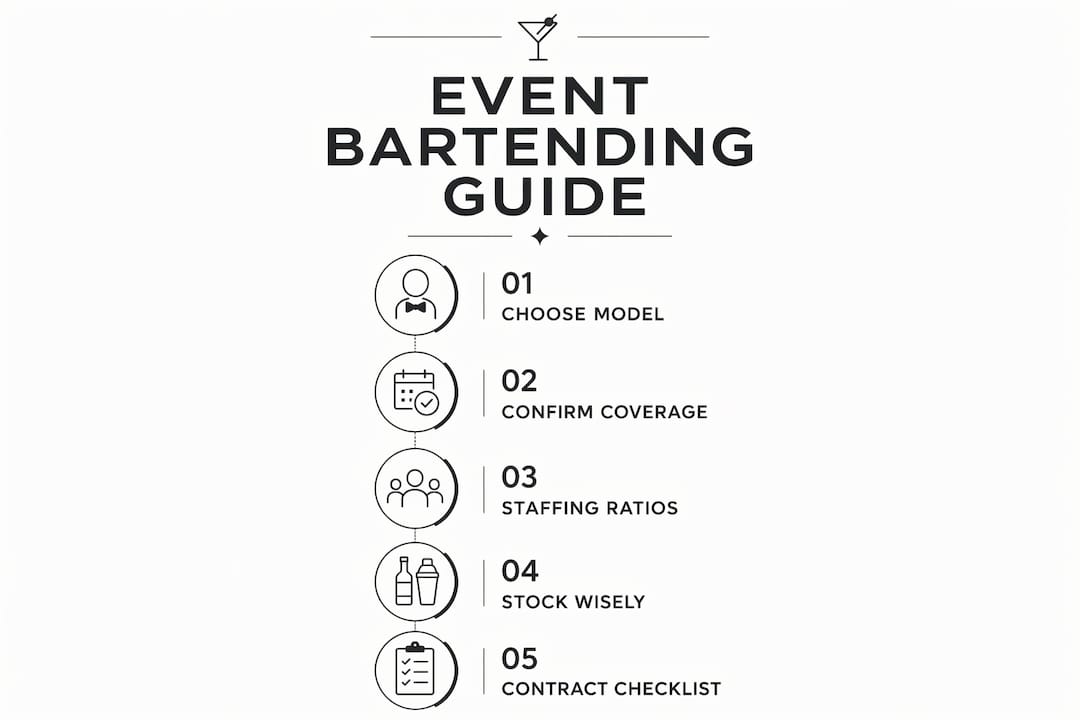
Dry hire vs. full liquor catering: which model fits your event?
The two core service models are dry hire and full liquor catering, and choosing between them has a real impact on your budget.
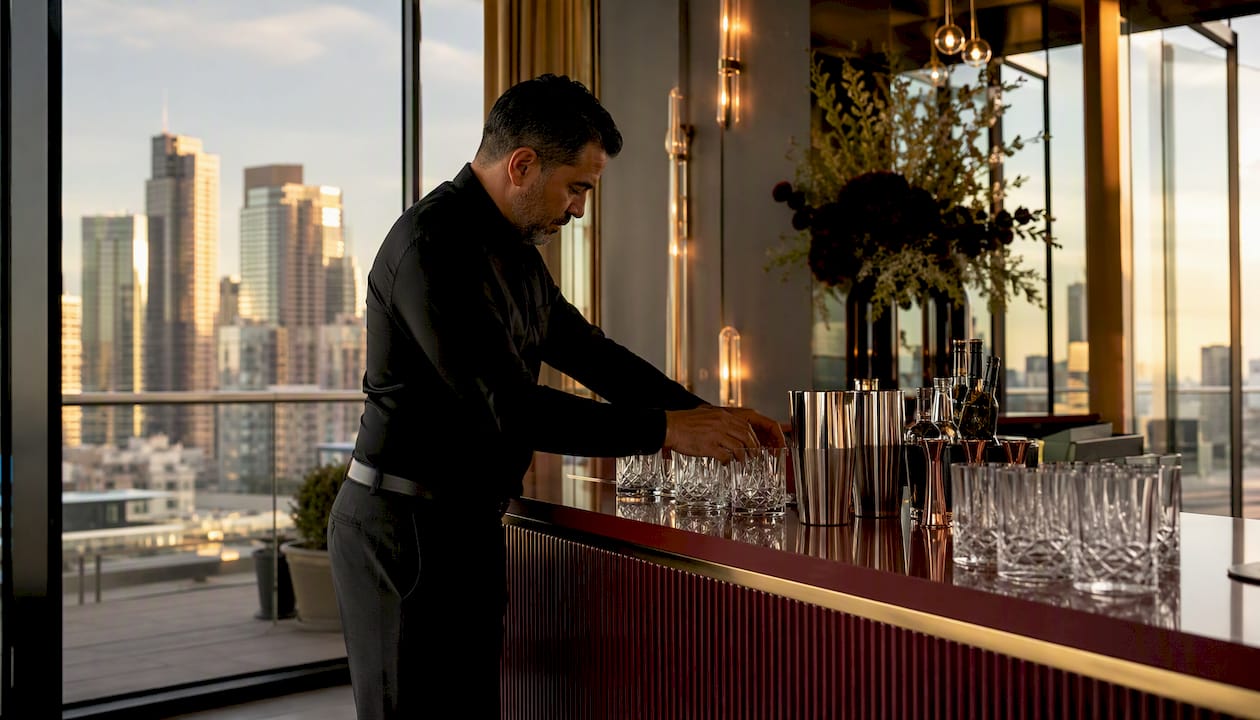
Dry hire means
You pay for staffing only. The bartenders show up, set up, and serve, but you purchase the alcohol at retail. Dry hire can save organizers a significant percentage compared to full-service caterer markups, and one provider’s case example showed substantial savings for a 100-guest wedding using this approach. The catch: you need the bandwidth to shop for alcohol and follow a vendor-provided shopping list to avoid over-purchasing.
Full liquor catering means
The vendor supplies the alcohol, handles purchasing, and builds the cost into the package. You pay more per head, but you hand off the logistics entirely.
Bar payment styles add another layer of choice:
- Open bar: The host pays a flat rate; guests drink freely.
- Cash bar: Guests pay per drink; the host covers staffing only.
- Hosted bar: The host covers a set dollar amount, then guests pay beyond that limit.
- Ticket bar: Guests receive a set number of drink tickets; additional drinks are cash.
Pro Tip: Ask your vendor for an itemized shopping list before committing to dry hire. Most clients underestimate quantities, and a good vendor will give you a breakdown by spirit, mixer, and garnish so you do not over-buy.
Inclusions that change your quote: glassware rental, bagged ice, specialty garnishes, a POS or card reader for cash bars, and a barback for high-volume events. Get every inclusion listed in writing before you sign.
How many bartenders do you need, and how much should you stock?
Staffing ratios
The standard guideline is about one bartender per 50–75 guests. That ratio holds for a relaxed dinner party or a reception with a full meal service. Push it tighter for a compressed service window.
A one-hour cocktail hour for 200 guests may require multiple bar stations and additional barbacks to maintain speed. The same logic applies to high-cocktail events where guests are ordering complex mixed drinks rather than beer and wine.
- Bartender: Primary drink service, menu execution, and consumption monitoring.
- Barback: Restocks ice, glassware, and garnishes; keeps the station clean so the bartender never stops pouring.
- Event bar manager: Oversees multiple stations, handles vendor coordination, and acts as the point of contact for the host. Needed for events with 150+ guests or multiple bar stations.
The 3-2-1 stocking rule
The 3-2-1 rule is a common beverage stocking heuristic: for every group of guests, plan for a set ratio of wine bottles, beer cases, and bottles of spirits as a baseline. It is a starting point, not a formula, and your actual mix depends heavily on your guest profile and event type.
Quick example for a 100-guest event:
- Wine: ~30 bottles
- Beer: ~20 cases (or roughly 240 cans/bottles)
- Spirits: ~10 bottles
Your bartending vendor should refine these numbers based on your specific menu and service window. A vendor who hands you a shopping list without asking about your guests’ preferences is cutting corners.
How is event bartending priced?
Pricing varies by market, service model, and what is included. Here is a practical breakdown of the models and typical U.S. ranges.
| Pricing model | Typical U.S. range | Notes |
|---|---|---|
| Hourly labor (dry hire) costs vary widely depending on location and provider, generally excluding liquor, glassware, and equipment. | ||
| Package rate (full-service) | Starting around a modest base for small events, scaling with guest count | Includes staffing and liquor; local variation is significant |
| Per-head pricing | Varies by market and inclusions | Common for open-bar packages with liquor included |
| Bar equipment rental | Add-on fee | Portable bar unit, POS, glassware, ice |
| Travel/venue fee | Varies by distance and venue access | Common for off-site or destination events |
Major price drivers:
- Number of bartenders and barbacks required
- Whether liquor is included (full catering vs. dry hire)
- Bar equipment rental and POS/ticketing systems
- Event duration and service window length
- Travel distance and venue load-in complexity
- Time of day and day of week (weekend premiums are common)
Dry hire is the most direct way to reduce cost if you are willing to handle alcohol purchasing. Mobile bartending providers advertise packages that start at a modest base rate for small private events and scale with inclusions. Always ask for an itemized quote, not a single package price, so you can see exactly what you are paying for.
What to ask before you sign a bartending contract
Pre-booking checklist
- Confirmed date, start time, and end time
- Final or estimated guest count
- Venue name, address, and any venue-specific liquor policies
- Service style decision (dry hire or full liquor catering)
- Bar style (open, cash, hosted, or ticket)
Contract checklist
- Proof of liquor liability insurance and a COI naming your venue
- Server training certifications (TIPS, ServSafe, or state equivalent)
- Itemized pricing with every inclusion listed
- Staffing ratio confirmed in writing
- Sample menu or cocktail list
- Cancellation and refund policy
- Cleanup and breakdown responsibilities
Red flags: A vendor who cannot produce a COI on request, quotes a single price with no itemization, or has no written contract is a liability risk. Walk away.
Licenses, insurance, and safety: what you must confirm
Vendors should carry liquor liability insurance and provide a Certificate of Insurance on request. Many venues require the vendor to name the venue as an additional insured on that policy. Confirm this before the event, not the day of.
Server training certifications such as TIPS or ServSafe are the standard proof that staff are trained in responsible alcohol service, including ID checking and recognizing intoxication. Ask for copies.
Pro Tip: Request the COI and server certifications at the same time you receive the contract. A vendor who delays providing these documents is a red flag, not a minor admin issue.
Host responsibilities to confirm:
- Your venue’s third-party vendor insurance requirements
- Whether your venue requires a separate event permit for alcohol service
- That the bartending team has a written policy for refusing service and handling intoxicated guests
What to expect on the day of your event
A mobile bar setup follows a predictable sequence, and slotting it into your broader event timeline prevents delays.
Typical day-of timeline:
- Arrival and load-in: 60–90 minutes before service starts, depending on setup complexity
- Setup: Bar unit assembly, stocking, and equipment check
- Service window: Defined start and end times agreed in the contract
- Last call: Usually 30 minutes before the contracted end time
- Breakdown and cleanup: 30–60 minutes post-service
Venue coordination checklist:
- Confirm power access for POS systems and blenders
- Identify and pre-approve the load-in route and parking for the vendor’s vehicle
- Arrange storage for leftover alcohol if the vendor does not remove it
- Designate a single point of contact the bartending team can reach during the event
Delays almost always trace back to unclear load-in logistics. A dedicated staging area and a pre-approved parking zone for the vendor’s vehicle solve most of them before they start.
Why Liquidcouragelv is the right choice for Las Vegas and Henderson events
Liquidcouragelv offers mobile bartending, full liquor catering, dry hire staffing, and custom cocktail menus for weddings, corporate events, and private parties across Las Vegas and Henderson, NV.
Services and trust signals:
- Mobile bar setup with portable bar units and full equipment
- Full liquor catering and dry hire options
- Custom cocktail menus and signature drink creation
- POS systems for cash and hosted bar setups
- Proof of insurance and COI provided on request
- Server-trained, certified staff
- Itemized written contracts with sample menus
- Venue coordination and staffing ratio confirmation
Liquidcouragelv builds every proposal around your specific event: date, guest count, service style, and venue rules. Request a quote and receive an itemized breakdown of staffing, inclusions, and pricing before you commit to anything.
To get an accurate proposal, have ready: your event date, estimated guest count, service style preference, and your venue’s liquor policy.
Key Takeaways
Professional event bartending requires choosing the right service model, confirming legal coverage, and getting every inclusion itemized in writing before you sign.
| Point | Details |
|---|---|
| Choose your service model first | Decide between dry hire (staffing-only, 30–60% cheaper) and full liquor catering before comparing quotes. |
| Apply the 1:50–75 staffing ratio | Plan one bartender per 50–75 guests; increase that ratio for compressed service windows or high-cocktail menus. |
| Require a COI before signing | Ask for a Certificate of Insurance with liquor liability coverage and confirm the venue is named as additional insured. |
| Get an itemized contract | Every inclusion, staffing ratio, cancellation term, and cleanup responsibility must appear in writing. |
| Liquidcouragelv for Las Vegas events | Liquidcouragelv provides mobile bartending and liquor catering in Las Vegas and Henderson with insured staff and itemized proposals. |
The part most planners overlook
Book Liquidcouragelv for your Las Vegas or Henderson event
Useful sources
- Kristina Ashley Bartending — staffing ratios, compressed service guidelines, and mobile bar setup timelines
- Wonderbarz — dry hire cost savings data, COI and insurance guidance
- Crème de la Crème Bartenders — event bartending service definitions, server certification standards
- Soinanyevent — professional bartending’s role in guest experience and event flow