
A beverage catering proposal is a formal document that presents beverage options, service details, pricing, and contractual terms to an event host or planner. If you have ever wondered what does beverage catering proposal mean and why it matters before signing anything, this article breaks down every component so you can read, compare, and negotiate with confidence. Whether you are planning a wedding in Henderson or a corporate event on the Las Vegas Strip, understanding this document protects your budget and your event.
What does a beverage catering proposal mean for event planners?
A beverage catering proposal is the industry term for a structured sales document that a bartending or liquor catering company sends before a contract is signed. It covers what beverages will be served, how service will run, what it costs, and what rules apply. The standard industry term is “beverage service proposal,” though vendors and planners often shorten it to simply “the proposal.” Both terms refer to the same document.
A well-built proposal does three things at once. It sells the service, sets expectations for the event, and protects the vendor’s business interests. That triple purpose is why reading one carefully matters more than most planners realize. A proposal that looks simple on the surface often contains pricing conditions, staffing ratios, and cancellation terms that directly affect your event day.
For Las Vegas and Henderson events specifically, beverage catering proposals carry extra weight. Many venues on the Strip and in Henderson require vendors to submit proposal details before granting access. Getting the document right from the start prevents delays and last-minute surprises.
What components are typically included in a beverage catering proposal?
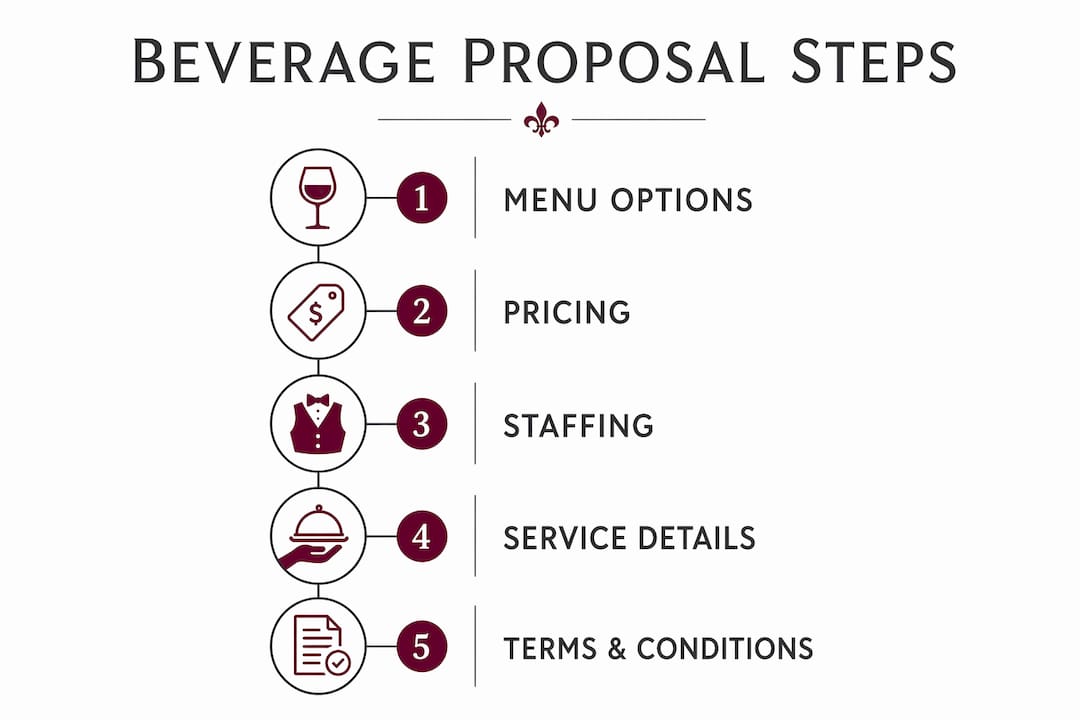
A well-organized proposal presents information in clear sections so planners can compare options and understand next steps without digging for answers. Most proposals follow a four-part structure:
- Service proposal overview: A summary of what the vendor offers, the event date, guest count, and the scope of service. This section confirms that the vendor understands your event before any money changes hands.
- Menu and beverage packages: A full list of alcoholic and non-alcoholic options. Beverage proposals typically include alcoholic selections alongside non-alcoholic stations with items like tea, lemonade, coffee, and water. Guests who do not drink alcohol still need options, and a strong proposal accounts for that.
- Service process: A step-by-step breakdown of setup, active service hours, and breakdown. This section tells you when bartenders arrive, when they start serving, and when they leave. Those time windows affect your venue rental window and your overall event timeline.
- Terms and conditions: Cancellation policies, payment schedules, liability clauses, and any venue-specific requirements. This is the section most planners skim and later regret skipping.
Additional line items you should expect to see include bartender staffing counts, ice delivery, disposable drinkware, and glassware. Some vendors include these in the base price. Others charge them separately. A proposal that does not specify which approach is being used is a proposal worth questioning before you sign.
Pro Tip: Ask every vendor to confirm in writing whether ice, cups, and glassware are included or billed as add-ons. That single question can reveal hundreds of dollars in hidden costs.
How is pricing typically structured within beverage catering proposals?
Beverage catering pricing follows two main models: per-person rates and flat package rates. Per-person pricing scales with your guest count and works well when attendance is uncertain. Package rates offer a fixed price for a defined guest range and service window, which makes budgeting more predictable.
A common package structure looks like this:
- Single bartender package: Covers 50–75 guests for five hours of service. Ice delivery and disposable drinkware are typically charged separately.
- Two bartender package: Covers 100–150 guests with proportional pricing increases.
- Three bartender package: Covers 175–225 guests, often including additional equipment.
- Four bartender package: Covers 250–300 guests with full bar setup and included supplies.
This tiered structure shows that bartender packages scale with guest count and service duration. That scalability matters because understaffing a bar is one of the fastest ways to ruin guest experience at a large event.
The table below shows how pricing variables interact in a typical proposal:
| Pricing Variable | What It Affects |
|---|---|
| Guest count | Determines bartender count and package tier |
| Service hours | Directly increases labor cost per hour |
| Add-ons (ice, cups) | Billed separately unless explicitly included |
| Venue requirements | May require licensed staff or specific insurance |
| Day of week | Weekend events often carry a premium rate |
Transparency in pricing is the clearest signal of a trustworthy vendor. Any proposal that lists a total without breaking down labor, supplies, and add-ons separately deserves a follow-up conversation before you commit.
How does a beverage proposal differ from a banquet event order?
A beverage catering proposal and a banquet event order (BEO) serve completely different purposes, even though both documents describe your event. Confusing the two is one of the most common mistakes planners make.
A BEO is an operational document focused on execution. It details timing, food and beverage specifics, staffing assignments, and room setup instructions. Venues and caterers use it on event day to run the operation. A beverage proposal, by contrast, is a sales document. It is what a vendor sends you before you book, not what the team reads during service.
The critical connection between the two is alignment. The beverage proposal translates directly into the BEO once you book. If your proposal says two bartenders will arrive at 4:00 PM and the BEO says one bartender at 5:00 PM, you have a problem that will surface at the worst possible moment.
| Document | Purpose | Used By | Timing |
|---|---|---|---|
| Beverage catering proposal | Sales and booking | Client and vendor | Before signing |
| Banquet event order (BEO) | Operational execution | Venue and service staff | Day of event |
Pro Tip: Before your event date, request a copy of the venue’s BEO and compare it line by line against your signed proposal. Any discrepancy needs to be resolved in writing, not on the day.
What practical tips help planners evaluate beverage catering proposals?
Reading a beverage service proposal critically is a skill. Most planners focus on price and miss the details that determine whether service actually runs smoothly.
- Check staffing ratios first. A proposal that lists one bartender for 200 guests is a red flag. Execution details like staffing and setup time are the most reliable indicators of whether a vendor has real operational experience.
- Verify setup and breakdown windows. If a vendor needs 90 minutes to set up and your venue access starts 60 minutes before guests arrive, you have a conflict. The proposal should state exact setup and breakdown times.
- Assess beverage variety. A proposal that only lists alcohol ignores a meaningful portion of most guest lists. Non-alcoholic options are not optional. They are a service standard.
- Read cancellation terms carefully. Some vendors keep 50% of the total if you cancel within 30 days. Others keep the full deposit regardless of timing. Know this before you sign.
- Confirm venue alignment. Las Vegas and Henderson venues often have specific requirements around licensed bartenders, insurance certificates, and approved vendor lists. Your proposal should confirm the vendor meets those requirements.
- Ask about change communication. Guest counts shift. Menus change. A good proposal will specify how and when changes must be communicated to avoid penalties or service gaps.
Pro Tip: Request a sample timeline from your vendor showing exactly how they run a comparable event from load-in to breakdown. If they cannot produce one, that tells you something important about their preparation.
Key Takeaways
A beverage catering proposal is the foundational document that defines every aspect of your event’s bar service before a single dollar is committed.
| Point | Details |
|---|---|
| Core definition | A beverage catering proposal is a formal sales document covering menu, pricing, service process, and terms. |
| Four standard sections | Expect a service overview, menu, service process, and terms and conditions in every solid proposal. |
| Pricing transparency | Always confirm whether ice, cups, and glassware are included or billed as add-ons before signing. |
| Proposal vs. BEO | The proposal is a sales tool; the BEO is the operational blueprint. Mismatches between them cause day-of failures. |
| Staffing ratios matter | Bartender packages typically scale from one bartender for 50–75 guests up to four bartenders for 250–300 guests. |
What I have learned from reviewing beverage proposals in Las Vegas
After working through beverage catering proposals for events across Las Vegas and Henderson, the pattern I see most often is this: planners focus on the menu and the price, then skip the service process and terms entirely. That is exactly backwards.
The menu is the easy part. Every vendor has a list of spirits and mixers. What separates a smooth event from a chaotic one is whether the proposal specifies when bartenders arrive, what they bring, and what happens if something changes. I have seen events where the proposal said “full bar setup” and the vendor interpreted that as bringing a folding table and a bottle opener. The detail was not in the proposal, so there was no recourse.
Las Vegas venues add another layer of complexity. Many properties on the Strip and in Henderson require vendors to carry specific insurance, use licensed staff, and coordinate load-in through service elevators with strict time windows. A proposal that does not address those requirements is not ready for a Las Vegas event. Ask directly. If the vendor hesitates, that is your answer.
Treat every proposal as a working document, not a brochure. Mark it up. Ask questions. Request revisions. A vendor who resists clarifying their own proposal is a vendor worth reconsidering.
— Brennon
Liquidcouragelv brings clarity to beverage catering in Las Vegas and Henderson
Planning bar service for a Las Vegas wedding, corporate event, or private party starts with a proposal that actually answers your questions.
Liquidcouragelv is a mobile bartending company serving Las Vegas and Henderson exclusively. Every proposal from Liquidcouragelv covers bartender staffing, setup and breakdown timing, beverage menu options, and pricing with no buried add-ons. If you are comparing liquor catering services for your next event and want a proposal that reads clearly from the first line to the last, Liquidcouragelv is built for exactly that. Reach out through the website to request a custom beverage service proposal for your event date.
FAQ
What does a beverage catering proposal include?
A beverage catering proposal includes menu options, pricing, service process details, staffing information, and terms and conditions. It is the document a vendor sends before you book, covering everything from setup time to cancellation policy.
How is beverage catering pricing typically calculated?
Beverage catering pricing is calculated by guest count and service hours, using either a per-person rate or a flat package rate. Add-ons like ice delivery and disposable drinkware are often billed separately unless the proposal explicitly states otherwise.
What is the difference between a beverage proposal and a BEO?
A beverage catering proposal is a sales document used before booking. A banquet event order (BEO) is an operational execution document used by venue and service staff on event day. The two must align to prevent service errors.
How many bartenders does a typical beverage catering proposal include?
Bartender counts in proposals scale with guest count. One bartender typically covers 50–75 guests. Four bartenders cover 250–300 guests. Any proposal that does not specify a staffing ratio for your guest count needs clarification before you sign.
What should Las Vegas event planners watch for in beverage proposals?
Las Vegas planners should verify that the vendor meets venue-specific requirements including licensed bartenders, liability insurance, and approved vendor status. Local venues often have strict load-in windows and compliance rules that must appear in the proposal before booking.