

Event insurance for bartending covers two core policy types: general liability for bodily injury and property damage, and liquor liability for alcohol-related incidents at weddings, corporate events, and private parties. These coverages protect event hosts, bartenders, and venues from financial and legal exposure when alcohol service goes wrong. Understanding what does event insurance cover bartending means knowing which policy applies to which party, and why each one is non-negotiable when alcohol is on the menu. In Las Vegas, where events run large and venues enforce strict documentation requirements, getting this right before the event date is the only acceptable approach.
What specific risks does bartending coverage address at events?
Liquor liability insurance covers legal defense, settlements, and judgments arising from injuries or property damage caused by intoxicated guests or serving minors. Standard general liability policies exclude alcohol-related incidents entirely. That exclusion is the reason every event serving alcohol needs a separate liquor liability policy in place.
The practical risks that bartending coverage addresses include:
- Third-party bodily injury: A guest slips near the bar setup and breaks a wrist. General liability covers the medical costs and any resulting lawsuit.
- Property damage from bar service: A bartender knocks over a display at a venue, or a guest damages property after being over-served. Both scenarios trigger liability claims.
- Intoxicated guest incidents: A guest leaves your wedding reception and causes a car accident. Liquor liability covers the legal defense and any settlement tied to that incident.
- Serving minors: A minor is served alcohol at a corporate event. Liquor liability covers the legal costs and penalties that follow.
- Alcohol-related legal defense: Even a claim without merit requires a legal response. Liquor liability pays attorney fees regardless of outcome.
These scenarios apply equally to weddings at a Las Vegas ballroom, corporate holiday parties in Henderson, and private backyard gatherings. The risk does not shrink because the event is informal.
Pro Tip: Ask your insurance provider whether your policy covers both on-premises incidents and off-premises incidents, such as a guest causing an accident after leaving your event. Many hosts assume coverage stops at the venue door.
How does coverage differ between the host, bartender, and venue?
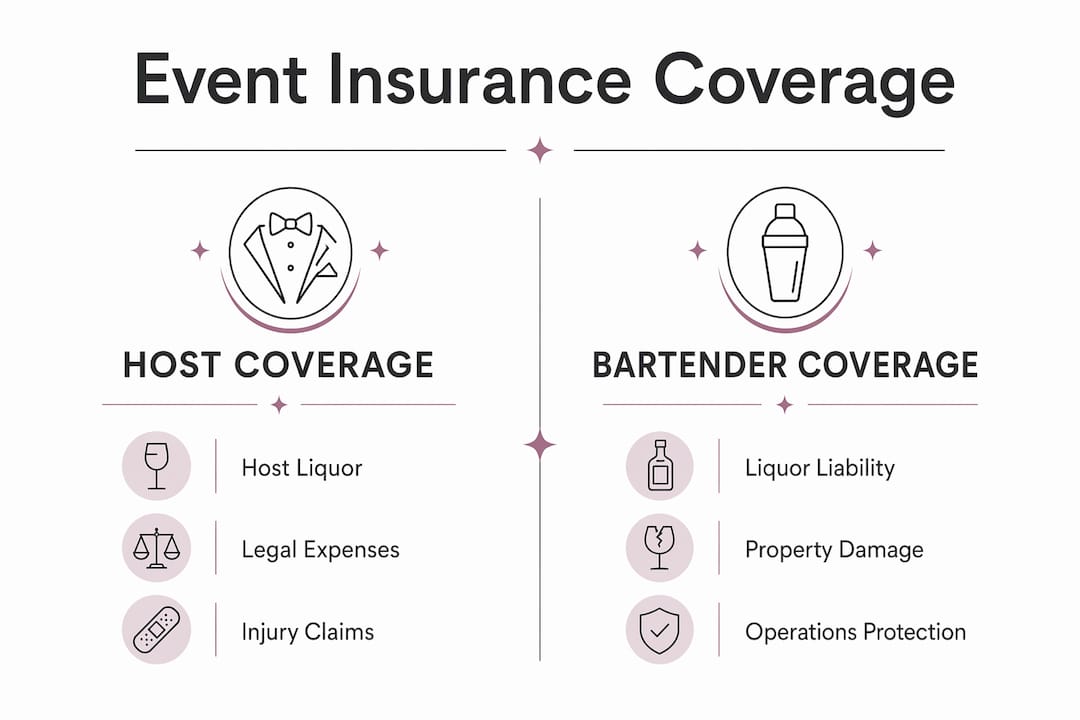
Each party at an event carries a distinct insurance responsibility. Both hosts and bartenders usually need separate insurance policies for full liability protection. Relying on one party’s coverage to protect everyone is the most common and costly mistake in event alcohol service.
Host liquor liability
Host liquor liability applies when alcohol is provided free of charge. If you are hosting a wedding reception and guests drink at no cost, your host liquor liability policy covers you as the person who provided the alcohol. This is separate from the bartender’s policy and from the venue’s policy.
Bartender liquor liability
A professional bartender carries their own liquor liability insurance covering their operations. This policy protects the bartender from claims tied to how they served alcohol. It does not protect you as the host. Hosts often mistakenly assume that hiring an insured bartender removes their own liability. Both parties can be named in a lawsuit, and overlapping coverage is the correct approach.
Venue insurance
Venue insurance covers the physical property and the venue’s own operations. Most venues require hosts to carry event liability insurance separate from vendor policies because venue insurance does not cover specific event risks. A venue’s policy will not respond to a claim arising from your guest’s behavior or your bartender’s service.
| Party | Coverage type | What it protects |
|---|---|---|
| Event host | Host liquor liability | Host’s legal exposure from free alcohol service |
| Bartender | Bartender liquor liability | Bartender’s operations and service decisions |
| Venue | Venue property insurance | Physical building and venue operations only |
Pro Tip: When you book a venue in Las Vegas, read the insurance clause in your contract before signing. Most venues specify the exact coverage limits and additional insured wording they require. Getting this wrong costs time and money to fix later.
Venues require event organizers and vendors, including bartenders, to provide Certificates of Insurance naming the venue as additional insured. This has become standard practice across Las Vegas event venues. A Certificate of Insurance, commonly called a COI, is a one-page document that proves active coverage and lists the venue as a protected party under your policy.
What Las Vegas hosts need to know about liquor liability
Nevada’s legal environment makes liquor liability coverage especially critical. Dram shop laws hold both the alcohol server and event host liable for accidents caused by visibly intoxicated guests. Nevada laws emphasize shared accountability under these statutes. That means you, as the host, carry legal exposure even if a licensed and insured bartender served every drink.
Key points every Las Vegas event planner and host should understand:
- Nevada dram shop liability is shared. Both the server and the host can face lawsuits after an alcohol-related accident. Insurance for both parties is the only complete protection.
- Venue risk-transfer policies are strict. Las Vegas venues routinely require COIs from both the event host and every alcohol-service vendor before allowing setup. Missing documentation can result in denied entry on the event day.
- Free alcohol versus sold alcohol changes your coverage needs. Whether alcohol is served free or sold determines which insurance type applies. This distinction must be established early in your planning process. Free service requires host liquor liability. Sold alcohol requires retail liquor liability.
- Licensed and insured bartenders reduce your risk. Hiring a bartender who carries active liquor liability insurance and holds a valid Nevada alcohol service certification adds a documented layer of protection. It does not replace your own coverage, but it strengthens your overall position if a claim arises.
- Corporate events carry the same exposure as weddings. A company holiday party in Henderson where alcohol is served creates identical liability risks. The event type does not change the legal framework.
For Las Vegas wedding hosts, reviewing a wedding beverage catering guide specific to local venue requirements gives you a practical starting point for understanding what documentation you will need.
How do you obtain and verify the right coverage?
Getting the right bartending insurance coverage in place requires a clear sequence of steps. Skipping any one of them creates a gap that can become expensive.
- Determine your coverage type. Decide whether you need a short-term event policy or an annual policy. Short-term event liquor liability insurance starts around $275 for one-time events, while annual packages for mobile bartenders run approximately $550 or $35.42 per month. Pricing depends on guest count, event location, gross income, and coverage limits.
- Confirm your venue’s requirements. Contact your venue and request the exact COI wording they require, including the additional insured name and address. Venues in Las Vegas are specific about this language.
- Purchase your policy with the correct limits. Most venues require a minimum of $1,000,000 per occurrence in general liability. Confirm the exact figure with your venue contract.
- Request a COI from your bartender. Your bartender should provide a COI showing active liquor liability coverage with your venue named as additional insured. Failing to secure a venue-approved COI with exact additional insured wording prior to the event can cause last-minute entry denial or cancellation.
- Verify the policy is active. A COI shows a policy was active when issued. Call the insurance provider directly to confirm the policy has not lapsed before your event date.
- Review your bartending contract. Your contract with any bartending service should specify which party carries which coverage and confirm that both policies will be in force on the event date. A wedding liquor catering contract checklist helps you track every required document.
Pro Tip: Request all COIs at least two weeks before your event. Insurance corrections, policy endorsements, and additional insured additions take time to process. Last-minute requests are the leading cause of documentation problems on event day.
Key Takeaways
Event insurance for bartending requires both host liquor liability and bartender liquor liability coverage, because neither policy alone protects all parties under Nevada dram shop law.
| Point | Details |
|---|---|
| Two policies are required | Hosts and bartenders each need separate liquor liability coverage; one does not replace the other. |
| Standard policies exclude alcohol | General liability policies do not cover alcohol-related incidents without a separate liquor liability endorsement. |
| COIs must name the venue | Venues require Certificates of Insurance with exact additional insured wording before allowing event setup. |
| Nevada dram shop law is shared | Both the host and the server face legal liability for accidents caused by intoxicated guests under Nevada law. |
| Free vs. sold alcohol matters | Whether alcohol is complimentary or sold determines which type of liquor liability policy applies to your event. |
What I’ve learned from watching insurance gaps play out at events
I have seen hosts arrive at a Las Vegas venue on their wedding day with a bartender’s COI in hand and still get stopped at the door. The venue’s insurance clause required the host’s own event policy, not just the vendor’s. The bartender was fully insured. The host was not. That distinction cost them two hours and a frantic phone call to an insurance broker.
The most consistent mistake I see is treating the bartender’s insurance as a complete solution. It is not. A bartender’s liquor liability policy covers the bartender’s actions. It does not cover the host’s decision to serve alcohol at the event. Courts and insurance adjusters treat these as separate exposures, and they are right to do so.
The second mistake is waiting until the week before the event to sort out documentation. COIs with venue-specific additional insured language sometimes require policy endorsements that take several business days to process. Planners who start this process 30 days out never have a problem. Those who start three days out almost always do.
My advice to every Las Vegas event host is straightforward. Hire a bartending service that carries active liquor liability insurance and can produce a COI on request. Then buy your own host liquor liability policy. Confirm both documents meet your venue’s exact requirements. Do this 30 days before the event, not the night before. The cost of a short-term event policy is small compared to the cost of a single alcohol-related lawsuit.
— Brennon
Liquidcouragelv makes insurance compliance part of the service
Planning an event in Las Vegas means managing a lot of moving parts. Insurance documentation should not be one of the stressful ones.
Liquidcouragelv provides licensed, insured mobile bartending and liquor catering services for weddings, corporate events, and private parties across Las Vegas and Henderson. Every booking includes active liquor liability coverage and COI documentation ready for your venue’s requirements. Whether you are planning a wedding reception at a Strip property or a private party in Henderson, Liquidcouragelv handles the bar so you can focus on the event. Review the full range of event packages and services to find the right fit for your event, or explore corporate alcohol budget planning to get your numbers right from the start.
FAQ
What does event insurance cover for bartending services?
Event insurance for bartending covers general liability for bodily injury and property damage, plus liquor liability for alcohol-related incidents including intoxicated guest accidents, serving minors, and legal defense costs. Standard general liability policies exclude alcohol-related claims, making a separate liquor liability policy necessary.
Does hiring an insured bartender protect me as the host?
No. A bartender’s liquor liability policy covers the bartender’s operations, not the host’s liability. Both parties can be named in a lawsuit, and hosts must carry their own host liquor liability coverage to be protected.
What is a Certificate of Insurance and why does my venue require it?
A Certificate of Insurance is a document proving active coverage, listing the venue as an additional insured party. Las Vegas venues require COIs from both the event host and bartending vendors before allowing event setup, as standard risk-transfer practice.
How much does short-term event liquor liability insurance cost?
Short-term event liquor liability insurance starts around $275 for a one-time event. Pricing varies based on guest count, event location, and coverage limits.
Do Nevada dram shop laws affect my liability as an event host?
Yes. Nevada dram shop laws hold both the alcohol server and the event host liable for accidents caused by visibly intoxicated guests. Hosting an event where alcohol is served creates direct legal exposure for you, regardless of whether a licensed bartender served every drink.