

A wedding beverage minimum is a contractual total spending threshold on food and drinks at your venue, not a per-person charge or a flexible estimate. If your contract states a $10,000 beverage minimum, you must spend that full amount on qualifying food and drink regardless of how many guests attend. For couples planning a Las Vegas wedding, understanding this distinction before signing anything is the difference between a smooth reception and a surprise bill at the end of the night. This guide breaks down exactly how beverage minimums work, what counts toward them, and how to budget without getting caught off guard.
What is a wedding beverage minimum and how does it work?
A wedding beverage minimum is a spending floor, not a pricing formula. Venues set this number to guarantee a certain revenue from your event, and your job is to hit it through qualifying purchases. Couples often misunderstand beverage minimums by treating them as package prices rather than spending thresholds, which leads directly to budget mistakes.
The minimum applies to your total event, not per table or per hour. If you book a venue with a $8,000 food and beverage minimum and your guests only consume $6,500 worth of food and drinks, you still owe $8,000. The venue keeps the difference. No extra food arrives, no credit carries over, and no refund is issued.
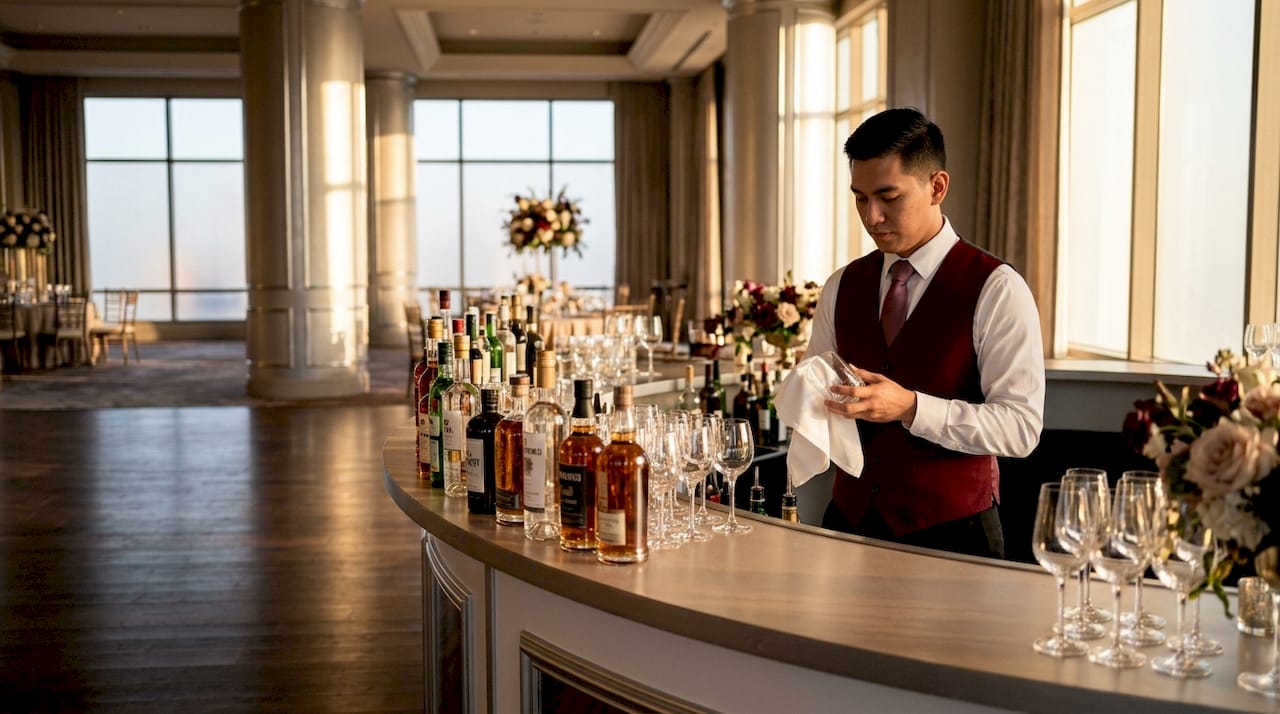
This structure is standard across Las Vegas hotel ballrooms, rooftop venues, and private dining spaces. The minimum is the venue’s way of protecting its revenue floor while giving you flexibility in how you spend within that range.
What counts toward the minimum (and what doesn’t)
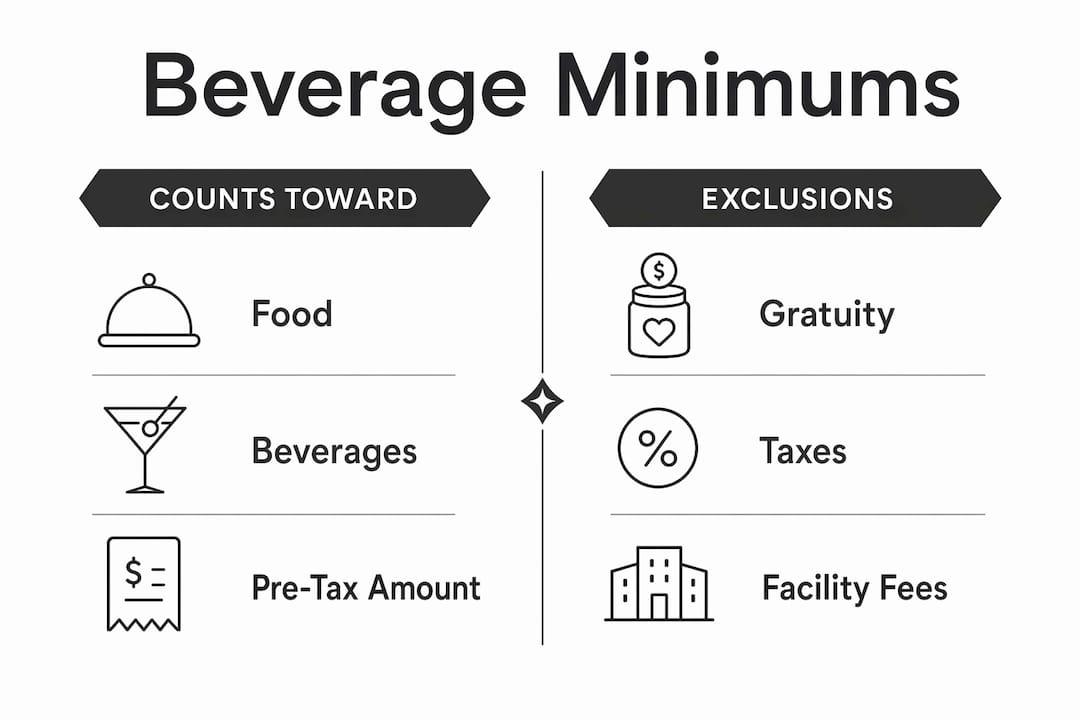
Most venues count the actual cost of food and beverages consumed toward the minimum. That typically includes plated meals, buffet items, cocktail hour appetizers, alcoholic drinks, non-alcoholic beverages, and any specialty drink stations you add.
What frequently does not count is where couples get surprised. Beverage minimums often exclude taxes, gratuity, room rental fees, labor charges, and equipment rentals. Those costs are real and they add up fast, but they do not reduce your minimum balance.
Here is what is commonly excluded from the beverage minimum calculation:
- Sales tax (typically 8–9% in Nevada)
- Service charges and gratuity (often 20–22% added on top)
- Room or venue rental fees
- Labor and staffing fees
- Cake cutting fees
- Linen, glassware, or equipment rentals
Venues differ on whether the minimum is calculated before or after tax and gratuity. Most calculate it pre-tax, which means your actual bill will be significantly higher than the minimum number in your contract. A $10,000 minimum with 22% gratuity and 8.5% tax adds roughly $3,000 to your final invoice.
Pro Tip: Ask your venue coordinator one specific question before signing: “Is the beverage minimum calculated before or after taxes and gratuity?” That single answer changes your entire budget projection.
Open bar vs. cash bar vs. limited bar: which affects your minimum most?
The bar format you choose directly shapes how quickly you reach your beverage minimum and what your per-person costs look like. Each format carries different price points and different implications for your spending floor.
| Bar Type | Typical Cost Per Person | Impact on Beverage Minimum |
|---|---|---|
| Open bar | $15–$60 per person | Highest spend, easiest to reach minimum |
| Limited bar | $10–$30 per person | Moderate spend, may need add-ons |
| Cash bar | Minimal host cost | Hardest to reach minimum from host spend alone |
Open bar packages are the most expensive option per person, but they also generate the most qualifying spend toward your minimum. A 100-guest wedding with a $40 per-person open bar package produces $4,000 in qualifying beverage spend before food is even counted.
A cash bar shifts drink costs to guests, which means the venue collects money from your guests rather than from you. That guest spending may or may not count toward your minimum depending on how your contract is written. Always confirm this in writing.
A limited bar, which typically covers beer, wine, and a signature cocktail, falls in the middle. It gives guests a curated experience while generating moderate qualifying spend. Adding top-shelf liquor upgrades or specialty cocktails to a limited bar is one of the most effective ways to increase your spend toward the minimum without dramatically changing the guest experience.
Key factors that affect how bar type intersects with your minimum:
- Guest count relative to the minimum amount
- Whether premium spirits are included or cost extra
- Whether non-alcoholic drink stations count as qualifying spend
- Whether cocktail hour and reception bar are billed separately
Smaller weddings and the challenge of meeting minimums
Smaller weddings face the sharpest tension with beverage minimums. A venue that sets a $12,000 minimum designed for 150-person events becomes genuinely difficult to reach with 60 guests, even with an open bar and a full dinner service.
If you do not reach the minimum, you pay the difference. The venue does not provide additional food, upgraded service, or any other benefit in exchange. You simply write a check for the gap. This is a hard contractual commitment, not a guideline.
Here is a practical approach to closing a potential shortfall before the event:
- Calculate your projected spend first. Multiply your guest count by your per-person food and beverage estimate. Compare that number to the minimum. If there is a gap, you know exactly how much you need to add.
- Add a signature cocktail program. A custom cocktail with a premium spirit adds per-drink cost and creates a memorable guest moment. It is one of the most efficient ways to increase qualifying spend.
- Include a late-night snack station. Sliders, fries, or a dessert bar added after dinner service adds qualifying food spend and keeps guests energized through the end of the night.
- Upgrade your bar tier. Moving from well spirits to premium or top-shelf increases the per-drink cost, which counts toward your minimum and often improves guest satisfaction.
- Add a champagne toast. A proper champagne toast for all guests adds a meaningful qualifying line item and requires no additional planning complexity.
Planning optional upgrades proactively avoids last-minute scrambling and improves the overall event experience. Treat the minimum as a firm target and build your menu around reaching it intentionally, not reactively.
Pro Tip: Build a 10–15% buffer above your projected spend when budgeting. If your minimum is $10,000 and you project $10,200 in qualifying spend, one menu change or a lower-than-expected guest turnout could put you below the threshold.
Las Vegas-specific considerations for beverage minimums
Las Vegas operates on a minimum-spend culture that goes well beyond weddings. The city’s nightclub and dayclub industry uses table minimums that can reach $2,500 or more before taxes, fees, and gratuity are applied. Understanding that Las Vegas uses distinct minimum-spend models across different venue types helps couples recognize that wedding beverage minimums follow a similar logic but are structured differently.
For wedding venues specifically, Las Vegas hotel properties and dedicated event spaces typically set minimums based on their standard event revenue expectations. A Strip hotel ballroom may carry a $20,000 food and beverage minimum for a Saturday night, while an off-Strip venue or boutique property may set minimums closer to $5,000 to $8,000.
Key points to clarify in any Las Vegas venue contract:
- Whether the minimum is calculated pre-tax and pre-gratuity (most common locally)
- Whether gratuity is fixed or negotiable, and at what percentage
- Whether the room rental fee is separate from or applied toward the minimum
- Whether outside catering or mobile bartending services are permitted, and how that affects the minimum
- What happens if your guest count drops significantly from your original estimate
Las Vegas venues often add a resort or facility fee on top of the minimum and gratuity. That fee is almost never a qualifying spend item. Reading the contract line by line, or having someone experienced with local venue contracts review it, prevents the most common and costly surprises.
Key takeaways
A wedding beverage minimum is a hard spending floor your venue contract requires you to reach, and failing to plan for exclusions like taxes and gratuity is the most common and expensive mistake couples make.
| Point | Details |
|---|---|
| Minimum is a spending threshold | You must reach the total dollar amount or pay the difference with no added benefit. |
| Exclusions inflate your real cost | Taxes, gratuity, and rental fees do not count toward the minimum but add 25–35% to your final bill. |
| Bar type determines spend pace | Open bar generates the most qualifying spend; cash bar generates the least from the host’s side. |
| Smaller weddings need a strategy | Add signature cocktails, premium upgrades, or late-night food stations to close shortfall gaps proactively. |
| Las Vegas contracts need scrutiny | Local venues often calculate minimums pre-tax and pre-gratuity, making the final bill significantly higher than the stated minimum. |
What I’ve learned from Las Vegas wedding bar contracts
I have reviewed enough Las Vegas venue contracts to know that the beverage minimum number printed on the first page is almost never the number couples actually pay. The real cost is that number plus gratuity, plus tax, plus whatever fees the venue buries in the addendum. Couples who focus only on the minimum figure and sign without reading the exclusions section are setting themselves up for a genuine shock at final reconciliation.
The most common conversation I have with couples goes like this: they budgeted $12,000 for food and beverages, their minimum was $10,000, and they felt comfortable. Then the invoice arrived at $14,800 because gratuity and taxes were calculated on top of the minimum, not included within it. That gap is not the venue being dishonest. It is the couple not asking the right questions before signing.
My honest advice is to treat the beverage minimum as the floor of a range, not a ceiling. Plan to spend 20–25% above it when you account for all the add-ons that make a reception feel special. Signature cocktails, a late-night bite, a champagne toast. These things cost money, they count toward your minimum, and they make your guests feel genuinely taken care of. That is a much better outcome than scrambling to add spend at the last minute because you are $800 short of your threshold two weeks before the wedding.
— Brennon
How Liquidcouragelv helps Las Vegas couples manage bar service
Planning a wedding bar in Las Vegas is complicated enough without worrying about whether your beverage minimum is being met. Liquidcouragelv provides mobile bartending and liquor catering services exclusively in Las Vegas and Henderson, Nevada, built specifically for weddings, corporate events, and private parties.
Working with Liquidcouragelv means you get professional bartenders, custom drink packages, and local expertise on how Las Vegas venues structure their bar requirements. Whether you need a full open bar setup, a curated signature cocktail menu, or a flexible package designed to help you hit a venue’s spending threshold without waste, the team builds around your specific event. Reach out to Liquidcouragelv to discuss your wedding date and get a package that fits your guest count, your venue’s requirements, and your budget.
FAQ
What is a beverage minimum at a wedding venue?
A wedding beverage minimum is a contractual total spending requirement on food and drinks that couples must reach to satisfy their venue agreement. If the minimum is not met through actual consumption and purchases, couples pay the difference with no additional service or credit in return.
Does gratuity count toward the beverage minimum?
Gratuity almost never counts toward the beverage minimum. Gratuity and taxes are typically added on top of the minimum after qualifying food and beverage spend is calculated, which increases the final bill significantly beyond the stated minimum.
How much alcohol do you need for a wedding?
The amount of alcohol needed depends on guest count, event duration, and bar format. Open bar packages typically cost $15 to $60 per person and are the most reliable way to generate qualifying spend while covering guest consumption.
What happens if you don’t meet the beverage minimum?
If you fall short of the beverage minimum, you pay the difference as a flat charge. Couples who do not reach the minimum receive no additional food, upgraded service, or credit. The venue simply collects the gap amount.
Are Las Vegas wedding beverage minimums different from other cities?
Las Vegas venues often set higher minimums than comparable markets due to the city’s premium hospitality pricing. Minimums are typically calculated pre-tax and pre-gratuity, and Las Vegas contracts frequently include additional resort or facility fees that do not count toward the minimum threshold.