
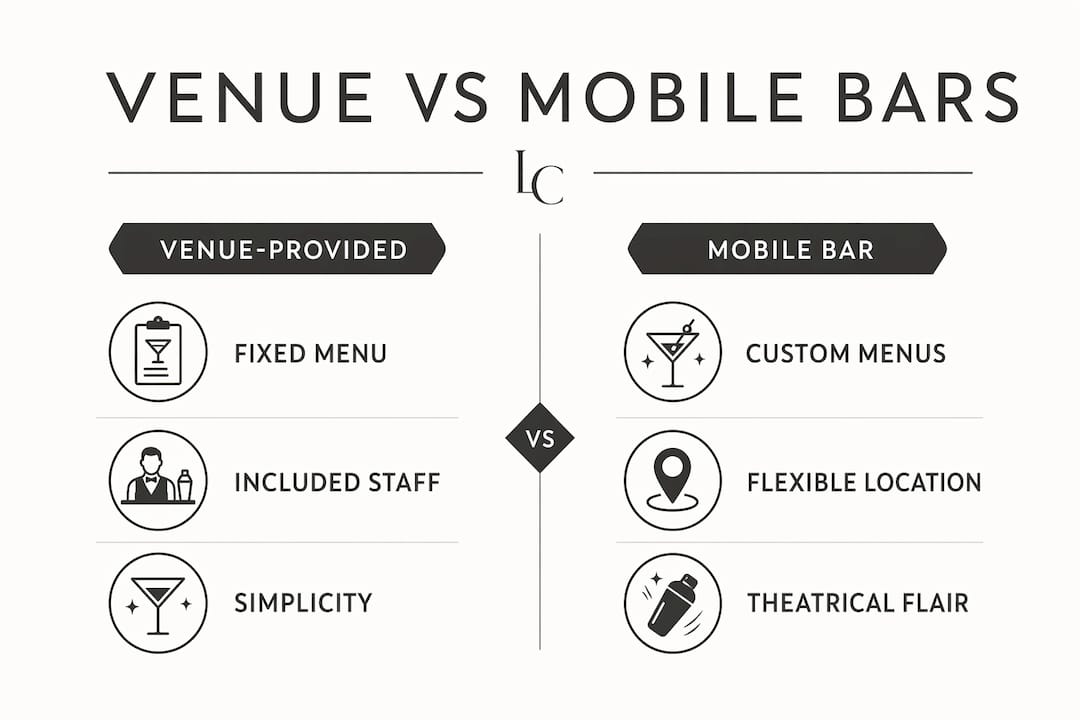
A venue-provided bar is a fixed, permanent bar built into an event space, staffed by house employees, and operated under the venue’s liquor license. A mobile bar is a portable, independently operated setup brought directly to your event, wherever that happens to be. That single structural difference ripples through every decision you make about drinks, budget, aesthetics, and guest experience.
Understanding what venue-provided vs mobile bar means comes down to one core tradeoff: convenience versus control. Venue-provided bars offer a fixed drinks menu, house staff stretched across the whole event, and pricing set well in advance. Mobile bars bring full customization, dedicated bartenders, and the freedom to set up in a garden, rooftop, warehouse, or anywhere else your event calls for.
Here is what each option actually looks like in practice:
- Venue-provided bar: Integrated into the venue’s infrastructure, covered by the venue’s permanent liquor license, staffed by house employees, and bundled into event packages with limited room for menu changes or branding.
- Mobile bar: A self-contained unit transported to your location, operated by an independent bartending company, requiring its own licensing arrangements, and fully customizable from the drink menu to the physical aesthetic of the bar itself.
What are the real pros and cons of each bar type?
Venue-provided bar
The biggest advantage is simplicity. You book the venue, and the bar comes with it. No separate vendor, no extra coordination, no worrying about setup. For a small corporate dinner or a low-key private gathering, that convenience is genuinely hard to beat.
The tradeoffs show up fast, though. Venue bars typically operate from a fixed menu, with house brands, pre-batched cocktails, and limited flexibility for special requests. Corkage fees, minimum spend requirements, and inflated per-drink pricing can push costs well above what you budgeted. Staff are shared across the entire venue, not dedicated to your event.
Mobile bar
The benefits of mobile bars center on customization and storytelling. You choose the drink menu, the bar’s visual style, the spirits brands, and where the bar sits in the room. Pricing is typically transparent, whether that is a per-head package or a flat hire rate, with no surprise charges at the end of the night.
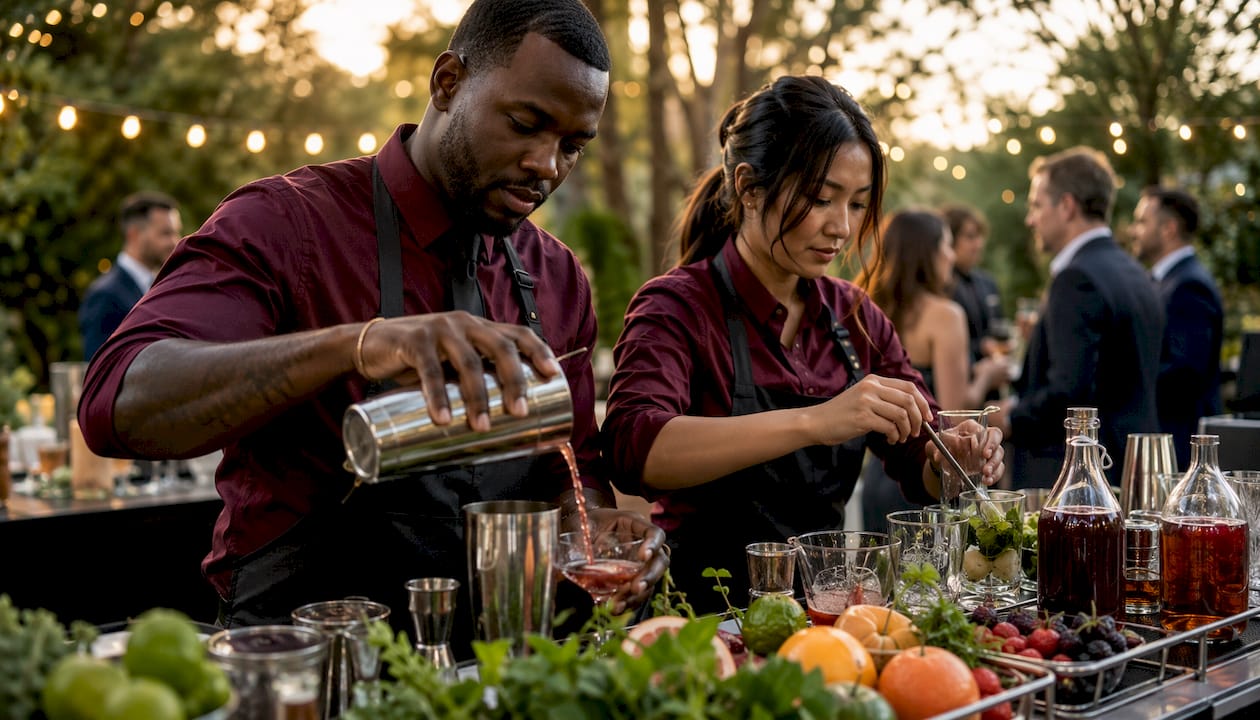
The practical cons are real. Mobile bars require more coordination upfront: you need to confirm licensing arrangements, manage alcohol procurement if you are on a dry hire arrangement, and plan for setup and breakdown logistics. For very small events at well-equipped venues, that extra effort may not be worth it.
Pro Tip: Mobile bartenders who use theatrical techniques like dry ice, fresh-cut garnishes, and tableside shaking turn the bar into a live performance. Guests gather, conversations start, and the bar becomes a social anchor rather than a functional corner.
Which events are best suited for each bar type?
When a venue-provided bar makes sense
- Small to mid-size gatherings at hotels, banquet halls, or restaurants where the venue’s drinks offering is already strong.
- Events where simplicity and all-inclusive packages are the priority and customization is not a concern.
- Short-duration events where the coordination overhead of a separate bar vendor outweighs the benefits.
- Situations where the venue contract requires exclusive use of house bar services.
When a mobile bar is the stronger choice
- Outdoor weddings, backyard receptions, barn venues, or any location without built-in bar infrastructure. Many weddings now take place outdoors, and mobile setups are built for exactly those environments.
- Corporate events where branding matters. Mobile bars can carry logos, color schemes, and product graphics in ways a fixed counter simply cannot.
- Large events with high guest counts. Multiple mobile bar stations reduce bottlenecks and cut wait times by distributing service across the space rather than funneling everyone to one location.
- Events where the bar is meant to be a design feature, not background furniture.
Pro Tip: For large weddings or corporate receptions, place one mobile bar near the entrance and a second near the dance floor or main gathering area. Guests naturally split between the two, and lines disappear.
Strategic bar placement does more than reduce wait times. Positioning a bar near focal areas transforms it into a social hub, drawing guests together and generating the kind of organic energy that a tucked-away venue bar rarely creates.
What Liquidcouragelv knows about running mobile bars in Las Vegas
Liquidcouragelv operates exclusively in Las Vegas and Henderson, Nevada, which means every setup accounts for the specific demands of desert events: heat management, outdoor power access, and the logistical realities of venues ranging from hotel ballrooms to private estates. That local focus matters when you are planning a Las Vegas wedding reception or a corporate event on the Strip.
On the licensing side, mobile bars cannot rely on a venue’s permanent liquor license. Mobile bar operations typically require event-specific temporary permits, and the requirements vary by jurisdiction. Working with an experienced mobile bartending company means those permits are handled correctly before the event, not scrambled for the morning of.
Dry hire arrangements, where the client supplies the alcohol and the bar company provides staff and equipment, require careful planning. Alcohol procurement for dry hire needs to account for guest count, event duration, and drink preferences to avoid both shortfalls and costly leftover inventory. Liquidcouragelv guides clients through that calculation as part of the booking process.
From a cost standpoint, mobile bars eliminate the permanent build-out costs and venue markups that inflate traditional bar spending. For corporate events especially, the ability to brand the bar and place it strategically often generates better guest engagement than a fixed counter ever could.
Common misconceptions about mobile bars
“Mobile bars are only for outdoor events.” Not true. Mobile setups work in hotel ballrooms, office spaces, warehouses, and rooftop venues just as well as open fields. The portability is an advantage indoors too, particularly when a venue’s fixed bar is in the wrong location for your event layout.
“Mobile bars are more expensive.” Venue bars often carry hidden costs: corkage fees, minimum spend requirements, and per-drink markups on house brands. A mobile bar’s pricing is typically upfront and all-in, which makes it easier to budget accurately and often cheaper in total.
“Mobile bars can’t handle large crowds.” The opposite is usually true. A single fixed venue bar creates one bottleneck. Multiple mobile units spread across a large event space handle high guest counts more efficiently, with dedicated staff focused entirely on your event rather than split across the whole venue.
“Licensing is the client’s problem.” A professional mobile bartending company handles its own permits and compliance. You confirm the event details; they manage the legal side.
Liquidcouragelv brings the bar to you in Las Vegas and Henderson
Skip the venue markup and the fixed menu. Liquidcouragelv delivers a fully equipped, professionally staffed mobile bar to your wedding, corporate event, or private party anywhere in Las Vegas or Henderson, with a custom drink menu built around your event and a setup that looks as good as it pours.
From signature cocktail programs to last-minute corporate bookings, Liquidcouragelv handles the logistics, the licensing, and the breakdown so you can focus on the event itself. Every package includes professional bartenders, full equipment, and transparent pricing with no surprise charges. Want to see exactly how a mobile bar setup works from arrival to last call? The mobile bar setup guide walks through every step.
Key Takeaways
A mobile bar gives event planners full control over the drinks experience, the bar’s placement, and the overall aesthetic, while a venue-provided bar trades that control for simplicity and built-in logistics.
| Point | Details |
|---|---|
| Core tradeoff | Venue bars offer convenience; mobile bars offer control, customization, and location flexibility. |
| Cost transparency | Mobile bars use upfront pricing with no minimum spend or corkage fees; venue bars often carry hidden charges. |
| Guest flow | Multiple mobile bar stations reduce bottlenecks at large events better than a single fixed venue bar. |
| Licensing | Mobile bars require event-specific temporary permits; venue bars operate under the venue’s permanent license. |
| Liquidcouragelv | Serves Las Vegas and Henderson with fully equipped mobile bar setups for weddings, corporate events, and private parties. |