
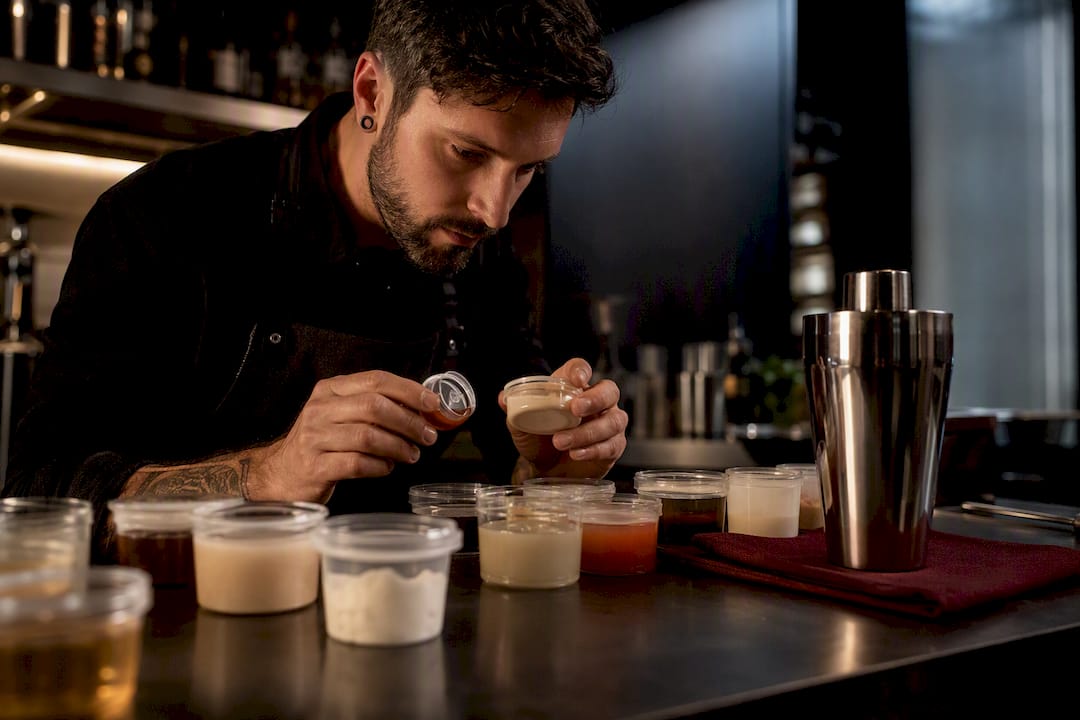
Hiring a professional bartending service that guarantees vegan ingredients and controls allergen cross-contact is the only reliable way to deliver a fully vegan cocktail menu at an event. A professional bartending vendor can build that menu from the ground up rather than swapping ingredients last minute. The sections below cover the exact ingredients to verify, a vendor-vetting checklist, sample menus, and the logistics that keep the bar running fast without breaking the vegan promise.
TL;DR:
- A fully vegan cocktail menu requires a professional bartending service that provides verified ingredients and strict cross-contamination procedures.
- Key substitutes include aquafaba for egg whites, coconut cream for dairy, and agave or maple syrup for honey, with ingredient lists confirmed beforehand.
- Prebatched vegan modifiers and foam stabilizers improve service speed and consistency, especially during longer events like weddings or corporate receptions.
- Staffing should be adjusted based on drink complexity, with one bartender per fifty guests for simple menus and additional staff for foam-intensive drinks.
- Asking vendors for detailed ingredient lists, vegan tastings, and cold storage plans ensures reliable execution of vegan cocktails at large events.
Table of Contents
- What Makes a Cocktail Menu Truly Vegan for Events?
- Vendor-Vetting Checklist: What to Ask, Require, and Contract For
- The Ingredient Science Behind Vegan Cocktail Texture
- Sample Vegan Cocktail Menus by Event Type
- Running the Bar: Logistics That Keep Vegan Service Smooth
- What Liquid Courage Has Learned Running Vegan Bar Programs
- Ready to Book a Vegan-Friendly Bar for Your Event?
- Sources
- FAQ
What Makes a Cocktail Menu Truly Vegan for Events?
A cocktail is only as vegan as its weakest ingredient, and the usual suspects hide in places most guests never think to check. Egg whites show up in sours and fizzes. Dairy cream lands in flips and some dessert cocktails. Honey sneaks into “natural” syrups, and certain liqueurs use animal-derived tinctures or are clarified with substances like isinglass.
The fix isn’t always a one-to-one swap. Vegan mixology works best when bartenders use plant ingredients for what they’re good at, rather than forcing them to imitate dairy exactly. A bartender specializing in vegan cocktails will tell you that coconut cream builds a rounder, richer texture than heavy cream ever did, just a different one.
Common substitutes planners should recognize on a proposed menu:
- Aquafaba (chickpea brine) for egg-white foam
- Coconut cream for dairy cream in flips and creamy cocktails
- Agave or maple syrup in place of honey
- Methyl cellulose or other modernist stabilizers for consistent foam at scale
Most distilled spirits, vodka, gin, rum, whiskey, are naturally vegan. The risk sits in the mixers, bitters, and house-made syrups, which is exactly where a vendor’s ingredient list needs scrutiny.
Vendor-Vetting Checklist: What to Ask, Require, and Contract For
A confident vendor hands you a written ingredient list without being asked twice. If a bartending company hesitates on that request, treat it as a warning sign, not a formality.
Work through these steps before signing anything:
- Request a written recipe and ingredient list for every cocktail on the proposed menu, not just the signature drinks.
- Ask for a vegan-only tasting, or clearly labeled vegan samples if the tasting covers a mixed menu. A dedicated vegan tasting eliminates the guesswork of “which glass was which” after the fact.
- Confirm cross-contamination procedures, including whether staff use separate shakers, strainers, or garnish stations for vegan drinks.
- Verify insurance and liquor licensing, and ask directly about staff-to-guest ratios for your headcount.
- Get an itemized pricing model that breaks out liquor, mixers, garnishes, and labor rather than a single vague line item.
- Nail down timeline details: prebatching windows, cold storage requirements, ingredient labeling, and the vendor’s policy on last-minute menu changes or cancellations.
Pro Tip: Ask the vendor to label prebatched vegan modifiers (syrups, foams, purees) in storage the same way a restaurant labels allergens in a walk-in. If they already do this without prompting, it’s a strong sign vegan service isn’t an afterthought for them.
The Ingredient Science Behind Vegan Cocktail Texture
Texture is where vegan cocktails either succeed or fall apart, and it’s worth understanding the trade-offs before you approve a menu.
Aquafaba is the workhorse of vegan foam. It whips up almost like egg white, carries no salmonella risk, and doubles as a sustainability win since it repurposes liquid usually poured down the drain. Canned aquafaba is more concentrated and foams faster; powdered versions are shelf-stable and easier to transport to an event site, but some bartenders find the foam slightly less stable over a long reception.
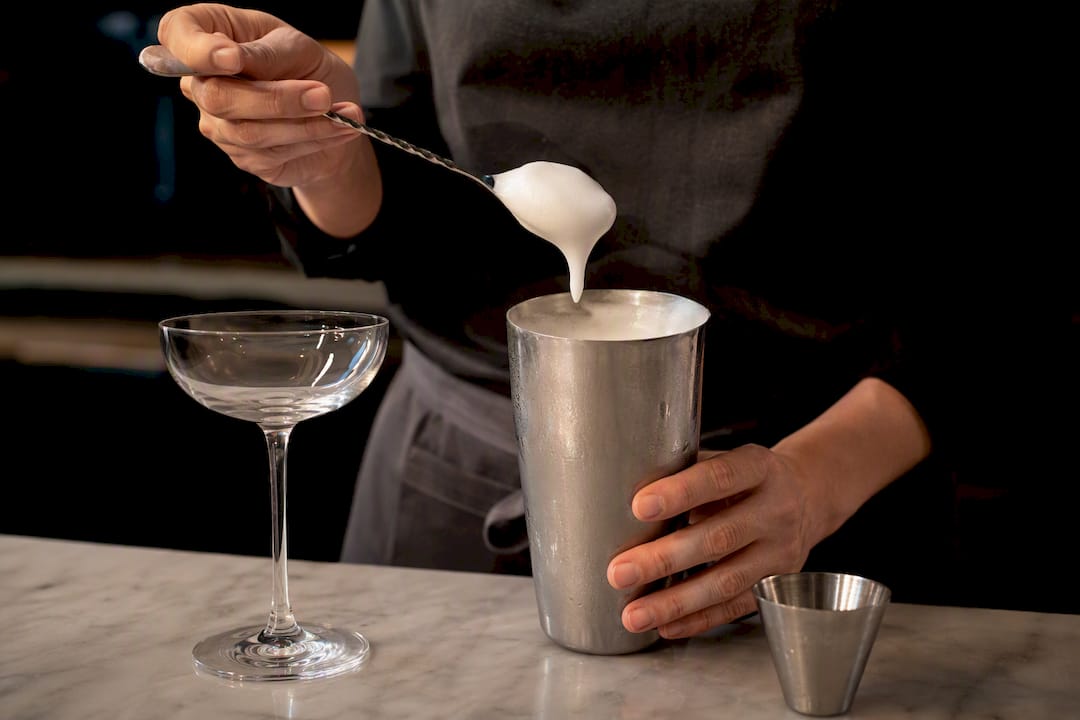
For bigger events, many professional bars lean on modernist alternatives instead. Lab testing by Campari Academy on ten egg-white substitutes found that methyl cellulose formulations delivered the most stable foam with a neutral flavor, and held up longer than several other options during service. That consistency matters most at a four-hour wedding reception, where a foam that collapses by hour two looks sloppy next to one that holds through the toast.
A few more swaps worth knowing:
- Coconut cream changes the flavor profile of a drink, not just the texture, so it works best in cocktails built around it rather than dropped into a classic recipe unchanged.
- Agave, maple, and cane syrups replace honey cleanly, but house-made syrups and some liqueurs can contain hidden honey or glycerin, which is why ingredient disclosure matters.
- Prebatching affects foam retention. Some stabilizers hold up fine when batched hours ahead; others perform best mixed close to service.
Sample Vegan Cocktail Menus by Event Type
Menu size should match the event, not the other way around. A wedding calls for polish and a small, memorable list. A corporate reception needs speed and a bit of branding. A private party rewards variety.
Wedding reception (two signature cocktails plus one mocktail):
- A gin fizz made with aquafaba foam instead of egg white
- A coconut cream flip finished with a citrus twist
- A zero-proof shrub spritz for the non-drinking side of the guest list
Corporate event (branded cocktail plus two crowd-pleasers):
- One cocktail built around the company’s brand colors or logo garnish
- A classic margarita with agave in place of any honey-based mix
- A low-ABV spritz for daytime networking sessions
Private party (four to six casual options):
- A rotating punch, a vodka soda variation, a coconut-based tropical drink, and at least one zero-proof option for designated drivers
For a small wedding party or an intimate private gathering, one bartender per fifty guests keeps service moving. Larger corporate receptions or weddings with more guests usually need two or more bartenders working the same bar to avoid a line forming during cocktail hour. Planners refining a wedding cocktail menu or a corporate reception plan should size the menu to the crowd before locking in staffing.
Running the Bar: Logistics That Keep Vegan Service Smooth
The best vegan menu on paper still fails if the bar can’t execute it at speed. Prebatched vegan modifiers, foams, purees, infused syrups, need clear labeling and correct cold storage, the same way any perishable ingredient would at a catered event.
Speed is a real trade-off. Made-to-order aquafaba foam takes longer to shake than a prebatched syrup poured over ice, so a complex vegan menu with multiple foamed drinks may need an extra bartender to hit the same pace as a simpler one. Planners weighing interactive cocktail stations against a single central bar should factor that extra prep time into the layout.
Guest-facing details matter just as much as what happens behind the bar:
- Menu cards should flag which drinks are vegan and which contain common allergens like nuts or dairy.
- Bar staff should be briefed on how to answer dietary questions confidently, not guess.
- Vegan-only bar programs, rather than a mixed menu with a token vegan option, tend to reduce staff errors and guest confusion since there’s no risk of grabbing the wrong shaker.
Sustainability fits naturally here too. Upcycled aquafaba, reusable garnish tools, and reduced single-use plastic all pair well with a vegan program, and a sustainable bar service checklist can help planners cut waste without adding steps to the bartender’s workflow.
Pro Tip: If your venue has limited refrigeration space, ask the vendor how they plan to store prebatched foams and creams on site. A vendor without a clear answer may be improvising their cold-chain plan on your event day.
What Liquid Courage Has Learned Running Vegan Bar Programs
Vegan service shouldn’t slow anyone down at the bar. In practice, that means building foam-based drinks into the prep list before doors open, not scrambling mid-event, so a bartender can pour a gin fizz as fast as any classic cocktail.
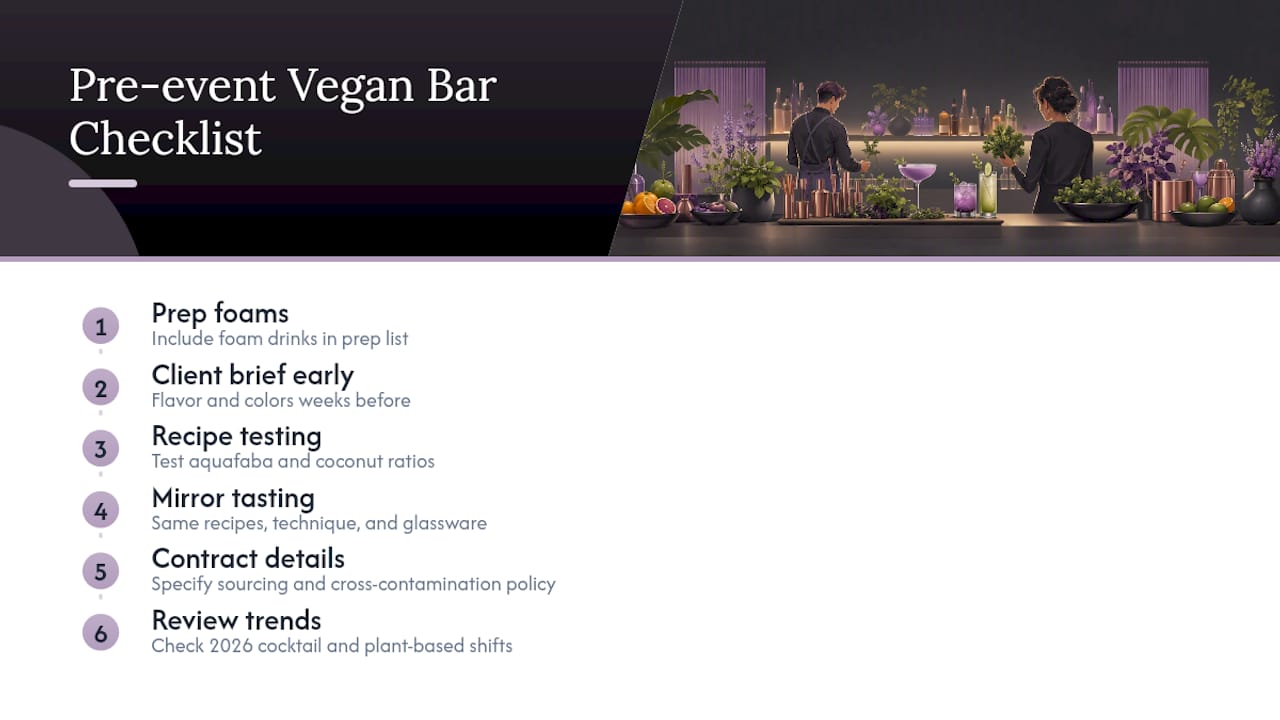
Branded corporate cocktails work best when the client briefs the bar team on flavor direction and brand colors weeks ahead, not the morning of the event. That lead time lets a bar team test aquafaba ratios or coconut cream proportions until the drink tastes balanced, not just visually on brand.
A vegan tasting should feel like a real preview of event day: same recipes, same technique, same glassware. Contracts should spell out ingredient sourcing and a cross-contamination policy in writing, so nothing gets left to a verbal promise. Reviewing 2026 cocktail trends can also help planners see where plant-based ingredients are already reshaping standard menus.
— Brennon
Ready to Book a Vegan-Friendly Bar for Your Event?
Professional bartending services build vegan cocktail menus from the ingredients up, with a tasting to prove it before your event date arrives. That means no scrambling to substitute egg whites the week of your wedding and no vague promises about “vegan options available.”

Event bartending services often cover vegan menu development, tastings, branded corporate cocktails, staffing sized to your guest count, and required insurance and contract documentation. To get an accurate quote, include your event date, guest count, service hours, whether you want a fully vegan bar or a mixed menu with vegan options, and your tasting preference.
Start with the event bartending hiring guide to see how the process works from quote to event day, or review the wedding liquor catering contract checklist if you’re finalizing details for a Las Vegas or Henderson wedding. Request your quote now and lock in your date before your preferred bar team books up.
Sources
- Using aquafaba in cocktails
- Best egg-white substitutes for cocktails
- Bartender explains how to make vegan cocktails
- How to choose a vegan caterer: evaluation guide
FAQ
Can bartenders make cocktails completely vegan for a wedding?
Yes. A professional bartending service can build an entire wedding cocktail menu around vegan-friendly ingredients like aquafaba, coconut cream, and agave, as long as syrups and liqueurs are verified for hidden animal-derived components.
Is aquafaba safe to use in cocktails at large events?
Aquafaba is a safe, egg-free foaming agent with no salmonella risk, and it works well for both wedding-scale and corporate-scale service when stored and labeled correctly.
How many bartenders do I need for a vegan cocktail menu?
For a simple menu, one bartender per fifty guests keeps service moving, but complex vegan drinks that require made-to-order foam often need an extra bartender to maintain speed at larger events.
What should I ask a vendor before booking vegan cocktail service?
Ask for a written ingredient list, a vegan-only tasting, cross-contamination procedures, proof of insurance and licensing, and an itemized pricing breakdown before signing a contract.
Are all liquors and spirits vegan by default?
Most distilled spirits are naturally vegan, but some liqueurs use animal-derived clarifying agents or tinctures, so it’s worth confirming with the vendor rather than assuming.