

Yes, licensed mobile bartending and liquor catering can serve your event at a Las Vegas venue, but only when the vendor holds the correct local permit and the venue clears it. Confirm which jurisdiction governs your address, request the vendor’s Certificate of Insurance and proof of alcohol-awareness training, and start permit paperwork the day you book the venue. Waiting costs money and, sometimes, the whole bar setup.
TL;DR:
- Vendors must hold a valid Clark County liquor caterer license and obtain the appropriate permit for the specific event date and location.
- Dry hire shifts responsibility to the host for purchasing, storing, and returning alcohol, while wet hire requires the vendor to handle all alcohol sales and service.
- Most permits and licenses must be secured at least ten days before the event to avoid double fees and delays, especially in unincorporated Clark County.
- Confirm whether the venue allows outside vendors, as some have exclusive contracts with in-house caterers or require specific licensing and insurance.
- Vendor verification should include current licensing numbers, certificates of insurance, and evidence of alcohol-awareness training, not just reputation or marketing materials.
Table of Contents
- Dry Hire, Wet Hire, and What Actually Changes for You
- What Local Permits Do You Actually Need in Las Vegas?
- How Do You Pick the Right Bartending Vendor?
- What Staffing and Site Details Does Your Venue Need to Confirm?
- What Will Permits and Vendor Fees Actually Cost You?
- Does Your Venue Have Exclusive Bar Vendor Agreements?
- Which Licensed Mobile Bartending Services Cover Las Vegas Venues?
- How Does Booking a Bartender for a Union Venue Work?
- What Do Union Mobile Bar Services Typically Cost?
- Union vs. Non-Union Bar Vendors: What’s the Real Difference?
- How Do You Verify a Vendor’s Legitimacy Before Booking?
- A Local Perspective on Coordinating Licensed Bar Service in Las Vegas
- Ready to Book Licensed Bar Service for Your Las Vegas Event?
- Sources
Dry Hire, Wet Hire, and What Actually Changes for You
The service model you pick determines who is legally on the hook for the alcohol, and that single decision shapes almost everything else in your contract.
Dry hire means you buy the alcohol and the vendor supplies the bartenders, equipment, and expertise to serve it. This route often sidesteps seller-licensing rules that apply to a business selling drinks directly, but you take on the job of purchasing enough liquor, storing it properly, and dealing with the return of unopened bottles. It works well for private parties and some weddings where a host wants control over the bar budget.
Wet hire, also called liquor catering, means the vendor sells and serves the alcohol as part of the package. This is where a business generally has to hold a valid liquor caterer license and pull the correct event permit before pouring a single drink, per Clark County’s licensing rules.
Equipment matters too:
- Folding portable bars tend to avoid the plan-review and commissary requirements that come with mobile-unit classification.
- Trailer-style mobile units can trigger commercial-kitchen standards and commissary contracts, adding cost and lead time.
- Bartender-only staffing (no bar structure at all) is common for venues that already own bar furniture and just need licensed hands behind it.
What Local Permits Do You Actually Need in Las Vegas?
Every organizer asks the same question eventually: who is responsible for the paperwork, me or the vendor? The answer depends on the service model, but the permit itself almost always falls on the caterer.
Clark County requires any business serving alcohol at a special event to hold a current Liquor Caterer business license and pull a Liquor Caterer Permit for that specific date and location. If your venue sits inside the City of Las Vegas rather than unincorporated Clark County, the process runs through a separate set of alcoholic caterer instructions, including planning and fire-department review and, for some license types, a background investigation that can stretch across months.
Statistic to know: the Clark County permit application uses a per-service-station fee structure, and applications submitted less than 10 calendar days before the event can be charged double the standard fee.
Ask any vendor quoting your event for:
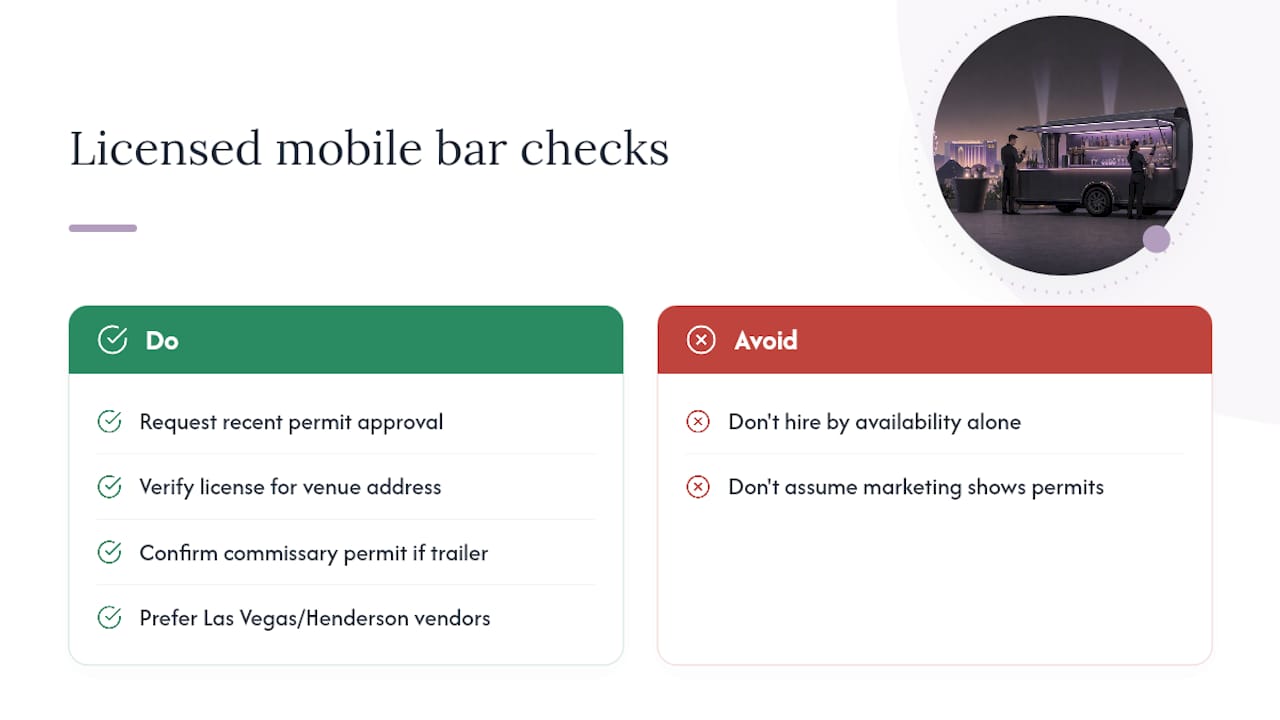
- Their liquor caterer license number, current and unexpired.
- A copy of a recent permit approval for another Las Vegas event.
- A Certificate of Insurance naming your venue as an additional insured.
- A staff roster showing TAM cards or the equivalent Nevada alcohol-awareness work-card training.
Confirming jurisdiction early matters more than it sounds. Plenty of Las Vegas addresses that feel like “the city” actually sit in unincorporated Clark County, which changes which office reviews your application and how long approval takes.
How Do You Pick the Right Bartending Vendor?
Comparing quotes gets confusing fast when one vendor’s “full service” package means something different from the next vendor’s. A short list of pointed questions clears that up before you sign anything.
- Which service model are you quoting, dry hire, wet hire, or bartender-only?
- Who buys the alcohol, and who owns the leftover bottles after the event?
- How many bartenders are included, and for how many hours?
- What’s the overtime rate if the event runs long?
- Who handles setup, teardown, and cleanup, and is that priced separately?
- What’s your cancellation and rescheduling policy?
- Do you have a backup staffing plan if a bartender calls out sick?
Build a simple comparison table from those answers: responsibility, what’s included, and any red flag. A red flag is a vendor that can’t answer the license question directly, or one whose “full bar service” quote leaves out ice, mixers, or cleanup without saying so upfront.
Pro Tip: Ask every vendor for a written “owner’s list” that assigns each supply item, alcohol, ice, glassware, garnishes, mixers, to a specific party. It sounds tedious, but it’s the single fastest way to kill a scope dispute before it starts.
Our event bartending hiring guide walks through this comparison in more depth if you’re staring down three or four quotes that all look different on paper.
What Staffing and Site Details Does Your Venue Need to Confirm?
Guest count and menu complexity drive staffing math more than most organizers expect. A 100-guest cocktail hour pouring wine and beer needs fewer hands than a 100-guest event built around four craft cocktails and a tight one-hour window. Batch-friendly menus speed up short service windows; a la carte craft drinks slow them down and usually call for an extra bartender.
Beyond headcount, confirm these logistics with both the venue and the vendor before the week of the event:
- A dedicated bar footprint with enough clearance for a portable bar or folding setup.
- Loading and access routes for equipment and ice delivery.
- Power availability if the setup includes lighting, blenders, or refrigeration.
- Water or sink access if a mobile trailer unit is involved.
- Agreed setup and teardown windows that don’t conflict with other vendors.
On the insurance side, check that the Certificate of Insurance names your venue as an additional insured and lists coverage limits that meet the venue’s own requirements, not just a generic minimum. Staff should carry TAM card records or equivalent alcohol-awareness training documentation on hand, not just “on file somewhere.”
What Will Permits and Vendor Fees Actually Cost You?
Clark County’s per-service-station fee model means permit costs scale with how many pour points you set up, and filing late is the expensive mistake: applications inside the 10-day window can be charged double.
Vendor pricing typically breaks down a few ways:
- Per-bartender hourly rates, often with a minimum booking window.
- Flat package pricing that bundles staff, equipment, and setup.
- Alcohol-inclusive packages versus host-purchased liquor under a dry-hire model.
Most vendors ask for a deposit at booking and the balance shortly before the event date. For routine weddings and parties, start vendor outreach and permit filing sufficiently in advance, preferably more than a few weeks out. Push that to 45 or 60 days during peak wedding season or if a mobile trailer unit needs plan review.
Does Your Venue Have Exclusive Bar Vendor Agreements?
This is the question every organizer should ask the venue coordinator directly, and the answer is never universal. Some Las Vegas event spaces, particularly hotel ballrooms, resort properties, and certain banquet halls, hold exclusive contracts with an in-house catering or beverage department. Others operate as open venues that welcome outside licensed vendors without restriction.
There’s no shortcut around this. You have to ask the venue, in writing, whether outside liquor caterers are permitted and whether any exclusivity clause exists in your rental agreement. Some venues allow outside bartenders but require alcohol to be purchased through the house. Others allow a fully outside wet-hire vendor as long as that vendor carries proper licensing and insurance naming the venue.
If a restriction exists, it usually shows up in the venue’s rental contract under a section about vendor policies or preferred-vendor lists. Read that section before you sign anything, and before you get too attached to a specific mobile bartending company. A venue coordinator can typically tell you within a single phone call whether outside licensed bar service is even an option for your date.
Booking your bartender before confirming this is one of the more common, and avoidable, planning mistakes in Las Vegas events. It’s a five-minute question that saves weeks of backtracking.
Which Licensed Mobile Bartending Services Cover Las Vegas Venues?
Las Vegas supports a genuinely active market for mobile bar services, with providers offering everything from vintage-trailer setups to sleek indoor portable bars, and price ranges that vary widely depending on service model and event size, based on local mobile bar directory data. That range gives organizers real choice, but it also means not every listed provider carries the licensing or insurance a given venue requires.
The practical filter isn’t “who’s available,” it’s “who’s licensed to operate at this specific address, under this specific venue’s insurance requirements.” A vendor might run a beautiful vintage-trailer setup and still lack the Clark County liquor caterer permit history a stricter venue wants to see, or the commissary agreement a trailer classification demands.
Some licensed bartending providers operate specifically within Las Vegas and Henderson, which means the licensing and permit conversation isn’t a side detail, it’s built into how quotes and bookings get handled from the first phone call. That local focus matters more at union-affiliated and hotel-style venues, where the coordinator wants a vendor who already understands the venue’s specific insurance and permit expectations rather than one learning the process for the first time.
Whatever provider you’re considering, ask to see their most recent permit approval for a comparable Las Vegas venue. That single document tells you more than any marketing page will.
How Does Booking a Bartender for a Union Venue Work?
Booking bar service at a venue with union staffing or house vendor requirements follows a slightly different sequence than booking for a backyard party or open banquet hall.
Start by contacting the venue coordinator, not the bartending vendor, and ask directly whether outside bar vendors are permitted and what documentation the venue requires. Get that answer in writing if you can.
Once you know outside vendors are allowed, request quotes and confirm each vendor’s liquor caterer license number and permit history. Ask for their Certificate of Insurance early, since some venues need to review and approve it before finalizing your booking, sometimes weeks in advance.
Next, lock in the service model, dry hire, wet hire, or bartender-only, based on what the venue allows and what your event needs. Some union venues only permit wet-hire vendors because it keeps alcohol liability entirely with a licensed caterer rather than the host.
After that, the vendor files the Clark County or City of Las Vegas permit application using your confirmed event date, guest count, and station count. This step needs your final headcount and bar layout, so lock those details before the vendor submits paperwork.
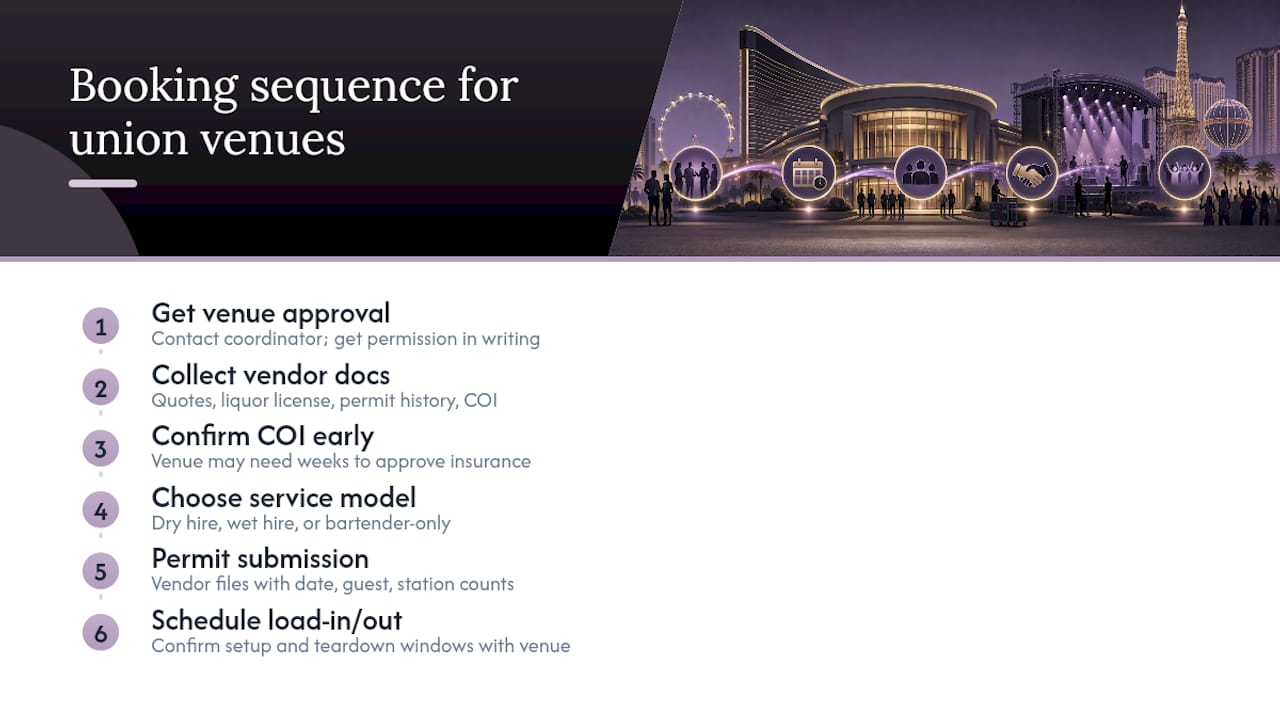
Finally, confirm setup and teardown windows with both the venue and vendor, since union venues sometimes have stricter load-in schedules tied to staffing shifts. Build that timing into your day-of schedule early rather than discovering it the week before.
What Do Union Mobile Bar Services Typically Cost?
Costs at a union-affiliated venue break down into a few distinct pieces, and organizers who don’t separate them often get surprised by the final invoice.
Bartender labor is usually priced hourly per bartender, with a minimum booking window common across most Las Vegas vendors. Equipment rental, whether a folding bar or a full mobile setup, adds a separate line item. Alcohol costs vary enormously based on whether you’re running a dry-hire model with host-purchased liquor or a wet-hire package where the vendor supplies everything.
Gratuity is where things get venue-specific. Some union venues include a built-in service charge or gratuity requirement as part of the venue rental itself, separate from anything you tip your bartending vendor directly. That’s not the same as a “union fee,” and conflating the two is a common source of budget confusion. If your venue rental agreement lists a service charge, ask the coordinator directly whether it covers bar staff, catering staff, or both.
Permit fees stack on top of vendor pricing, scaled to the per-station fee structure Clark County uses. A single-station setup costs far less in fees than a multi-station bar spread across a large ballroom.
Ask every vendor for an itemized quote broken into labor, equipment, alcohol, and permit costs. A single flat number tells you almost nothing about where your money is actually going.
Union vs. Non-Union Bar Vendors: What’s the Real Difference?
“Union” in this context usually refers to the venue’s staffing agreements, not the bartending vendor’s own labor structure. Most mobile bartending companies serving Las Vegas events are independent small businesses, licensed through Clark County or the City of Las Vegas, rather than union shops themselves.
What changes at a union-affiliated venue is the layer of approval you have to clear. The venue may require outside vendors to carry specific insurance limits, submit documentation earlier than a non-union venue would ask, or coordinate load-in times around union staffing shifts already scheduled for that day. None of that makes the bartending service itself “union” or “non-union,” it just means the venue has more structured requirements around who’s allowed on-site and when.
A non-union, open venue tends to give you more flexibility on vendor choice and scheduling, but it also puts more of the compliance burden on you as the organizer, since there’s no venue-side coordinator double-checking your vendor’s paperwork.
Neither setup is inherently better; they’re just different. The real comparison point isn’t union versus non-union, it’s whether your chosen vendor holds a current liquor caterer license and can produce a Certificate of Insurance that satisfies your specific venue’s requirements, union-affiliated or not.
How Do You Verify a Vendor’s Legitimacy Before Booking?
Verification comes down to documents, not reputation. A polished website and good reviews don’t confirm licensing.
Ask the vendor to send their current Clark County or City of Las Vegas liquor caterer license number directly, then confirm it’s active rather than expired or pending renewal. Request a Certificate of Insurance and check that the coverage limits match what your venue requires, not just a generic policy minimum. Ask whether their bartenders carry TAM cards or equivalent alcohol-awareness training documentation, and ask to see that roster, not just a verbal assurance.
If the vendor claims experience at your specific venue or with union-affiliated staffing requirements, ask for a reference from that venue’s event coordinator. A legitimate vendor with real venue history will have that contact on hand. One that hesitates or can’t provide it is worth a second look before you sign a deposit check.
A Local Perspective on Coordinating Licensed Bar Service in Las Vegas
Some licensed bartending providers focus their services within Las Vegas and Henderson, and that local experience means permit navigation isn’t guesswork, it’s routine. Most of the coordination work happens before a single drink gets poured: confirming which jurisdiction governs the venue, supplying the Certificate of Insurance the venue asks for, and mapping the bar footprint against the space the venue actually has available.
Our honest recommendation: hire a licensed specialist whenever your venue allows outside vendors, rather than defaulting to whatever bar package the venue offers. Outside specialists tend to know the permit timelines and staffing math better because it’s the only thing they do.
— Brennon
Ready to Book Licensed Bar Service for Your Las Vegas Event?
Some bartending vendors offer support to help clients navigate Clark County permit paperwork. Instead of piecing together licensing rules from a venue coordinator and a general contractor, choose a vendor whose packages account for Las Vegas and Henderson permit requirements, staffing math, and venue coordination from the first quote.
Various event packages often include licensed bartenders, bar equipment, a Certificate of Insurance ready for the venue, and assistance with the permit process. Before requesting a quote, gather your event date, venue name, guest count, and preferred service model, dry hire, wet hire, or bartender-only. For initial paperwork guidance, consider checking resources like the Wedding Liquor Catering Contract Checklist or the wedding beverage catering guide for a deeper walkthrough of what a Las Vegas bar package should include. Sending your event details to vendors can help them prepare proposals based on the venue’s requirements.
Sources
- Liquor Caterer License and Permit | Clark County, NV
- Alcoholic caterer instructions | City of Las Vegas business licensing
- Nevada Mobile Bartending Laws | TAM Cards, Licensing & Compliance