
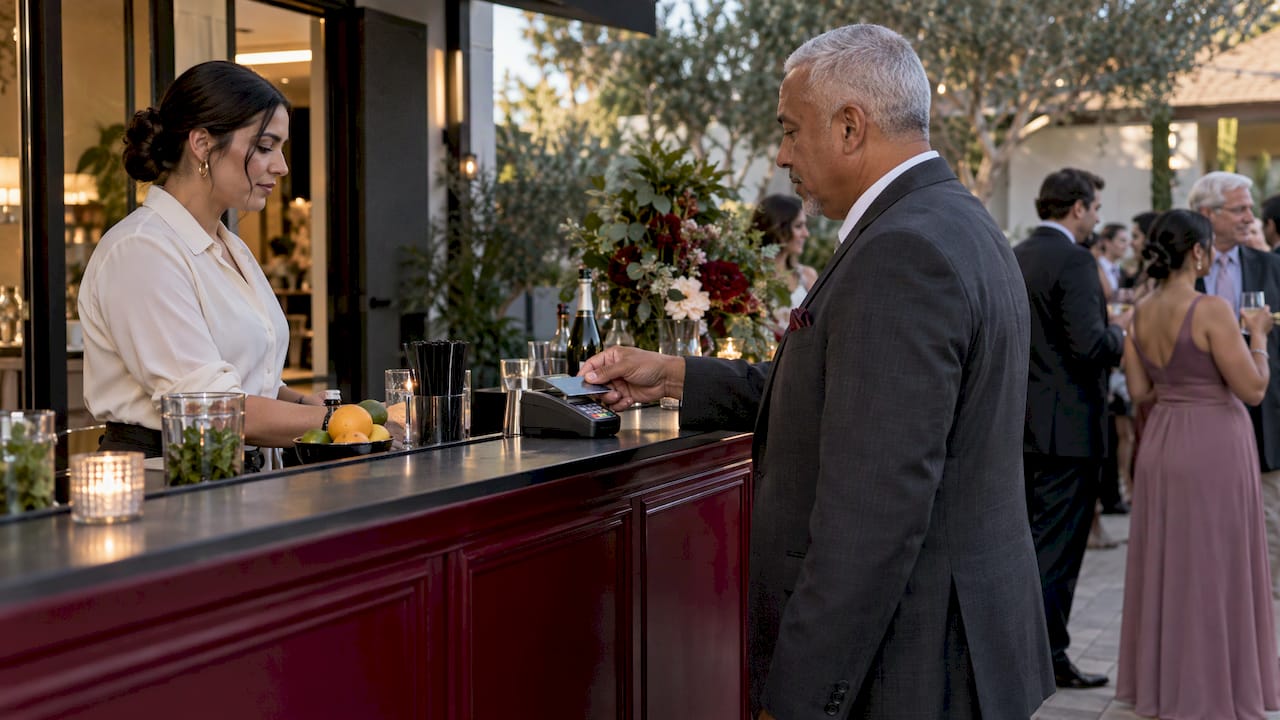
A cashless bar at a Las Vegas or Henderson event means guests pay for drinks by card, phone or a linked wristband instead of handing over bills. It is legal in Nevada, it speeds up lines and it makes the bar easy to reconcile. It works best when you plan three things before the event: how guests pay, how tips reach the bartenders, and what happens when the connection drops. We are a Las Vegas and Henderson mobile bartending company, and this guide covers those three things for couples and corporate planners.
TL;DR
- Nevada has no statewide law forcing a private business to accept cash, and federal law does not either, so a card-only event bar is allowed. Check city or county rules before you commit.
- Pick the payment method by event type: cards and phone wallets for most weddings, prepaid wristbands or electronic drink tickets for large corporate events.
- Decide tipping in advance. A service charge goes to the business, not automatically to the bartender, so say in writing how tips are handled.
- Plan for guests who cannot or will not pay digitally, and for a dropped connection, before the day.
- A cash bar does not mean cash only. It means guests pay for their own drinks, usually by cash or card.
Table of Contents
- Is a cashless bar allowed in Nevada?
- What does “cash bar” actually mean?
- How guests pay at a cashless event bar
- Tips at a cashless bar
- Guests who cannot or will not pay digitally
- Fees, connectivity and the backup plan
- A quick decision guide for planners
- Our perspective
- Planning your event bar with Liquid Courage
- FAQ
- Sources
Is a cashless bar allowed in Nevada?
Yes. The Federal Reserve says no federal statute requires a private business to accept currency or coins, and that businesses set their own cash policies unless a state law says otherwise. Legal tender rules cover debts, not a bar tab at your reception.
The state question matters more. A Vermont Legislative Research Service report completed in December 2024 lists Nevada among 32 states without a law banning cashless businesses, while 18 states do ban refusing cash. A Nevada payments guide also found no statewide Nevada rule requiring cash acceptance and suggests checking city or county code before going card-only.
Laws change, so treat this as the picture as of this writing. If your venue is a hotel, resort or private estate, it may also have its own payment rules for outside bar service. Raise it early. We work inside Las Vegas municipal code and coordinate with venues, so the payment plan and the venue’s rules get settled together.
What does “cash bar” actually mean?
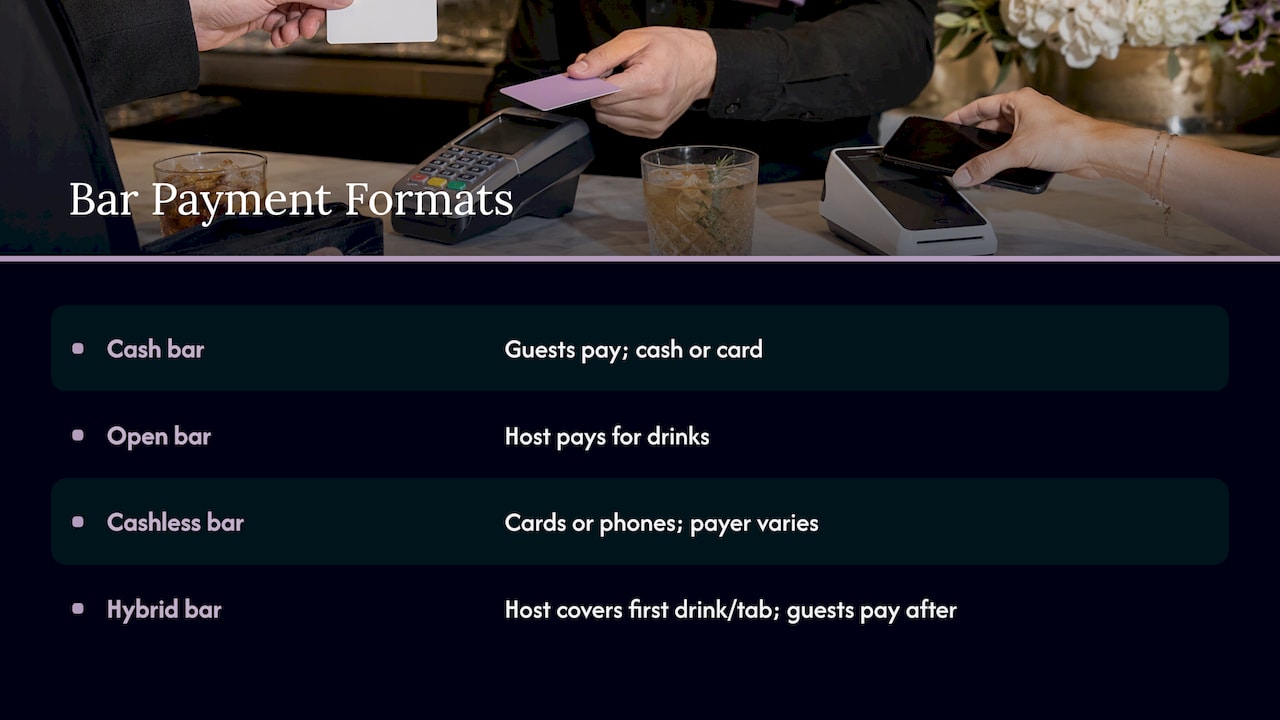
People often assume a cash bar takes only cash. It does not. A cash bar, also called a no-host bar, is one where guests pay for their own drinks, usually by cash or card. The opposite is an open bar, where the host pays.
So “cash bar” describes who pays, and “cashless” describes how. You can run a cash bar that takes only cards and phones, or an open bar where nobody pays at all. A hybrid is common too: the hosts cover a first drink or a set tab, and guests pay after that. For the formats and what each costs the host, see our cash bar setup guide and our comparison of open bar and cash bar weddings.
The wedding budget is why hosts consider guest-paid drinks. One 2026 industry guide cites 2025 data putting average alcohol spend at a US wedding around $2,800, about 11% of the budget. With a big guest list, shifting some of that cost to guests is a real option. The bar budget breakdown shows how to work the numbers.
How guests pay at a cashless event bar
There are four common setups. Each suits a different kind of event.
| Method | How it works | Best for |
|---|---|---|
| Card and phone wallet at the bar | Guests tap a card, Apple Pay or Google Pay and add a tip on screen | Weddings and private parties under about 150 guests |
| Open tab | Guest hands over a card, the bartender holds the tab and closes it at the end | Smaller receptions and cocktail hours |
| Prepaid wristband or card | Guests load value or link a card, then tap at every bar | Large conferences, galas, multi-bar venues |
| Drink tickets, paper or electronic | Host sets each guest’s allowance, and guests may pay beyond it | Corporate mixers, hosted-then-cash formats |
Cards, phones and tabs
This is the simplest route and the one guests already know. An open-loop system, meaning standard cards and wallets, is familiar to nearly everyone, though payments take longer per transaction and carry higher fixed fees per swipe than wristband systems.
Tabs need a rule. One bar-management guide explains that tabs can be individual, group or prepaid, including a deposit or a minimum-sales agreement for private events. It gives an example of a Saint Paul venue requiring a $1,500 bar minimum for weddings, with the host covering any shortfall. If your venue has a bar minimum, ask whether it applies to a bartending company brought in from outside.
Wristbands and electronic drink tickets
For a few hundred guests and several bars, wristbands change the math. Closed-loop systems run payments in roughly one to two seconds and collect one fee per top-up, but add 10 to 15 seconds at the entrance to hand out bands. Guests also set a budget when they top up, which tends to make spending more deliberate.
Corporate hosts get an extra benefit. One event-payments provider describes loading electronic drink tickets onto wristbands by attendee type, for example three alcoholic drinks and unlimited soft drinks, with higher allowances for managers or sponsors. You choose whether running out ends hosted drinks or lets the guest connect a card and pay their own way. That replaces the paper-ticket envelope and the post-event argument about the bill.
For a 60-person office party at a Henderson restaurant, wristbands are overkill. For a 600-person conference on the Strip, they pay for themselves in shorter lines. Our guide to corporate event bar planning by guest count covers how many bars and bartenders each size needs.
Tips at a cashless bar
Tipping is where cashless plans most often go wrong, because the money no longer sits in a jar. Three points matter.
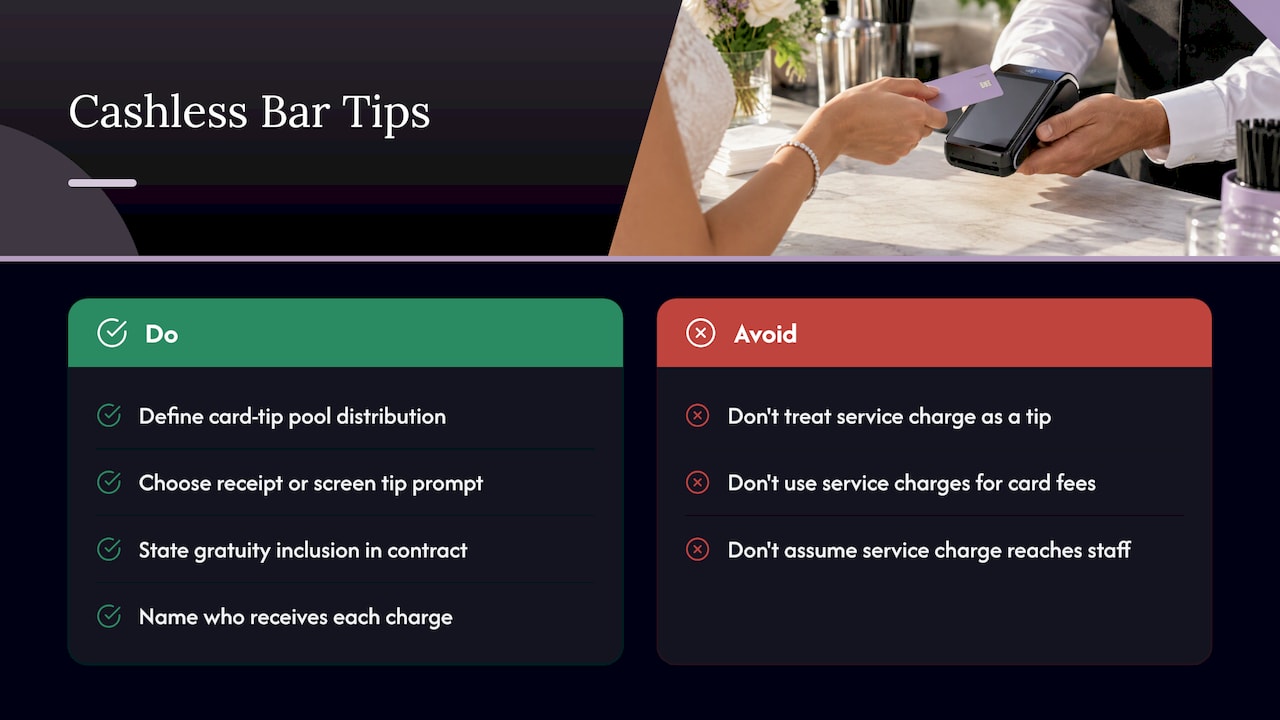
Card tips are tracked, then paid out by policy. Most tips now come through card payments, which a POS system tracks and divides under the pool’s distribution policy. Employees typically get pooled card tips in their paycheck, not on the spot.
A service charge is not a tip. A required service charge goes to the business, not automatically to the person serving. The same guidance warns against using the service-charge feature to cover card fees, since those are surcharges and carry network and state-law risk. Banquet event fees and large-party mandatory gratuity are legitimate uses.
Choose when the tip is added. Terminals can print a receipt with a tip line the guest signs, or let the guest add the tip on the screen before paying. The second method removes manual adjustment and keeps lines moving.
For couples, the practical step is to settle three things in the contract: whether gratuity is included, whether guests will see a tip prompt, and who receives what. Our guide to how bartending service billing works explains how fees, gratuity and charges usually appear on a bartending invoice.
Guests who cannot or will not pay digitally
A fully cashless bar can turn away people with no digital option. One payments guide warns that removing cash entirely can exclude attendees who have no alternative. At a wedding that might be a grandparent. At a corporate event it might be a vendor or a guest without a phone.
The Vermont research notes that going cashless hits some groups harder, including undocumented immigrants and people who avoid touchless payment for privacy. That is the reasoning behind the 18 state bans. Nevada is not one of them, but the guest experience problem is the same.
Good fixes are simple:
- A cash-to-value station. Hybrid guidance suggests cash top-up stations where staff load value onto a stored-value card or wristband.
- Clear instructions before the day. Put how to pay on the invitation website or in the event email, so no one arrives surprised.
- Staff who can explain it. One helper near the bar who explains payment kindly saves your bartenders from doing it mid-pour.
- A hosted option. For a wedding, a hosted first drink or a limited open bar removes the question for the people you most want to be comfortable.
Fees, connectivity and the backup plan
Cashless does not mean free. Card processing costs money, and the 2019 figure often quoted is that fees can reach as high as 5%, especially with AMEX for restaurants. We have not verified that figure for event bars, so ask for your actual rate in writing and see who bears it: the host, the guest or the bar operator. If a fee is mandatory, show it up front. The FTC’s fee rule, in effect since May 2025, covers live-event ticket sellers and short-term lodging, which tells you where regulators are heading on hidden charges.
Then plan for the day itself:
- Check connectivity at the actual bar location. Ballroom corners, desert venues and outdoor lawns around Henderson and Las Vegas can have weak signal. Industry guidance says to coordinate electrical access, Wi-Fi for card processing and cash-handling procedures with the venue ahead of time.
- Keep a cash float. A small count of bills, written down at the start and reconciled at the end, means a failed connection does not stop service.
- Separate pouring from payment. At busy bars, one person pours and a dedicated cashier handles transactions, with drawers assigned to named people and counts done by two staff.
- Confirm the receipt and closeout. Hosts paying a tab need an itemized record at the end of the night.
When most sales run on cards, the cash that remains is a small pile you can check, which is also why cashless systems reduce shrinkage at bars.
A quick decision guide for planners
Wedding, 50 to 150 guests, guests pay. Card and phone payment at the bar, a tip prompt on screen, a cash fallback and a short note on your wedding website.
Wedding, any size, hosts pay. No payment at the bar at all. Your decisions are the drink list and a total cap on the tab. See open bar versus cash bar.
Corporate mixer under 100. Hosted drink tickets for the first round, then cards for the rest.
Conference or gala over 300. Prepaid wristbands or electronic tickets, several service points and a staffed help desk.
Private party. Open tab or fully hosted. Do not complicate it.
Our perspective
We have poured at weddings and corporate events across Las Vegas and Henderson for over 20 years, and the pattern is consistent: the payment method is rarely what ruins a bar. The missing plan is.
A cashless bar fails when nobody decided who covers card fees, how tips are split, or what happens when the signal drops. It succeeds when those decisions are written down before the contract is signed, and when the bar is staffed and stocked for the real guest count.
That is why we build the bar around your event, not around a payment gadget. We are fully licensed and insured, we follow Las Vegas municipal code, and we offer turnkey packages with menu and bar branding. We coordinate with your venue so the bar format, the service plan and the billing are settled together.
If you are choosing between open, cash and hybrid formats, start with the guest list and the budget. The payment method follows.
Brennon
Planning your event bar with Liquid Courage
We provide mobile bartending, liquor catering, bar rental packages and dry hire staffing for events in Las Vegas and Henderson. Couples can start with our wedding bar services, and planners can see our corporate event bartending. Tell us your guest count, venue and whether guests or hosts are paying, and we will help you shape the bar format.
If you are comparing formats first, our bar rental packages show how a branded bar fits different spaces.
FAQ
Can a bar in Las Vegas refuse cash?
Generally yes. No federal law requires a private business to take cash, and Nevada is listed among the states without a ban on cashless businesses. City or county code can differ, so confirm before you commit to card-only. If your guests include people who rely on cash, offer a cash-to-card option.
Does a cash bar mean guests can only pay with cash?
No. A cash bar means guests pay for their own drinks, and most accept both cash and cards. Whether it takes cash at all is up to the host and the bar operator. Tell guests in advance how to pay.
Who gets the tips at a cashless bar?
It depends on how tips are set up. Tips added on card payments are tracked by the payment system and typically paid out through payroll or a pool. A service charge, by contrast, goes to the business unless the contract says otherwise. Put gratuity terms in writing before the event.
What if the card system goes down mid-event?
Have a cash float and a manual way to record orders, so service continues while the connection returns. Check signal and power at the bar location with the venue beforehand. Keeping pouring and payment as separate jobs also helps in busy periods.
Sources
- The Fed: Is it legal for a business to refuse cash?
- Vermont Legislative Research Service: Cashless businesses
- Credit Card Processing in Nevada
- Cash Bars: What To Consider
- Different Types of Bar Service for Events
- A cashless guide for event organisers
- How Do Bar Tabs Work?
- Electronic drink tickets for corporate events
- What Is Tip Pooling and How Does It Work?
- Customize Service Charges and Mandatory Gratuity
- Pay-at-the-Table FAQ
- Event payment processing: What to look for
- Cashless That Respects Cash: Hybrid Payment Solutions
- Event Box Office and Door Sales Guide
- Financial controls for event bars