
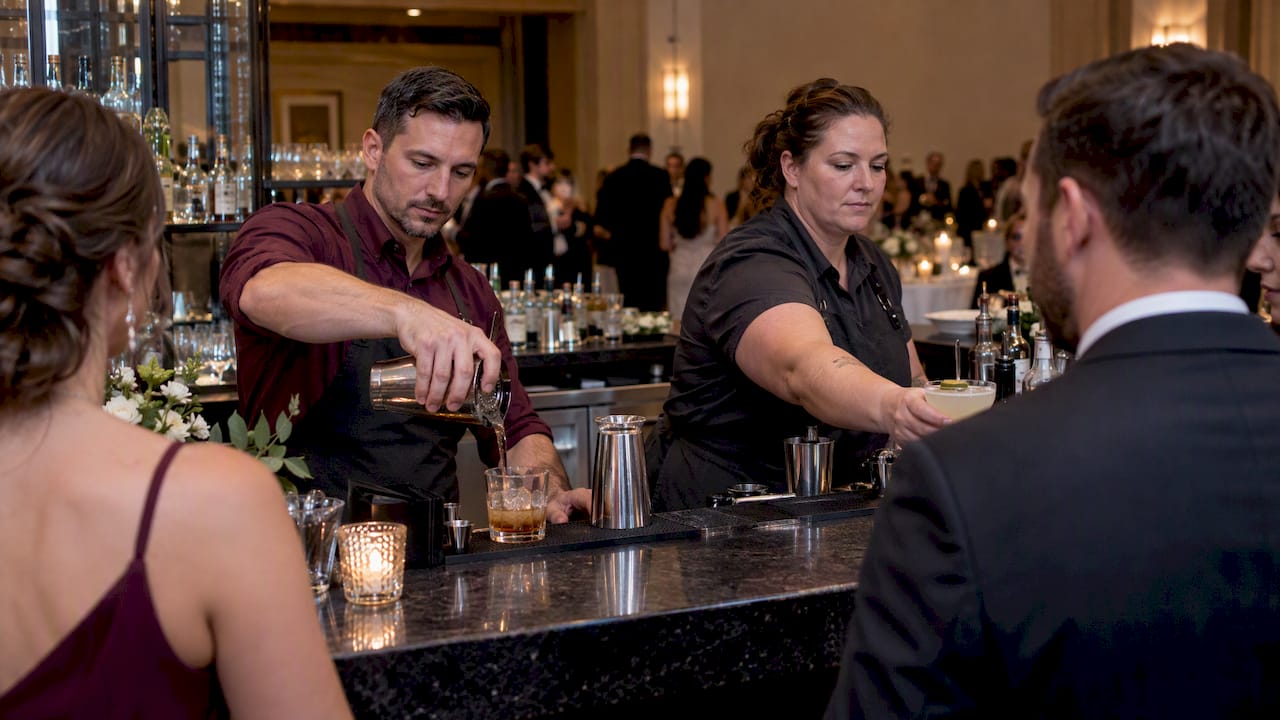
Plan on one bartender per 50 guests for a full bar and one per 75 for beer and wine only, then check the chart below to pick your starter number. Heavy cocktail menus, a rush of guests arriving at once, or a VIP bar push you toward more staff. The sample scenarios later in this guide show how those numbers turn into real staffing plans.
TL;DR:
- Keep at least two bartenders for events around 75 to 100 guests or larger, unless service is limited to a few simple pours.
- Add staff above baseline when cocktails require shaking and garnishing or guests arrive together; staggered arrivals, short menus, and drinks prepared in advance support lower staffing.
- Use at least two bar stations for 100 to 175 guests, and three or more stations for 200 guests or a bar serving both sides.
- Estimate one drink per guest per hour, then staff for peak demand; throughput examples of 25 or 40 drinks hourly are illustrations, not industry standards.
Table of Contents
- What is the right bartender staffing chart for your guest count?
- Which factors change how many bartenders you need?
- How many bar stations and barbacks do you need?
- How do you calculate drinks and turn them into bartenders?
- What does staffing look like at 100, 150, 200, and 300 guests?
- How can you keep lines short during peak times?
- Why experience matters more than the ratio
- Need help turning this staffing plan into a booking?
- FAQ
- Sources
What is the right bartender staffing chart for your guest count?
Start with the ratios, then round up to whole bartenders. The baseline is 1 bartender per 75 guests for beer and wine, and 1 per 50 guests for cocktails or a full bar. Many venues stretch that to 1 per 75–100 guests, but two bartenders at 100 guests gives noticeably better service.
| Guests | Beer and wine only | Signature cocktails | Full open bar |
|---|---|---|---|
| 50 | 1 | 1–2 | 1–2 |
| 75 | 1–2 | 2 | 2 |
| 100 | 2 | 2 | 2–3 |
| 150 | 2 | 3 | 3 |
| 200 | 3 | 3–4 | 4 |
| 300 | 4 | 5 | 6 |
Treat these as starting ranges, not promises. Use them like this:
- Pick the higher end when guests drink fast, your cocktails are complex, or many guests arrive at once.
- Pick the lower end when arrivals are staggered, the menu is short, and drinks are poured ahead of time.
- Keep a minimum of two bartenders for any event around 75–100 guests or more, unless your service is deliberately limited to a few simple pours.
Which factors change how many bartenders you need?
The ratio is a baseline. Your event decides whether you land above or below it, and these variables do most of the work:
- Menu complexity. A shaken, garnished cocktail takes far longer than opening a beer. If your signature drinks can be batched ahead, they behave more like pours than builds.
- Event length and pace. The standard planning assumption is about one drink per guest per hour. A longer party means more total drinks, and a crowd that front-loads its drinking creates a harder first hour than the average suggests.
- Arrival pattern. A ceremony that ends and sends everyone to the bar at once needs more hands than a drop-in reception where guests trickle in.
- Venue layout. Long walks to ice, stairs, or a bar tucked in a separate room all slow service. Distance adds minutes to every restock.
- Service model. An open bar moves faster than a cash bar, because no one is fumbling with payment. Ticketed drinks and pre-pour stations sit in between.
For an example of a staffing tier that goes beyond the baseline, our VIP bar setup guide covers staffing considerations for VIP bars.
How many bar stations and barbacks do you need?
Stations matter as much as headcount. Industry practice is at least two bar stations for 100–175 guests, and three or more stations or a double-sided bar for 200 or more. Spreading guests across stations prevents the single crowded bar that makes everyone feel the wait.
Barbacks keep bartenders behind the bar and pouring. A common approach is to add barback support based on the workload and restocking needs. Splitting beer and wine from cocktails also helps, because simple orders stop getting stuck behind a complicated one. Our bar station layout guide goes deeper on placement.
Check each station for:
- Ice, stocked and within arm’s reach
- Clean glassware, with extra racks nearby
- Speed rails holding the most-used spirits
- A clearing zone for empties and used cups
- A runner assigned to bring supplies
Pro Tip: Walk the route from storage to each bar before doors open. If a restock takes longer than two minutes, add a barback or move the supplies closer.
How do you calculate drinks and turn them into bartenders?
Here is a repeatable method. Start from the planning rule that each guest drinks about one drink per hour, so a five-hour reception means roughly five drinks per guest.
- Multiply guests by event hours to get total drinks. Say 150 guests at 4 hours gives 600 drinks.
- Assume a throughput per bartender. For illustration, choose an estimated hourly throughput for simple pours and cocktails. These are example inputs, not industry data.
- Find your peak hour. If a large share of drinks land in the busiest hour, use that estimate to calculate peak demand.
- Divide peak drinks by throughput. At 40 per hour that is 4.5, so plan on 5 bartenders. At 25 per hour it is 7.2, so plan on 7 or more.
- Compare to the ratio chart and use the higher number.
A planning rule of thumb: about one drink per guest per hour. Longer events and batchable recipes change the total, so adjust before you book.
A champagne toast is a short, concentrated spike. Pre-pour it and use extra hands for the toast rather than adding a bartender for the whole night.
What does staffing look like at 100, 150, 200, and 300 guests?
These templates start from The Knot’s expert staffing recommendations for weddings. Copy them, then adjust using the factors above.
- 100 guests: At least two bartenders and one barback. For beer and wine only, two bartenders cover it comfortably. A signature cocktail menu or full open bar is where you consider a third.
- 150 guests: Three bartenders and one barback. This is the point to add a second station, so lines split instead of stacking up.
- 200 guests: At least four bartenders and two barbacks. Run three stations or a double-sided bar, with one barback covering restocks and the other covering glassware and ice.
- 300 guests: Six bartenders and three barbacks. Deploy multiple stations, keep beer and wine separate from cocktails, and add a runner or floater for back-of-house support.
Weddings often run heavier than a casual corporate mixer, so a mixer with short hours and a limited menu can sit at the lower end. Planning one? See our notes on wedding beverage catering in Las Vegas.
How can you keep lines short during peak times?
Most wait-time problems come from a few fixable habits. Work through these in order:
- Batch your signature cocktails. Limit the menu to one or two drinks that can be mixed ahead. Batching ratios help: this margarita ratio guide shows how a simple 2:1:0.75 mix keeps a build fast and consistent.
- Pre-pour at predictable moments. Line up wine and champagne before the toast or the end of dinner.
- Open an express station. Serve nonalcoholic and prepaid drinks away from the main bar.
- Assign roles. One runner, one floater, and one person focused only on restocking.
- Make payment fast. Post a menu, use a card reader if it is a cash bar, and overlap shifts so fresh staff arrive before the rush.
Pro Tip: Staff for the busiest part of service, not the average hour. Cocktail hour is the usual crush, and our planner’s guide to cocktail hour explains why.
Why experience matters more than the ratio
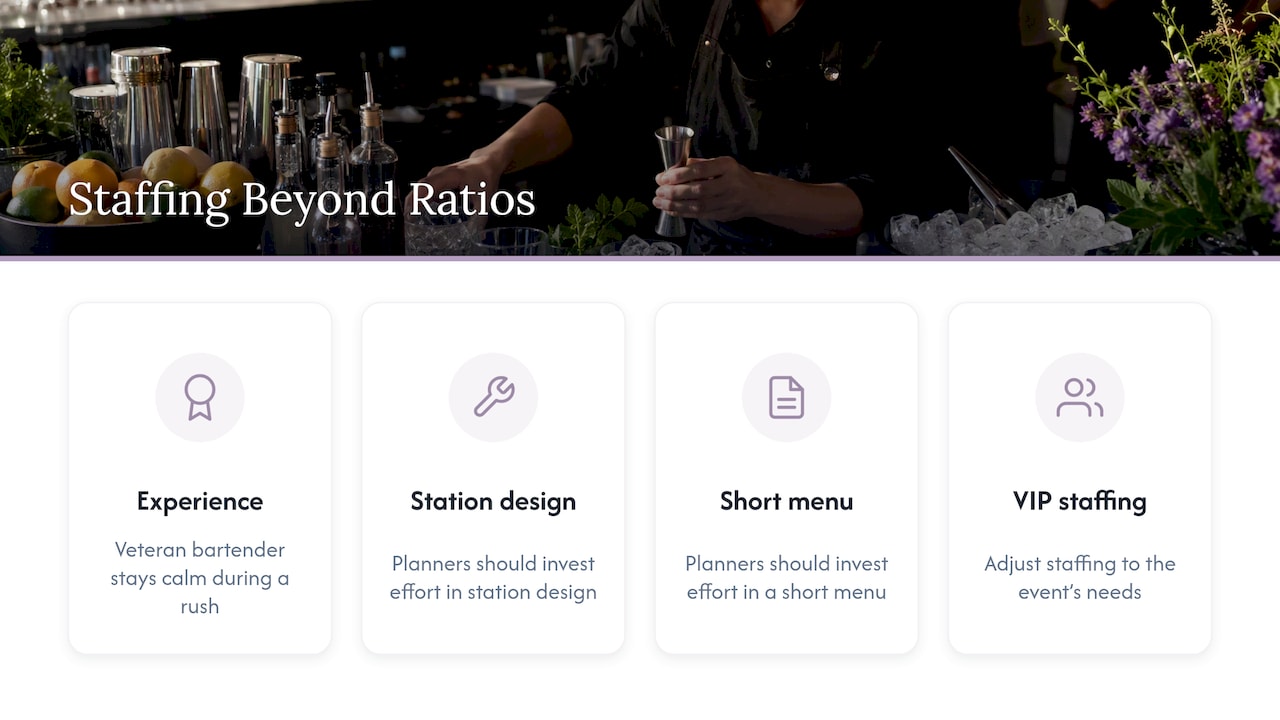
We run mobile bartending across Las Vegas and Henderson. After enough events, one thing keeps standing out: the ratio gets planners into the right neighborhood, but the quality of the people behind the bar can affect how long guests wait. A veteran bartender who stays calm during a rush, keeps the rail stocked, and reads the crowd will outpace a larger but rattled team.
So treat the chart as a floor and spend your effort on experience, station design, and a short menu. For VIP bars we adjust staffing to the event’s needs. If your event does not fit a template, we adapt it and quote a custom staffing plan.
— Brennon
Need help turning this staffing plan into a booking?
We handle the staffing math, the barbacks, and the station setup, so you can focus on the rest of your event. Our mobile bartending and liquor catering service covers what planners usually need:
- Mobile bartending and liquor catering for weddings and corporate events
- Bar rental packages with custom setups
- Private bartenders for smaller parties
Bring us your guest count, hours, and menu, and we will size the team, station layout, and barbacks to match. Request a custom quote at Liquidcouragelv and we will adapt this template to your event.
FAQ
How many bartenders do you need per 100 guests?
Plan on two bartenders for 100 guests. The Knot suggests a minimum of two bartenders and one barback at 100 guests, and a heavy cocktail menu may call for a third.
What is the standard bartender to guest ratio?
The common baseline is one bartender per 75 guests for beer and wine and one per 50 for a full bar. Many venues stretch it to 75–100 guests, but two bartenders at 100 guests gives better service.
How many bar stations do you need for 200 guests?
Use three or more stations, or a double-sided bar. Industry practice for 200 or more guests favors spreading service over several points instead of one central bar.
How many drinks should you plan for per guest?
Plan on about one drink per guest per hour. That works out to roughly five drinks for a five-hour reception, adjusted for your crowd and menu.
Sources
- Wedding Alcohol Calculator: How Much to Buy for Your Wedding
- 7 Proven Bartenders Staffing Tips: How Many Do You Need?
- Ziprecruiter