
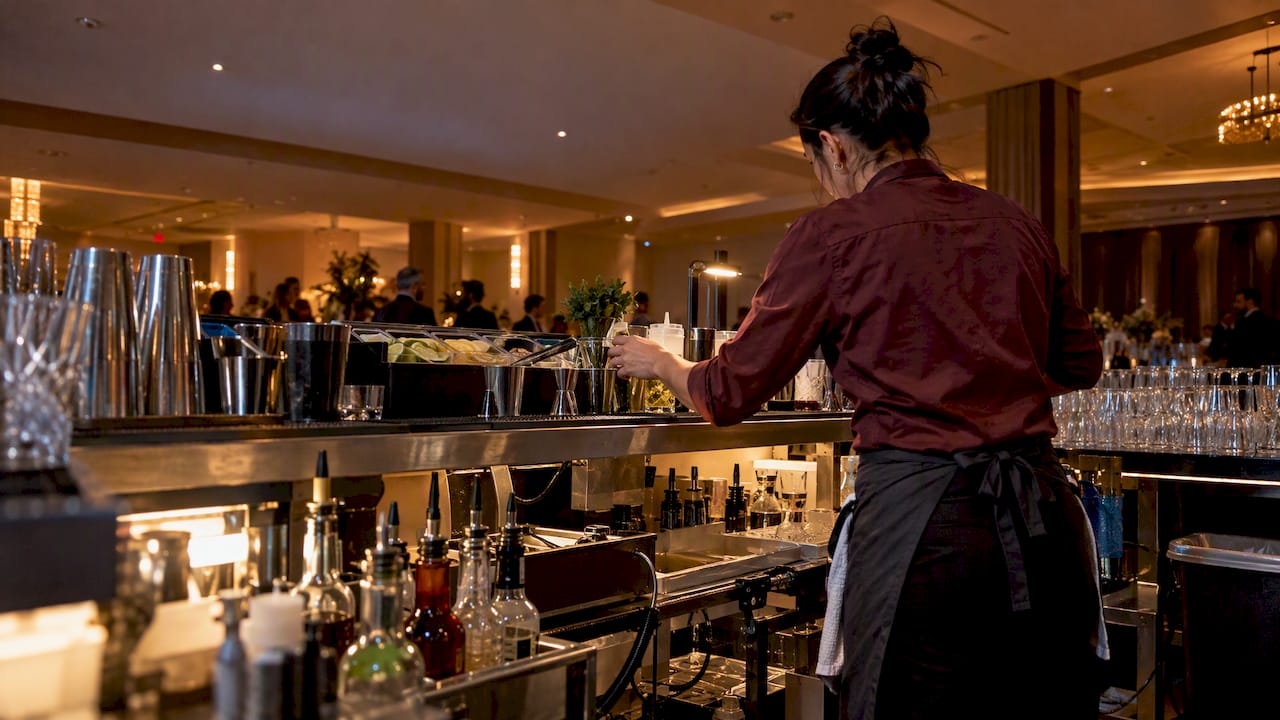
The strongest setups for temporary and mobile event bars combine under-bar LED strip lighting, battery-powered warm string lights, and low-heat pendant or puck task lights, sometimes paired with portable uplighting for backdrop color. These options install fast, run cool enough to sit near glassware and ice, dim to match the room, and photograph well without slowing down the pour. Mobile bartending teams like the one at Liquid Courage use this combination because it holds up under real service pressure, not just on a mood board.
TL;DR:
- Battery-powered LED strips and warm string lights are preferred for their quick installation, portability, and ability to operate without dedicated power sources.
- Light fixtures should be pre-rigged off-site when possible to streamline setup and prevent damage from ad hoc mounting methods.
- Dimmer compatibility and fire code restrictions should be verified beforehand, with timing and placement optimized for both service flow and photography.
- Renting lighting fixtures is usually more cost-effective for single events, while buying makes sense only if fixtures are reused across multiple occasions.
- Regular troubleshooting includes checking batteries, connections, and heat levels, along with having backup fixtures and basic repair tools on hand.
Table of Contents
- Practical bar lighting ideas with pros, cons, and mounting tips
- A planner’s checklist for choosing bar lighting
- Power, installation, and safety for temporary bars
- Event-specific lighting recipes for weddings, corporate events, and private parties
- Renting versus buying versus bundling lighting with your bar package
- Maintenance and troubleshooting common lighting issues in bars
- A bartender’s view on lighting that actually holds up
- Turnkey bar lighting and bartending from Liquid Courage
- FAQ
- Useful Liquid Courage guides and a partner lighting reference
Practical bar lighting ideas with pros, cons, and mounting tips
Each of these fits a temporary bar setup without requiring an electrician or a full rigging crew.
- Under-bar LED strip lighting. Mounted along the front lip or inside the bar face, these run on low-voltage power or battery packs and give the bar a glowing edge that reads well in photos. Install takes minutes with adhesive backing or clamp mounts, and the bar staff can reach pours without obstruction.
- Battery-operated warm string lights. Draped along the back bar or overhead, these need no outlet and suit outdoor tents or venues with strict power rules. They work for weddings and private parties where a soft glow matters more than a sharp accent.
- Low-heat pendant or puck task lights. Positioned directly over the pour and garnish stations, these keep bartenders working accurately in dim rooms. Puck lights are magnetic or clip-mounted, so they go up and come down in seconds.
- Portable battery uplights. Placed behind or beside the bar, these wash color onto a backdrop or draping without touching the service surface. They are the easiest way to add a branded color scheme without interfering with staff movement.
Pro Tip: Ask your bar vendor to pre-rig LED strips and clamp-mount fixtures before arrival. Clamp and magnetic mounts avoid wall or furniture damage, which matters for venues that restrict adhesive or screw-in fixtures.
A planner’s checklist for choosing bar lighting
Before you commit to a lighting plan, run through a short set of questions with your venue and your bar vendor.
- Is there a dedicated power source near the bar, or will you need battery fixtures?
- Is the bar indoors, outdoors, or both over the course of the event?
- Can each fixture dim, and does the venue allow flashing or colored lights?
- What color temperature fits the mood: warm (2700 to 3000K) for weddings and private parties, or neutral for corporate work?
- Are there mounting restrictions on walls, tables, or draping?
- Will fixtures block staff sightlines or pour access?
- Does the venue require a permit or have fire code restrictions on open flame or certain fixture types?
Prioritize service flow first, since a bar that looks great but slows pours creates longer lines and frustrated guests. Photography and brand visibility matter, but they should sit downstream of whether bartenders can move and see clearly.
Pro Tip: Walk the bar layout with your vendor before the event and ask them to flag any fixture that would sit in a bartender’s direct line of sight or reach.
Power, installation, and safety for temporary bars
Power planning determines whether your lighting plan survives contact with a real event.
- Confirm dedicated circuits. Temporary bars pull power for ice wells, blenders, and sometimes POS systems, so lighting should not compete for the same outlet.
- Use battery alternatives where power is uncertain. Battery-operated LED strips and string lights hold a charge for several hours of service, which mobile vendors often rely on to reduce the need for extension cords across walkways.
- Pre-rig low-voltage fixtures off-site when possible, and leave only final hookup and placement for the day of the event.
- Manage cables with mats or tape across any walkway, and keep heat-generating fixtures away from napkins, garnish trays, or alcohol-soaked rags.
- Confirm venue fire code and insurance requirements before finalizing fixture choice, especially for open flame substitutes or draping near lighting.
Event-specific lighting recipes for weddings, corporate events, and private parties
The right lighting recipe depends on the event’s tone as much as its venue.
- Weddings: warm-tone string lights overhead, a soft under-bar glow, and low-angle uplighting on a backdrop or floral wall behind the bar.
- Corporate events: neutral-color dimmable uplights, a branded color wash kept subtle near the service points, and clear, bright task lighting directly over the pour.
- Private parties: playful RGB uplighting around the bar perimeter, a single spotlight on a featured cocktail, while the actual pour area stays bright enough for accurate measuring.
Warm color temperature in the 2700 to 3000K range, combined with avoiding direct angled reflections on glassware, tends to photograph best for cocktails and keeps the drink’s actual color accurate instead of washed out by a cooler light.
Glare is the most common photography mistake at temporary bars. Keep direct light sources off-axis from glassware and let the under-bar glow do the work instead of a harsh overhead beam.
Renting versus buying versus bundling lighting with your bar package
For a single event, renting beats buying in almost every case, since mobile lighting fixtures lose value fast once better LED options arrive. Buying only makes sense if you run multiple events a year and want fixtures with replaceable battery packs and known rated runtimes.
- Renting fits most one-off weddings, private parties, and single corporate functions.
- Buying fits planners or venues running recurring events where the same fixtures get reused.
- Bundling lighting into your bar rental or bartending package often reduces vendor coordination since one team handles setup, power, and teardown together.
- When comparing quotes, confirm whether lighting, mounting hardware, and labor are included or billed separately, so you are comparing like for like.
Maintenance and troubleshooting common lighting issues in bars
Temporary lighting fails in predictable ways, and most problems trace back to batteries, connections, or heat.
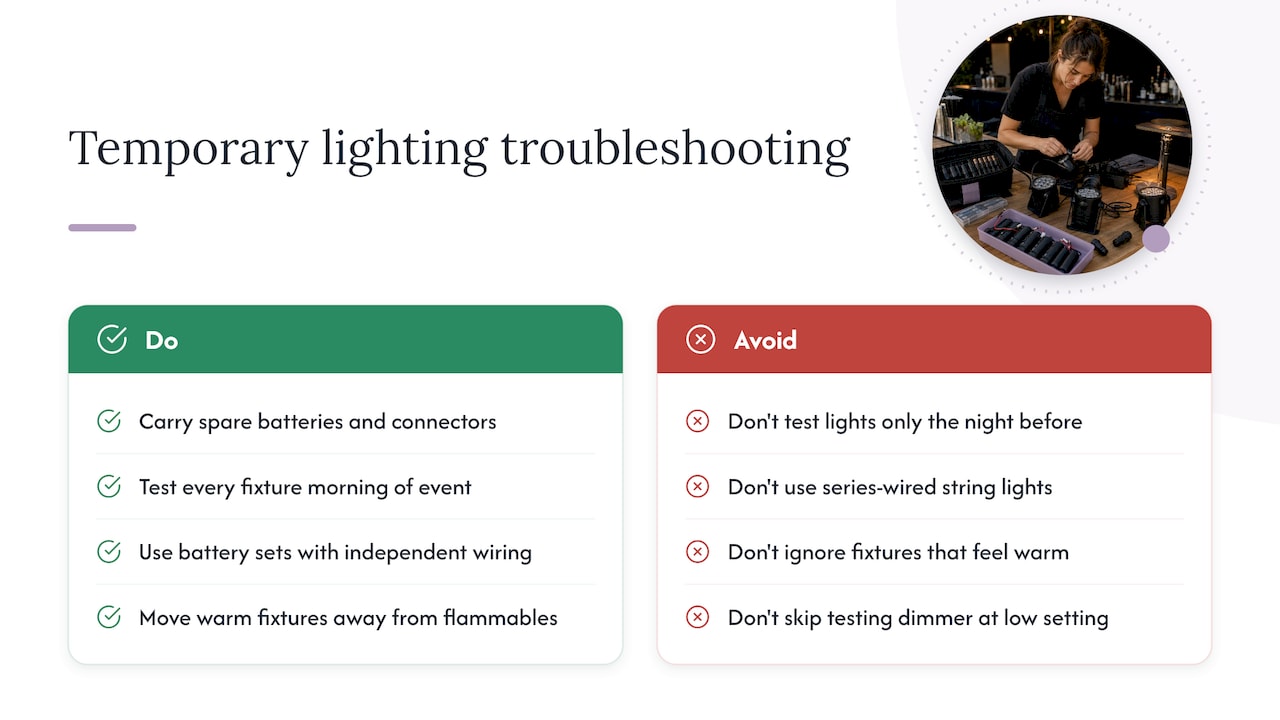
Flickering LED strips usually point to a loose connector or a battery pack running low, so carry spares and test every fixture the morning of the event, not the night before. String lights that go dark in sections often have a single failed bulb breaking the circuit, which is why battery-operated sets with independent bulb wiring are worth the extra cost over cheaper series-wired strings.
Heat buildup is rare with LED fixtures but still worth checking, especially with puck lights mounted close to garnish trays or napkins. If a fixture feels warm to the touch after an hour of use, move it farther from any flammable material and confirm it matches the heat and mounting guidance your fixture manufacturer provides.
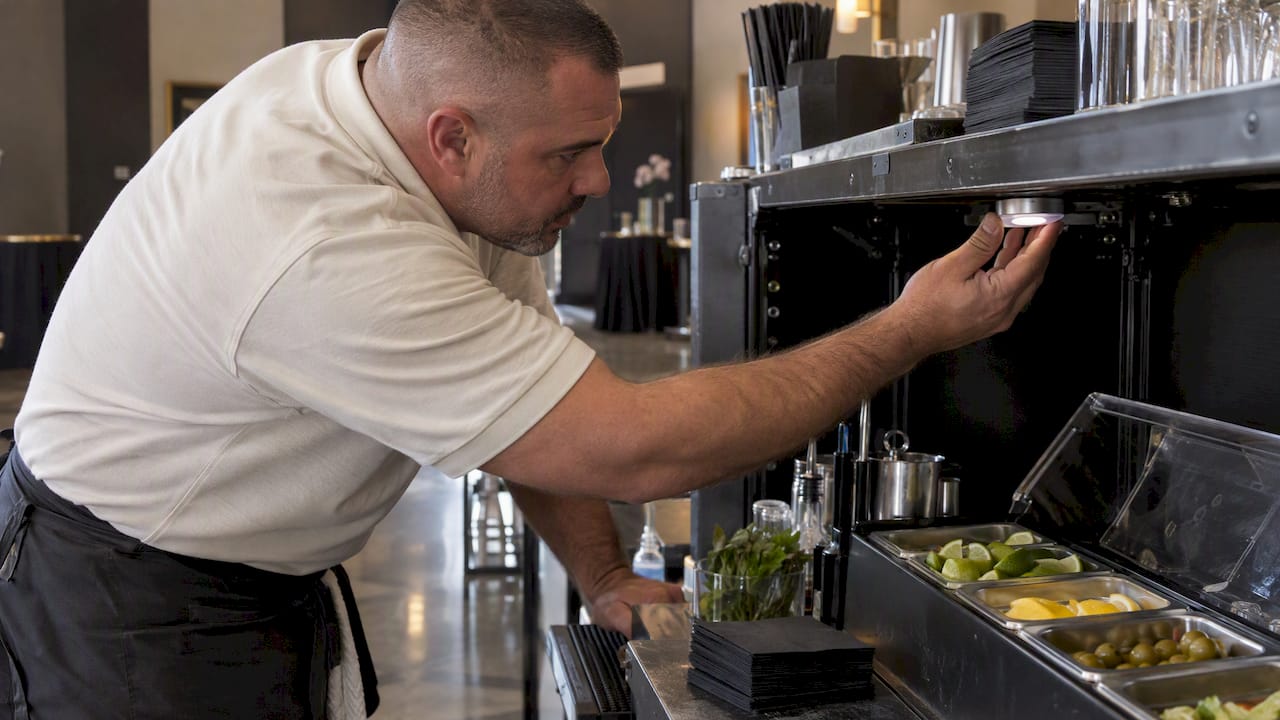
Dimmer compatibility causes more support calls than any other issue. Not every LED fixture dims smoothly with every dimmer switch, so test the full lighting rig at the lowest dimmer setting before the event, not just at full brightness. Keep a basic repair kit on hand: spare batteries, electrical tape, a few extra connectors, and a backup battery-powered fixture in case a primary light fails mid-service.
A bartender’s view on lighting that actually holds up
Lighting that looks good in a walkthrough photo sometimes fails once a line forms and bartenders are moving fast. The fixtures that hold up are the ones staff can ignore entirely: no cords to step over, no glare in their eyes, no battery pack that dies halfway through cocktail hour.
A short brief for your vendor should cover power source, mounting method, dimmer compatibility, and a backup plan for any battery fixture.
— Brennon
Turnkey bar lighting and bartending from Liquid Courage
We build bar lighting into the setup, not as an afterthought, because our bartenders are the ones working under it all night. Booking mobile bartending or a bar rental package with us means one contract, one install, and a staff that already knows where the lights sit relative to the pour line.
| Service | What it covers |
|---|---|
| Mobile Bartending | Licensed, insured bartenders for weddings, corporate events, and private parties |
| Bar Rental Packages | Customized bars with branding and setup options for your venue |
| Private Bartender Services | Staffing and bar packages for private events |
| Corporate Events | Bartending built around corporate schedules and venue requirements |
If you are planning a wedding, corporate reception, or private party in Las Vegas or Henderson, reach out through our services page to talk through your bar setup and lighting needs before you lock in a date.
FAQ
What is the best lighting for a temporary event bar?
Under-bar LED strips, battery-powered warm string lights, and low-heat puck or pendant task lighting cover most temporary bar needs. They install quickly, run cool, and dim to match the room’s mood.
Do mobile bars need an electrician for lighting?
Most battery-powered and low-voltage LED fixtures used at mobile bars do not require an electrician. A dedicated circuit may be worth arranging only if you are running higher-draw equipment alongside the lighting.
How far in advance should bar lighting be installed?
Low-voltage fixtures and battery lighting can often be pre-rigged the day before or earlier that same day, with final placement and power checks happening close to service start. Coordinating this timing with your bar vendor avoids last-minute surprises.
Should I rent or buy lighting for a one-time event?
Renting almost always makes more sense for a single event, since fixtures lose relevance quickly as better options come out. Buying only pays off for planners running multiple events a year.
What color temperature works best for cocktail photography?
A warm range around 2700 to 3000K tends to flatter cocktails and skin tones while keeping drink color accurate in photos. Avoiding direct angled reflections on glassware helps prevent glare from ruining the shot.
Useful Liquid Courage guides and a partner lighting reference
For setup and signage details, see our guides on Instagrammable bar setups and bar signage ideas. For fixture specs, this lighting spec guide covers mounting and heat considerations.