
Open-bar events typically run $15 to $90 per person, while opening a bar from scratch lands anywhere from $50,000 to $500,000 depending on your concept and license type. The right approach isn’t guessing a lump number. It’s splitting costs into one-time startup expenses and recurring operating costs, then running a break-even calculation before you sign a single vendor contract. The sections below walk through per-person examples, full startup ranges, and a worked break-even formula you can plug your own numbers into.
TL;DR:
- Liquor license costs vary widely, from a few hundred dollars in non-quota states to over $400,000 in quota markets, significantly impacting startup budgets.
- Open-bar costs for events range from $15 to $90 per person, with total expenses increasing sharply at higher guest counts, especially for full open bars.
- Starting a bar typically requires $50,000 to $500,000 in initial capital, with licenses and location choice being the largest unpredictable factors.
- Monthly operating costs usually exceed several thousand dollars, driven mainly by payroll and beverage costs, requiring careful margin management.
- Building a detailed budget with break-even analysis helps prevent common mistakes and ensures revenue covers fixed and variable costs before opening.
Table of Contents
- What Drives Bar Costs: Core Categories and Line Items
- Per-Event Open-Bar Costs: Per-Person and Total Examples
- Startup Cost Breakdown: What It Really Takes to Open
- Recurring Operating Budget: Monthly Costs and Margin Targets
- How to Build Your Bar Budget and Find Your Break-Even Point
- Cost-Control Playbook: Protecting Your Margin
- How to Estimate Alcohol Quantities for Events
- How These Numbers Were Compiled and Where to Verify Them
- What Actually Trips Up Bar Budgets
- Skip the Spreadsheet: Let a Bartending Team Handle the Budget
- Sources
- FAQ
What Drives Bar Costs: Core Categories and Line Items
Every bar budget splits into two buckets, and mixing them up is how new owners blow their numbers in month one. Startup costs are one-time: you pay them once to open the doors. Operating costs are recurring: they hit your bank account every single month whether you sell one drink or a thousand.
Startup costs include the liquor license, buildout or renovation, bar equipment, opening inventory, point-of-sale systems, furniture, and legal or permit fees. Operating costs include rent, payroll, cost of goods sold (COGS) on liquor and mixers, utilities, insurance, and marketing.
Here’s where most first-time budgets fall apart:
- Liquor license — the single most volatile line item on any bar budget, swinging from a few hundred dollars to over $400,000 depending on your state
- Buildout — raw shell conversions cost far more than taking over an existing bar-ready space
- Equipment — draft systems, refrigeration, ice machines, glassware, and back-bar tools
- Opening inventory — your first liquor, beer, wine, and mixer order, typically sized for 4 to 6 weeks of sales
- Rent — varies enormously by market, and landlords in entertainment districts often charge premium rates for foot traffic
- Payroll — bartenders, barbacks, security, and management before you’ve sold a single drink
- COGS — the ongoing cost of the alcohol and mixers you pour
- Utilities — power for refrigeration and ice runs higher than most new owners expect
- Insurance — liquor liability coverage is non-negotiable in most states
- Marketing — grand opening promotion, signage, and ongoing local advertising
Pro Tip: Call your state’s Alcohol Beverage Control (ABC) office before you write a single number into your budget. License fees and renewal costs are set at the state and sometimes county level, and a number you find in a national guide can be wildly wrong for your address.
The liquor license and rent are the two line items most likely to wreck a budget built on national averages, because both are hyperlocal. A financial plan built for a bar business needs to treat these two as variables to research directly, not numbers to copy from a blog post.
Per-Event Open-Bar Costs: Per-Person and Total Examples
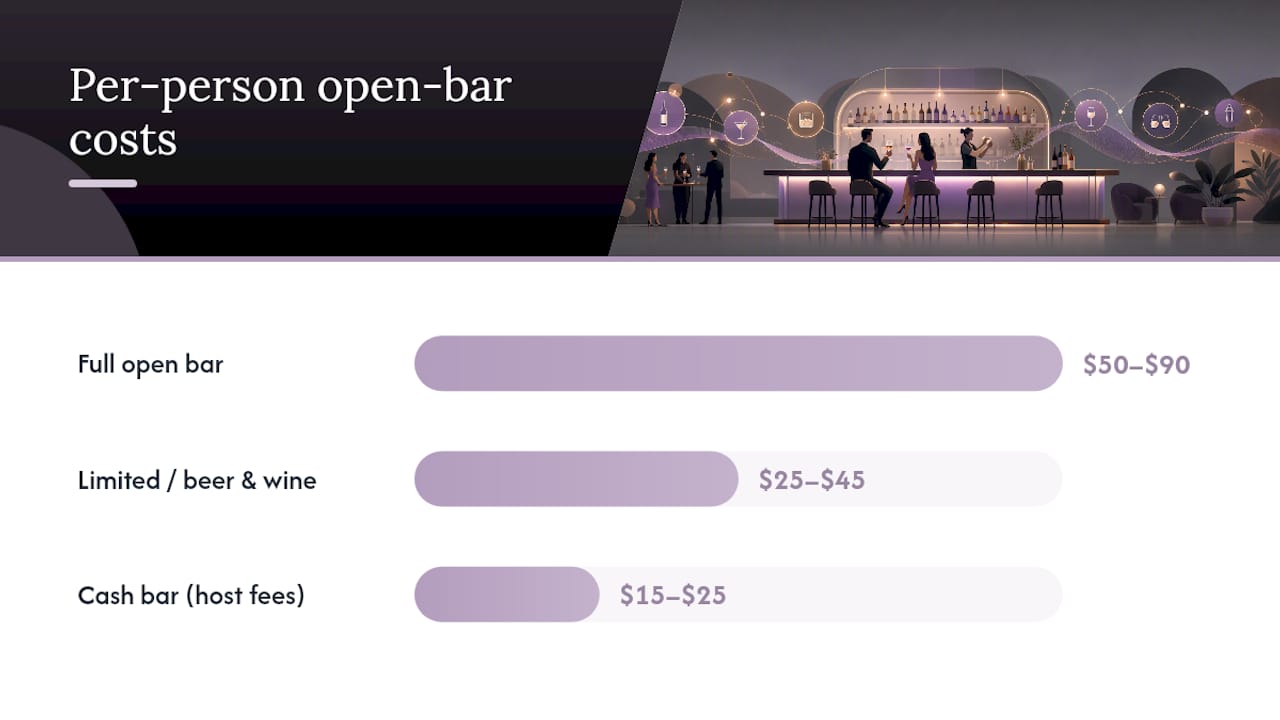
Open-bar pricing for weddings and private events typically runs $15 to $90 per person, with most couples landing in a 4,400 to 6,600 total budget range for the full bar package. That per-person spread is wide because it covers three very different service styles.
- Full open bar — top-shelf liquor, wine, and beer with no guest spending limit, typically $50 to $90 per person for a 4- to 5-hour event Limited or beer-and-wine bar — cuts out hard liquor or restricts to a curated menu, typically $25 to $45 per person
- Cash bar — the host pays a smaller flat fee for staffing and setup while guests buy their own drinks, often $15 to $25 per person in service fees alone
Guest count changes the math fast. A 50-guest full open bar at $60 per person runs roughly $3,000 before staffing and rental fees. Bump that to 100 guests and you’re at $6,000, which lines up closely with the national wedding average. Push to 200 guests and the same package crosses $12,000, though most vendors offer a slight per-person discount at that volume since fixed costs like bartender staffing and bar rental spread across more drinks.
Service style and event length move the number just as much as guest count. A 3-hour cocktail hour costs noticeably less per person than a 6-hour reception, since bartenders pour fewer rounds and you need less standing inventory. Swapping premium call brands for a curated cocktail menu, or limiting the bar to beer and wine, can cut 40 to 50 percent off a full open-bar quote without guests noticing much difference. Deciding between formats early matters more than most planners realize, and it’s worth reading through the trade-offs between open bar and cash bar formats before you lock a headcount with a vendor.
Minimums matter too. Most bartending vendors set a spending floor for smaller events, so a 30-guest party often pays close to the same total as a 50-guest one once minimums and staffing fees are factored in.
Startup Cost Breakdown: What It Really Takes to Open
Opening a bar costs $50,000 to $500,000 in total startup capital, and the license alone can be the difference between the low end and the high end of that range. This is the line item that catches new owners off guard more than any other.
In quota states, where the number of liquor licenses is capped by population, licenses trade on a secondary market and can run $50,000 to $400,000 or more. California’s Type 47 license, for example, has sold in the $300,000 to $400,000 range in tight markets. In non-quota states, the same license might cost under $3,000 in direct government fees. Texas often falls in the $600 to $4,000 band, while Wyoming licenses have been reported around $1,800.
Here’s a realistic breakdown of where startup capital typically goes:
- Liquor license: $1,800 to $400,000+ depending on state and quota status
- Buildout/renovation: tens of thousands for a raw space, far less for a bar-ready takeover
- Bar equipment: draft systems, ice machines, refrigeration, glassware
- Point-of-sale system: hardware plus monthly software fees
- Furniture and fixtures: seating, bar top, lighting, decor
- Opening inventory: first liquor and mixer order
- Legal and permit fees: attorney costs for entity formation, lease review, and license application
Pro Tip: If you’re in a quota state, start the license search 3 to 6 months before your target opening date. Secondary-market purchases take time to close, and legal review adds weeks you can’t skip.
The fastest way to cut your startup number isn’t skimping on equipment. It’s finding a location that already operated as a bar. Taking over a second-generation bar space instead of converting a raw commercial shell can save $30,000 to $80,000 on buildout alone, since the plumbing, ventilation, and electrical work for a commercial bar are already in place.
Recurring Operating Budget: Monthly Costs and Margin Targets
A working bar’s monthly operating budget commonly runs into the tens of thousands of dollars once payroll and beverage COGS are added up, and those two categories are almost always your biggest levers for improving margin.
| Category | Typical Monthly Range | Notes |
|---|---|---|
| Rent | Varies by market | Entertainment districts run highest |
| Payroll | Largest recurring cost | Scales with covers and hours |
| Beverage COGS | 18–25% of bar sales | Target range for pricing |
| Utilities | Higher than expected | Refrigeration and ice draw power |
| Insurance | Fixed monthly premium | Liquor liability is mandatory in most states |
| Marketing | Discretionary | Scales up during slow seasons |
| Software/POS | Fixed monthly fee | Includes payment processing |
Pour cost, also called beverage COGS, is the percentage of a drink’s sale price that goes toward the raw liquor and mixers. Bar managers generally target 18 to 25 percent depending on concept, with cocktail-forward bars trending toward the lower end and beer-heavy concepts sometimes running higher. If a cocktail costs you $2.20 in ingredients and you price it at $11, your pour cost sits at 20 percent, which is a healthy target for most full-bar concepts.
Staffing ratios follow guest volume, not just hours open. A common rule of thumb is one bartender per 50 to 75 covers during peak service, with a barback added once you cross roughly 100 covers in a shift. Getting this ratio wrong in either direction hurts you: understaffing slows service and kills upsells, while overstaffing quietly eats your margin every single week.
Two things to watch:
- Beverage COGS and payroll together typically account for the majority of monthly operating spend
- A 2 to 3 month cash reserve is standard practice for absorbing slow months without panic-cutting staff or inventory
How to Build Your Bar Budget and Find Your Break-Even Point
Building a usable bar budget takes five steps, and the last one is the number that actually tells you whether the business works.
- List every startup cost — license, buildout, equipment, inventory, legal fees, add a 10 to 15 percent contingency
- List every monthly fixed cost — rent, base payroll, insurance, software, loan payments
- Estimate your variable cost percentage — pour cost plus payment processing fees, typically 20 to 30 percent of each sales dollar
- Calculate contribution margin — subtract your variable cost percentage from 100 percent
- Divide fixed costs by contribution margin — this gives you break-even monthly sales
A financial plan built on contribution margin rather than gross margin gets you a realistic number, because it accounts for the fact that every dollar of sales also carries a variable cost that eats into it.
Here’s a worked example using numbers pulled from the ranges above:
| Line Item | Amount |
|---|---|
| Monthly fixed costs (rent, payroll, insurance, software) | $24,000 |
| Variable cost percentage (typically 20 to 30 percent) | 25% |
| Contribution margin (100% − 25%) | 75% |
| Break-even monthly sales ($24,000 ÷ 0.75) | $24,000 |
That bar needs $24,000 in monthly sales just to hit zero. If the average check is $30, that’s 800 checks a month, or roughly 27 a day. Suddenly the abstract budget turns into a concrete daily target you can measure your actual sales against every single week.
Pro Tip: Rerun this calculation monthly for your first year. Your fixed costs and pour cost percentage both shift as you renegotiate leases, adjust menus, and refine your ordering, and a 2 to 3 month cash buffer gives you room to course-correct without panic.
Cost-Control Playbook: Protecting Your Margin
Supplier relationships are worth more than most owners realize. Distributors often negotiate on price when you commit to consistent volume, and bundling your liquor, beer, and wine orders with a single or small set of vendors usually beats spreading purchases across five different reps chasing the lowest sticker price on each category.
Menu engineering is your second-biggest lever. Signature cocktails built around house-brand spirits let you control your pour cost precisely, since you’re not competing on the same call-brand pricing every bar in town uses. A well-designed cocktail menu also steers guests toward higher-margin drinks without them feeling upsold.
Operational tactics round out the playbook:
- Cap open-bar service hours at 4 to 5 hours for events, since extending service rarely adds proportional revenue but does add staffing and pour cost
- Set clear spending minimums and deposit requirements in every event contract to protect against last-minute cancellations
- Cross-train bartenders as barbacks during slow shifts to avoid paying for idle labor
Pro Tip: Review your top 10 best-selling drinks every quarter and price each one against its actual pour cost, not a guess. Menu items drift out of your target range faster than most owners check.
How to Estimate Alcohol Quantities for Events
A reliable rule of thumb: budget one drink per guest per hour for the first two hours, then drop to about 0.75 drinks per guest per hour after that as pacing slows.
- Multiply guest count by expected drinking hours, then by your per-hour drink assumption to get total drinks needed
- Convert total drinks to bottles using standard pours (a 750ml bottle yields about 16 cocktail pours or 25 wine pours, and a case of beer covers 24 servings)
- Add a 10 to 15 percent buffer for overpour, spillage, and guests who drink more than the average
- Adjust upward for signature cocktails, since batch recipes and garnishes tend to slow pour speed and increase usage per drink
A 100-guest, 4-hour event using this math needs roughly 350 drinks total before the buffer, which translates to a mixed order of liquor, wine, and beer rather than a single category. Skipping the buffer is the single most common ordering mistake, since running out mid-event forces expensive emergency runs at retail prices instead of your negotiated case rate.
How These Numbers Were Compiled and Where to Verify Them
The ranges in this guide come from national bar startup cost guides, liquor license cost compendiums, and wedding open-bar spending studies, each pulling from real vendor quotes and licensing data rather than single anecdotal examples.
Some figures are national averages that hold reasonably steady across markets, like typical pour-cost targets and per-person open-bar ranges. Others, especially liquor license fees and commercial rent, are entirely state and county dependent and can swing by a factor of 100 between a non-quota state and a tight quota market.
Before finalizing any budget:
- Check your state’s ABC or liquor authority website directly for current license fees and quota status
- Request written quotes from at least two local vendors for anything over $5,000
- Rerun your break-even math whenever a major cost assumption changes
What Actually Trips Up Bar Budgets
The biggest mistake I see is treating the liquor license like a fixed line item instead of the wildcard it actually is. Planners budget a national average and get blindsided by a quota-state price tag. The second mistake is skipping the break-even math entirely and just hoping revenue outpaces costs. The third is forgetting cash buffers, then panic-cutting staff the first slow month.
Three things to do now: separate startup from operating costs before you price anything, calculate your break-even sales target before signing a lease, and build in a real contingency line. Event bartending operations that handle high-volume weddings and corporate events, including groups like Liquidcouragelv, see these same cost patterns repeat across nearly every booking.
— Brennon
Skip the Spreadsheet: Let a Bartending Team Handle the Budget
Mobile bartending companies offer an alternative to building every line item yourself for events: instead of pricing out staffing, liquor procurement, and rental gear separately, you get a single package that folds those costs into one quote. That’s the practical benefit of outsourcing versus the DIY route covered above. Rather than tracking pour cost, negotiating with three separate liquor distributors, and sourcing your own bar equipment, a mobile bartending package bundles licensed and insured staff, stock procurement, and bar rentals into fewer decisions and fewer invoices.
This matters most for one-time events like weddings and corporate parties, where you don’t have the volume to negotiate distributor pricing the way an ongoing bar operation does. Liquidcouragelv brings over 20 years of experience navigating Las Vegas municipal code and venue coordination, so the compliance research this guide covers for full bar startups gets handled for you on a per-event basis instead. If your event calls for a specific look or a curated menu, the customized bar rental packages page breaks down branding and setup options, and the private bartender services page covers staffing structures for weddings and corporate bookings alike. Check dates and get a quote directly through the main services page before you lock in a venue.
Sources
Verify state-specific liquor license costs directly through your state’s liquor licensing guide rather than relying on national averages alone, since quota-state pricing can be dramatically higher than the figures in general startup guides. Cross-check overall startup ranges against a dedicated bar startup cost breakdown for line-item detail on equipment and buildout. For event pricing specifically, the wedding open-bar cost study offers the clearest per-person benchmarks available. Run your own break-even numbers using the bar business plan framework before finalizing any budget.
- How Much Does It Cost to Start a Bar? ($50K-$500K, 2026) | Startup Costs
- How Much to Open a Bar: $110K–$850K Breakdown (2026)
- How Much Does an Open Bar at a Wedding Cost? Price Breakdown and Budget Guide
- Starting your business: bar business plan (Square)
FAQ
What Is the 50% Rule in Bartending?
The 50% rule generally refers to targeting a beverage cost percentage around 50% of a drink’s sale price in some bar concepts, though most modern bar managers aim tighter, closer to the 18 to 25 percent pour-cost range for better margins.
Can You Make $1,000 a Night Bartending?
High-volume events with strong tip structures can push a bartender’s nightly earnings into that territory, but it depends heavily on event size, service style, and gratuity policy rather than being typical for an average shift.
How Much Does Alcohol for 100 Guests Cost?
For a full open bar at a 4-hour event, 100 guests typically runs close to the national average of $5,541 total, or roughly $55 per person, though limited bar or beer-and-wine options can bring that down significantly.
How Much Does It Cost to Hire a Mobile Bartending Service?
Pricing depends on guest count, event length, and package selection; current rates for services like Liquidcouragelv’s bartending and liquor catering packages are listed directly on the site rather than as a single flat number.