
Three tax layers touch every catered bar in Nevada: liquor excise tax (paid by the licensed importer or manufacturer, not the caterer), sales tax on the bundled catering price, and occasional use tax on unpaid purchases. On top of that, no event can legally pour a drink without a local liquor-caterer permit from Clark County, Las Vegas, or Henderson, each with its own deadline and fee. Miss any one of these and you’re looking at penalties, a denied permit, or an audit letter.
TL;DR:
- The salesperson must itemize alcohol, mixers, paper goods, and service fees separately on invoices to ensure compliance and accurate tax reporting.
- Clark County charges $10 per service station per day for permits, with fees doubling if filed less than 10 days before the event, making timely filings crucial.
- Nevada’s sales tax applies to the full bundled catering price, including alcohol, garnishes, and disposables, not just the food component.
- Liquor excise tax is paid by the licensed importer or manufacturer, not the caterer, and due dates are the 20th of the month following importation, with penalties for late payment.
- Permit applications for local counties or cities must be filed well in advance, typically at least 10 days before an event, to avoid fines or event shutdowns.
Table of Contents
- At-a-Glance: The Three Taxes and Permits You Must Check Before an Event
- Who Pays What: Excise Tax vs. Sales Tax vs. Use Tax
- Nevada Rates, Deadlines, Discounts, and Penalties for Liquor Excise
- How Sales Tax Applies to Catering Packages and What to Itemize on Invoices
- Local Permitting and Fees: Clark County, Las Vegas, and Henderson
- How to Register, File, and Pay: A Step-by-Step Checklist
- Common Taxpayer Errors, Audit Triggers, and a Compliance Checklist
- Liquid Courage’s Las Vegas and Henderson Event Checklist
- Why the Standard Advice on This Topic Falls Short
- Book Compliant Bar Service Without the Permit Guesswork
- Sources
- FAQ
At-a-Glance: The Three Taxes and Permits You Must Check Before an Event
Before you sign a contract or quote a client, run through this short list. Each item has a different owner, deadline, and paper trail, and skipping one usually surfaces at the worst possible time, like the morning of a wedding.
- Liquor excise tax is baked into what you pay your distributor. You don’t remit it directly, but it shapes your wholesale cost and, in turn, your menu pricing.
- Sales tax applies to the total catering sales price, which in Nevada includes alcohol, mixers, garnishes, and paper goods, not just the food line.
- Use tax kicks in if you bought alcohol or disposables from an out-of-state or informal source where sales tax wasn’t collected at purchase.
- Municipal permits from Clark County, the City of Las Vegas, or Henderson are required per event, often per service station, with fees that double if you file late.
Treat these as four separate checkboxes, not one bundled “alcohol tax” line. Confusing them is the single most common mistake we see among first-time event caterers.
Who Pays What: Excise Tax vs. Sales Tax vs. Use Tax
Nevada’s liquor tax FAQ is direct about this: the excise tax is assessed to the Nevada-licensed importer or manufacturer that first brings alcohol into the state, not the bartender pouring it or the planner booking the event. As a caterer, you feel it indirectly through your case price, but you’re not the one filing that return.
Sales tax is different. When alcohol is part of a prepared catering sale, the state’s guidance on sales price treats it the same as food: taxable, and due on the full bundled price. If you bought inventory somewhere sales tax wasn’t charged, say from a private buying club or an out-of-state source, use tax fills that gap at the same rate.
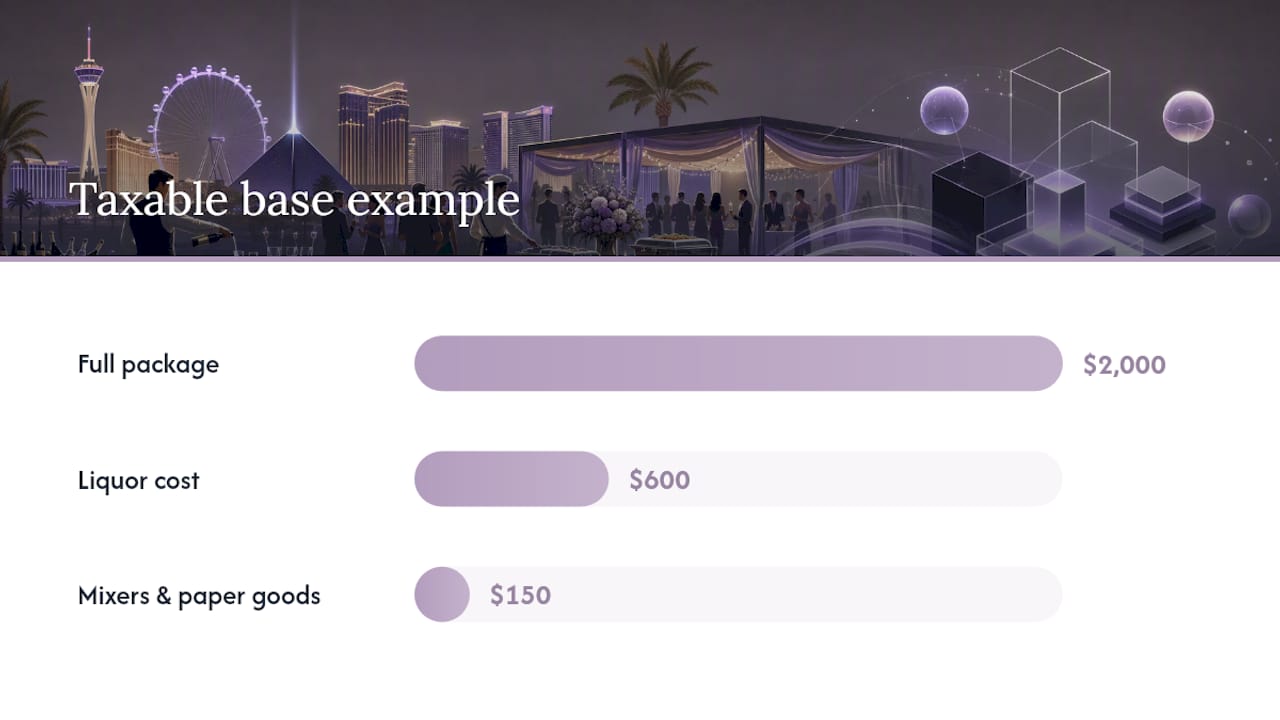
Pro Tip: Run a quick math check before you send a quote. If a $2,000 bar package includes $600 in liquor cost and $150 in mixers and paper goods, Nevada’s combined sales tax rate applies to the full $2,000, not just the service fee.
- Excise tax: distributor’s problem, shows up in your cost basis.
- Sales tax: your problem, collected from the client on the full package.
- Use tax: your problem only if sales tax was skipped upstream.
Nevada Rates, Deadlines, Discounts, and Penalties for Liquor Excise
You won’t file the LIQ-1 yourself unless you’re also a licensed importer, but knowing the rate structure helps you understand why liquor pricing shifts by category, and it matters if your business ever expands into distribution.
The state’s liquor tax page sets the due date on the 20th of the month following importation, with a 0.25% discount for anyone who pays by the 15th. Miss the deadline and you’re looking at a penalty capped at 10% plus 0.75% monthly interest. The LIQ-1 return asks filers to report taxable gallons by category, apply credits, and reconcile gross versus adjusted tax. One practical wrinkle: many supplier invoices list volume in liters, so converting to wine gallons correctly before filing avoids disputes down the line.
How Sales Tax Applies to Catering Packages and What to Itemize on Invoices
Nevada defines “sales price” broadly. Per the state’s restaurant and bar guidance, that includes food ingredients, alcoholic and nonalcoholic beverages, and paper products like napkins, cups, and to-go containers. There’s no carve-out for the garnish tray or the cocktail napkins just because they feel incidental.
What you can sometimes separate is the distinction between mandatory service charges (taxable, treated as part of the sale) and truly voluntary gratuities (generally not). That line matters for your bottom line and for how your invoice reads to an auditor.
A clean invoice structure looks like this:
- Alcohol and mixer cost, itemized by category.
- Paper goods and disposables, listed separately even if the amount is small.
- Service fee or staffing charge, marked as mandatory or optional.
- Sales tax line, calculated on the full taxable total.
Vague, bundled quotes are convenient for sales conversations but painful during a review. Clear itemization, as the state’s own guidance on documentation implies, gives you a paper trail that matches what you actually charged and collected.
Local Permitting and Fees: Clark County, Las Vegas, and Henderson
State tax compliance is only half the job. Nevada decentralizes alcohol licensing to counties and cities, so a state license doesn’t clear you to pour at a specific event. You still need a local permit tied to that date and venue.
- Clark County charges $10 per service station per day for a liquor caterer permit, and doubles that fee if you apply less than 10 calendar days before the event.
- City of Las Vegas requires its own alcoholic beverage caterer license with separate application and semi-annual renewal fees; check current amounts before quoting a client.
- Henderson and unincorporated areas often layer a special-event permit on top of standard licensing, so confirm with the local clerk rather than assuming county rules cover you.
- Required documentation typically includes your state liquor caterer license number, the event sponsor’s name, a count of service stations, and proof of a trained on-site supervisor.
Pro Tip: File Clark County paperwork at least two weeks out. The math is simple: a five-station wedding bar costs $50 in permit fees on time, or $100 if you’re late. That’s real margin lost for no reason. Planners scaling up bar setups should also look at company party beverage station ideas to plan station counts before filing.
How to Register, File, and Pay: A Step-by-Step Checklist
If your business is the licensed importer or manufacturer responsible for excise tax, here’s the practical sequence for staying current with the state.
- Create an account on Mynvtax and link the liquor tax type to your business profile.
- Pull taxable gallon totals by category (malt, wine, fortified wine, spirits) from supplier invoices each reporting period.
- Complete the LIQ-1, applying any credits and confirming the discount if paying before the 15th.
- Submit payment through mynvtax or by mail, watching postmark rules closely since late submissions trigger penalty and interest.
- Retain supplier invoices, gallon conversion worksheets, and filed returns for at least three years in case of audit.
Auditors expect to see supporting documentation, not just the filed number. A missing supplier invoice is a red flag even when the tax was calculated correctly.
Common Taxpayer Errors, Audit Triggers, and a Compliance Checklist
Most problems trace back to the same handful of mistakes. Bundled charges get misclassified as nontaxable service fees when they should be part of the taxable sale. Sales tax gets skipped on the alcohol portion of a prepared package because someone assumed it was covered elsewhere. Permit applications get filed after the deadline, or not at all. Invoices arrive with a single lump total and no breakdown.
On the audit side, examiners look for supplier invoices that don’t match reported gallons, incorrect liter-to-gallon conversions, and complimentary drinks that were never valued or documented. As one state guidance document notes, clean itemization and clear mandatory-versus-voluntary labeling meaningfully cut audit exposure.
A quick five-point check before any event:
- Permit application filed at least 10 days out.
- Invoice itemizes alcohol, mixers, paper goods, and service fees separately.
- Sales tax calculated on the full bundled price, not just the food line.
- Supplier invoices on file showing tax paid or use tax accrued.
- Supervisor credentials and permit copies printed and on-site.
Liquid Courage’s Las Vegas and Henderson Event Checklist
Every event Liquid Courage staffs starts with the same verification pass: current liquor license, proof of insurance, and Alcohol Awareness training for the lead bartender. That review happens well before event week, not the morning of.
On-site, the checks are just as concrete:
- Confirm supervisor identification matches the permit paperwork.
- Match service station counts to what was filed with the county.
- Keep a physical or digital copy of the permit at the bar.
- Fold permit fees and expected tax treatment into the client quote up front, so there’s no surprise line item later.
For staffing standards behind these checks, see how we approach bartending hiring and training.
Why the Standard Advice on This Topic Falls Short
Most guides treat Nevada alcohol tax as a single number you look up and move on from. That’s backwards. The excise rate on the state’s schedule barely touches your business directly. What actually determines whether your event runs smoothly is the permit timeline and the sales tax treatment of your invoice, and those get almost no attention in generic tax explainers.
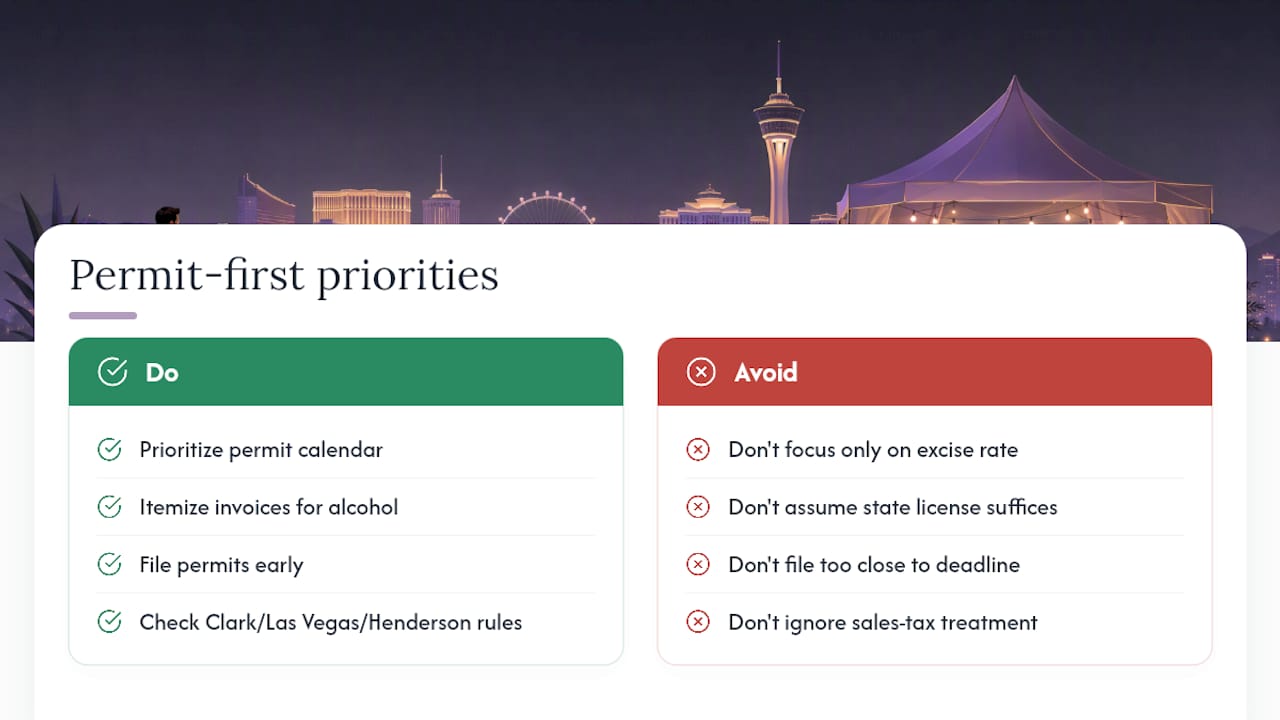
The bigger blind spot is decentralization. Planners assume a state liquor license is the finish line, when it’s really the starting point. Clark County, Las Vegas, and Henderson each run their own permit process, and that $10 per station number sounds trivial until you’re staring at a doubled fee because someone filed nine days out instead of eleven. I’d argue the permit deadline deserves more attention in any compliance conversation than the excise rate ever does, simply because it’s the one failure mode that can shut down an event outright.
If you take one thing from this, prioritize the permit calendar and invoice itemization before you worry about anything else. Get those two right, and the tax math mostly takes care of itself.
— Brennon
Book Compliant Bar Service Without the Permit Guesswork
Some companies in the mobile bartending and liquor catering industry handle the permit timeline and invoice itemization, which is the part of alcohol catering tax in Nevada that often causes issues. Quotes from these service providers may account for Clark County or city permit fees and clean, tax-ready invoice lines.
Our packages cover mobile bartending and liquor catering, customized bar rentals, and private bartender staffing for weddings, corporate events, and private parties. Every bartender we send carries current Alcohol Awareness training, and we handle the service-station math so your permit application matches what actually shows up on-site. If you’re planning a wedding or corporate event in the Las Vegas or Henderson area, check available dates and request a quote through our main booking page today.
FAQ
What Is the Alcohol Tax in Nevada?
Nevada charges a liquor excise tax that ranges from $0.16 per gallon for malt beverages up to $3.60 per gallon for spirits, paid by the licensed importer or manufacturer, plus standard sales tax on catered drinks sold to consumers.
Which State Has the Highest Alcohol Tax?
Rates vary widely by state and by alcohol category, and no single state holds the top rate across every category. Nevada’s spirits rate of $3.60 per gallon sits well below some states’ rates, but comparing exact national rankings requires checking each state’s current schedule directly.
Is It Cheaper to Buy Liquor in California or Nevada?
Nevada’s excise tax rates are generally lower than California’s, which is one reason bottle prices at Nevada retailers often run cheaper, but local sales tax and retailer pricing still affect the final shelf price in both states.
Why Is There a Liquor Tax on My Restaurant Bill?
That line reflects sales tax applied to the drink as part of a prepared sale, since Nevada’s sales price guidance treats alcoholic beverages the same as food and other menu items for tax purposes.
Does Liquid Courage Handle Permit Filing for Clients?
Liquid Courage helps clients understand Clark County and city permit requirements and builds those fees into event quotes, though final permit applications are typically filed by the licensed event sponsor; ask directly through our booking page for current details.