

Bartender overtime is the fee an event client pays when the bar stays open, or the bartender stays on site, past the time written in the contract. It is usually billed at a premium over the regular hourly rate, often around 1.5 times, in 30- or 60-minute blocks. It is a contract price. It is not the same thing as the overtime a bartender earns as an employee under wage law, and the two get mixed up all the time.
We run mobile bars for weddings, corporate events and private parties in Las Vegas and Henderson, so this is a question we answer on almost every walkthrough call. Below you will find how the charge is built, when the clock really starts, what the law does and does not say, and how to keep the final invoice equal to the quote.
TL;DR
- Event overtime is a contract fee for time beyond your booked hours. Employee overtime is a wage rule between a bartender and the company that employs them. Wage law does not set your fee.
- Rates commonly run about 1.25 to 1.5 times the regular hourly rate, billed in 30- or 60-minute increments.
- The clock often starts at setup and ends after breakdown, so a 4-hour reception can bill as 6 or more hours if the contract is vague.
- Ask for a written hard stop time, the overtime rate, the billing increment and a written approval step before any extension.
- Late timelines, not slow bartenders, cause most overtime. Build the schedule with buffer and the fee rarely appears.
Table of Contents
- What a bartender overtime charge actually is
- Event overtime versus employee overtime pay
- How overtime rates are calculated
- When the overtime clock starts
- What a good contract says about overtime
- How to avoid surprise overtime
- Overtime at weddings, corporate events and private parties
- Our perspective on overtime
- Get a quote with the overtime terms written in
- FAQ
- Sources
What a bartender overtime charge actually is
When you hire a bartending company, you buy a block of service: a start time, an end time, a number of bartenders and a bar setup. Overtime is the price of extending that block. One industry pricing guide describes it as a contract price for extending the bartender’s agreed service beyond the scheduled end time, and notes that starting around 1.5 times the regular rate is customary.
The premium is not arbitrary. By the time your party runs long, the bartender has often already worked setup, service and a stretch of breakdown. The company may also have staff booked for the next morning, a van that has to be returned, and a venue that charges its own fees for late load-out. Some of that premium covers real cost, and some covers the fact that the extra hours are unplanned and the provider cannot fill them with another job.
It also helps to see what the base price covers. One wedding-cost analysis frames bartender fees as paying for risk mitigation, hospitality infrastructure and guest experience, not only pouring drinks. Licensing, insurance and compliance sit inside the hourly rate, and they keep running when the party does.
Event overtime versus employee overtime pay
Search results for this phrase are full of wage-and-hour pages: tipped minimum wage, time-and-a-half, wage theft. That is a different subject. If you are a guest of the contract rather than the employer, the rules below do not set what you owe.
What wage law covers
The U.S. Department of Labor explains that covered, nonexempt employees generally must receive at least 1.5 times their regular rate for hours over 40 in a seven-day workweek. Federal law does not make a weekend or holiday shift overtime by itself.
Nevada adds its own layer. Under NRS chapter 608, employers must pay 1.5 times the regular wage for work over 40 hours in a scheduled week, with listed exceptions. For some lower-paid employees the statute also reaches work over eight hours in a workday. The state’s labor office states that as of July 1, 2026, employees earning less than $18.00 per hour qualify for daily overtime at 1.5 times their regular rate after 8 hours in a 24-hour period, as well as after 40 hours in a week.
Why that does not set your fee
Those rules decide what a bartending company owes its own employees. They say nothing about what a client is charged for an extension. A company may pay a bartender 1.5 times their wage and bill you 1.5 times its event rate, or bill a flat premium, or absorb the extra time. Your price is whatever your signed agreement says.
Wage law does matter in one practical way. The Department of Labor treats unpaid cleanup and paperwork beyond the normal schedule as a common violation, and it notes that on-site standby time is generally paid. A responsible company therefore counts breakdown and waiting time as paid hours, and that cost shows up in how it writes service hours. If a quote ignores setup and breakdown entirely, ask how those hours are covered.
How overtime rates are calculated
There is no official rate card for event bartending, and we have no single published number to hand you. What the industry reports is a pattern.
| Method | How it works | Typical reported range |
|---|---|---|
| Multiplier | Regular hourly rate times a premium | 1.25 to 1.5 times the hourly rate when the event runs past the booked time |
| Fixed premium | A set dollar amount per extra hour | Set in the contract, often stated per bartender |
| Tiered hourly | A higher rate once a defined hour is passed | $45 to $75 per hour after the 6th hour of a shift, in one 2024 wedding-cost report |
The same wedding report says standard contracts often quote 4 to 5 hours of service, with overtime kicking in after that. Treat the dollar range as a national reference, not a Las Vegas quote. Strip pricing, venue rules and staffing demand vary a lot by weekend and by season.
An event contract guide notes that overtime can be set at 1.5 times the hourly rate or a fixed premium, and that either way the agreement should name the rate and the billing increments.
Billing increments matter as much as the rate
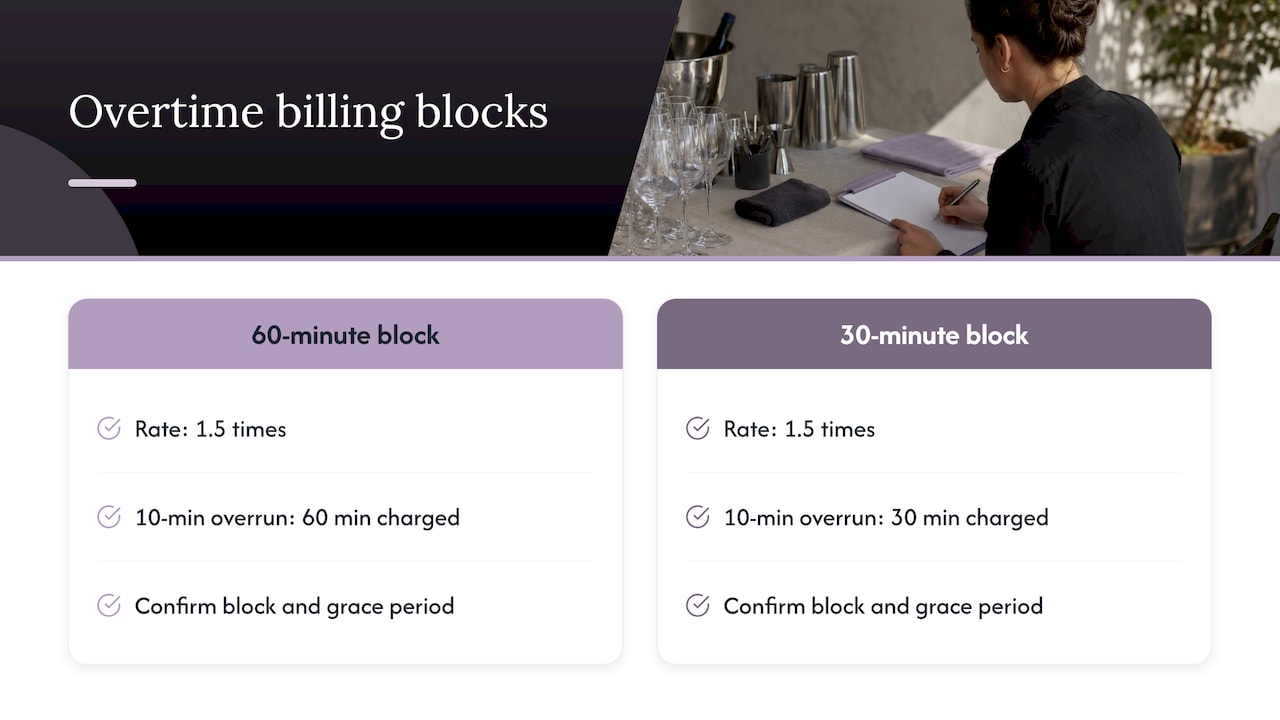
A 1.5 times rate sounds fixed, but the increment changes what you pay. If a provider bills in 60-minute blocks, going 10 minutes over costs a full hour. If it bills in 30-minute blocks, the same slip costs half that. The pricing guide cited above says providers commonly bill in 30- or 60-minute blocks, so ask which one applies and whether a short grace period exists.
A worked example
These numbers are made up to show the math, not a price from any company. Say a contract lists two bartenders at $50 per hour each, with overtime at 1.5 times the rate and billed in 30-minute blocks. Your reception runs 40 minutes past the stop time.
- The 40 minutes rounds up to two 30-minute blocks, so 1 hour of billable overtime.
- The overtime rate is $50 × 1.5 = $75 per bartender per hour.
- Two bartenders: $75 × 2 = $150.
With 60-minute blocks the result is the same here, but a 15-minute overrun would cost $75 under 30-minute billing and $150 under 60-minute billing. If the contract also says last call and breakdown fall inside the booked hours, the 40-minute overrun may not be overtime at all. Read the definition of service hours before you read the rate.
When the overtime clock starts
Most disputes are not about the rate. They are about what counts as the booked time. Ask about these four moments.
Setup
A mobile bar needs to be built: ice, garnishes, glassware, bar top, signage, sometimes a branded front. Many contracts define service hours to begin at the scheduled arrival or setup time, whichever is earlier, per one contract guide for event bartending. If the venue gives you access late and the team arrives earlier than planned, or has to wait, that waiting can be billable.
Service
This is the window guests see: first pour to last call. Reception timelines drift. Photos run long, the ceremony starts late, a corporate keynote overruns. We cover how bartending fits that sequence in our guide to the reception timeline. If your cocktail hour slides 30 minutes, the bar stays on the clock.
Breakdown
Breakdown is real work: pulling ice, packing glass, cleaning the bar, loading out. The same contract guide describes service hours ending after service and breakdown, or on release by the client or venue, whichever is later, with time past the included setup or breakdown allowance billable as overtime. Find out how much breakdown time your package includes.
Delays you did not cause
Late vendors, a locked venue, a delayed shuttle. Decide in advance who carries that cost. A fair agreement separates overtime you approve from delay that nobody controls, and says what happens in each case.
What a good contract says about overtime
A clear bartending agreement is the best protection against a surprise charge. LegalClarity’s contract guidance says an event contract should identify the venue, setup start, active service hours and breakdown period, and state the overtime rate, the minimum billing increment and whether you must approve an extension first.
Use this checklist when you review a proposal:
- Service hours defined. Start time, last call, end of breakdown, each written with a clock time.
- Overtime rate stated. A multiplier or a dollar amount, per bartender, per hour.
- Increment stated. 30 or 60 minutes, and whether a grace period applies.
- Approval step. One contract guide suggests requiring a written text or an on-site signature from the client before an extension is worked.
- Provider limits. Extensions depend on staff availability, and the provider may decline. A bartender who has already worked a long day can reasonably say no.
- Invoice detail. The actual end time recorded on the final invoice, which one invoicing resource recommends alongside a plain statement that time past the booked end is billed at the overtime rate.
For weddings we also keep a separate wedding liquor catering contract checklist that goes through the full agreement, not only hours.
How to avoid surprise overtime
Overtime is easier to prevent than to negotiate afterward. These habits do most of the work.
- Book the hours you will actually use. Count from the first guest drink to the last, then add setup and breakdown separately. If your venue has a hard curfew, work backward from it.
- Build a buffer into the timeline. Add 30 to 45 minutes between ceremony and reception or between the program and the cocktail reception. Delays are normal, and a buffer absorbs them for free.
- Set a hard stop and tell your guests. A last call announcement 15 minutes before the end gets glasses emptied and the bar closing on time.
- Assign one person to approve extensions. A planner, a coordinator or a single family member. Put the name in the contract so the bartenders are not taking requests from every table.
- Compare the cost of an extra hour with the cost of a shorter bar. Sometimes closing the bar earlier and moving to water, coffee or a late snack is cheaper than overtime.
- Ask about the venue’s rules too. Venues can charge their own fees for late load-out, which is separate from the bartender’s fee.
- Ask for the final invoice with times. Compare the recorded end time with your own notes.
If you are building a per-guest budget for the whole party, not just the bar, this breakdown of per-person party budgets shows how small hourly extras add up across a group.
How staffing size changes the number
Overtime is billed per bartender, so the headcount is a multiplier. A bar staffed for the crowd, a rule of thumb we explain in our piece on one bartender per 30 to 50 guests, costs more per extra hour than a single-bartender setup. If the party is winding down, ask whether one bartender can stay while the others are released. Many providers will do that, and it cuts the overtime bill sharply.
Overtime at weddings, corporate events and private parties
The cause of overtime differs by event type, and so should your plan.
Weddings. Photos, a late ceremony, long toasts and a lively dance floor all push the schedule. Couples also extend because the energy is high at the end of the night. Decide before the day whether you want that option, and what it costs. Our wedding bartending page explains how we plan wedding bar service.
Corporate events. Programs overrun, executives arrive late and an after-session mixer can be extended on the spot. A written approval step helps here because the person who agrees on the floor is rarely the person who signs the invoice. See our corporate events page and the corporate cocktail reception best practices for timeline ideas.
Private parties. Birthday and holiday parties are the most likely to slide, because nobody is watching a clock. A simple agreed end time with an optional extra hour, priced up front, works better than negotiating at midnight.
Our perspective on overtime
We work only in Las Vegas and Henderson, and we have been doing this for over 20 years. In that time we have learned that overtime is almost never a pricing problem. It is a communication problem.
A client who sees a surprise line on an invoice feels cheated, even when the charge is fair. A client who agreed to the rate in writing, approved the extension in the moment and saw the actual end time on the invoice does not. So we would rather explain the terms at the start than defend them at the end.
We are licensed and insured, and we follow Las Vegas municipal code. That is one reason the hours matter to us: a bar that stays open past its planned window is still our responsibility, and we need the staffing and the paperwork to match. It is also why we ask planners about venue rules, last call times and load-out windows during the first conversation, not the week of the event.
Our advice is simple. Pick a stop time you can live with, add a buffer, and ask your bartending company to write the rules for extension in plain words. If a company will not put its overtime terms on paper, treat that as a warning.
— Brennon
Get a quote with the overtime terms written in
We build packages for weddings, corporate events and private parties, including mobile bartending, liquor catering, bar rentals and dry hire staffing. Our pricing is custom, so we do not publish a rate card. Tell us your date, venue, guest count and expected end time, and we will put service hours, setup and breakdown allowances and any extension terms in the proposal before you sign. Start on our mobile bartending and liquor catering page, or see what a bar package includes first.
FAQ
Do bartenders charge overtime at events?
Yes, most event bartending companies charge for time beyond the booked hours. The rate is set by the contract, often a premium such as 1.25 to 1.5 times the regular hourly rate. Ask for the rate and the billing increment before you sign.
Is event overtime the same as overtime under Nevada law?
No. Nevada and federal wage law set what employers owe their employees, such as 1.5 times pay after 40 hours in a week, and daily overtime for some lower-paid workers. Your event fee is a contract price and can be a different number.
Does breakdown time count as overtime?
It depends on how the contract defines service hours. Many agreements include a set amount of setup and breakdown, and bill time beyond that allowance. Check the stated breakdown window and ask what happens if the venue delays load-out.
Can I extend the bar on the night of the event?
Usually yes, if staff are available. Providers may decline an extension, and good contracts require your written or on-site approval first. Decide ahead of time who may approve it and what the extra hour will cost.
How can I avoid overtime charges?
Book hours that match your real timeline, add a buffer, set a hard stop with a last call announcement and name one person who can approve extensions. Then compare the recorded end time on your final invoice with your own notes.
Sources
- What Do Bartenders Charge for Private Events? A Pricing Guide
- How Much Do Bartenders Cost For A Wedding
- Bartender Invoice Template | Invoice Command
- Event Bartending Service Agreement: Service Hours and Compensation
- Bartending Contract Terms, Pricing, and Liability
- U.S. Department of Labor, Fact Sheet #23: Overtime Pay Requirements of the FLSA
- U.S. Department of Labor, Fact Sheet #27: New Businesses Under the FLSA
- Nevada Revised Statutes, Chapter 608
- State of Nevada Daily Overtime 2026 Annual Bulletin
- Stag Do Cost in Ireland: Realistic Per-Person Budgets