
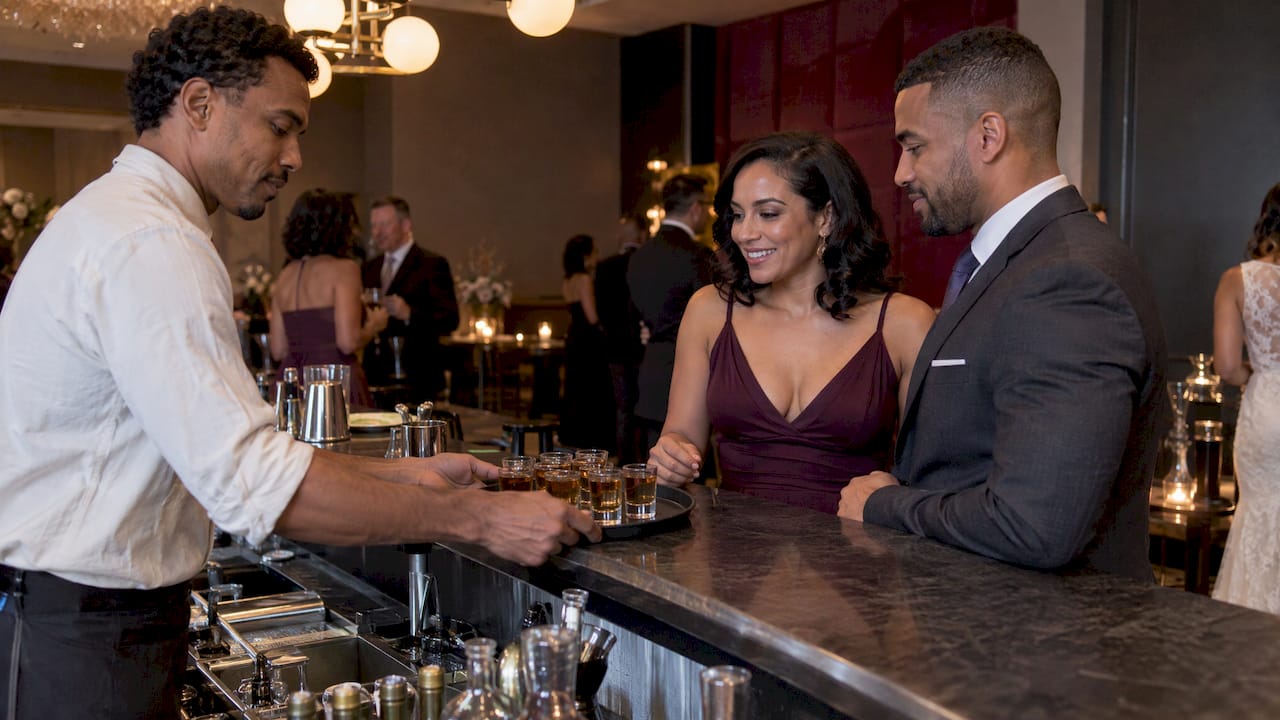
The best way to serve shots at a wedding is as one planned moment, such as a welcome toast, a bridal party cheers or a late-night round, poured by licensed bartenders who measure every pour and keep the count. In Las Vegas and Henderson, that also means working within Clark County and city alcohol rules. Our licensed, insured team handles wedding bar service in both cities, so the toast stays a highlight and never becomes a problem.
TL;DR
- Treat shots as a feature, not the whole bar: one planned round feels special, and more rounds suit smaller or after-party settings.
- Budget with a simple formula: guests × (hours + 1) drinks, with a 750 ml bottle of spirits yielding about 12 two-ounce pours.
- Pour measured shots, pair them with food and water, and stop service before the event ends.
- In Nevada, servers must be 21 or older and carry alcohol awareness cards, and off-site liquor service needs the right permit filed well ahead.
- Put the shot moments on the day-of timeline and share it with your lead bartender and coordinator.
Table of Contents
- Are shots appropriate at a wedding?
- Four shot moments that work
- How many shots and drinks to plan for
- Serving shots safely
- Nevada rules for serving shots in Las Vegas and Henderson
- Build shots into the timeline
- A note from us
- Let us handle the bar
- FAQ
- Sources
Are shots appropriate at a wedding?
Yes, when they are planned. The difference between a memorable toast and a messy night is structure. Wedding drink writers describe the best shots as a shared moment: a welcome toast, a cheers with the bridal party, a late-night surprise or a quick pour before the dance floor fills.
Guest etiquette points the same way. Some venues with open bars do not allow shot orders because of how fast they raise intoxication. Where shots are allowed, the expected pattern is one or two to celebrate, then move on. If your venue has a no-shots policy, confirm it before you print a menu around shots.
You also do not have to build the whole bar around liquor. A wedding can offer beer and wine, signature cocktails or nonalcoholic drinks alongside one planned shot moment. That choice is yours and your budget’s.
Four shot moments that work
- Welcome toast. Guests receive a small pour as they arrive or at the start of cocktail hour. It sets the tone and everyone is served at once.
- Bridal party cheers. A round for the wedding party before introductions or photos.
- Toast pour. A round timed to the speeches so the glasses are full when the best man or maid of honor speaks.
- Late-night round. A short, optional round before the dance floor peaks or as the send-off begins.
For most weddings, a single planned round is enough. Shots should be pre-planned, chilled and quick to pour rather than mixed one at a time during a rush, and always optional and clearly communicated so no guest feels pressured.
If you want the shot to fit your theme, build it into the drink list. Our wedding bar menu templates show how a signature shot sits beside cocktails, beer and wine.
How many shots and drinks to plan for
Start with total drinks, then carve out the shots. America’s Test Kitchen’s formula, developed with bartenders and wedding planners, is guests × (hours + 1). The same source counts a 750 ml bottle of spirits as 12 drinks at 2 fluid ounces each.
Here is a worked example for 100 guests and a 4-hour reception:
| Step | Calculation | Result |
|---|---|---|
| Total drinks | 100 × (4 + 1) | 500 drinks |
| One welcome round of shots | 100 guests × 1 shot | 100 shots |
| Bottles for that round | 100 ÷ 12 pours per bottle | about 9 bottles (8.3, rounded up) |
| One late-night round | 100 × 1 shot | 100 more shots, about 9 bottles |
In practice not every guest takes every round, so many couples plan on a share of guests rather than all of them. Shots also count toward the total, so each shot you pour replaces a cocktail, beer or glass of wine. Other planners suggest a more conservative one to two drinks per guest per hour, and offering at least one batched nonalcoholic drink that guests can spike or not.
One more detail: shot pours are smaller than a cocktail’s total volume, but they are strong. Under National Restaurant Association guidance, a standard drink is 1.5 oz of 80-proof liquor or a 1-oz shot of 100-proof liquor, and bartenders should pour measured shots so they know how many standard drinks each guest has had.
Serving shots safely
Safety is part of the service plan, and it is what a professional team does by default. These practices come from state alcohol regulators and hospitality training bodies:
- Measure every pour. The Washington State Liquor and Cannabis Board recommends one-ounce pour spouts or shot glasses. Training materials also recommend a jigger or mechanical pour spout.
- Serve, don’t self-serve. University event guidelines advise serving all drinks rather than letting guests help themselves, and prohibiting drinking games and chugging.
- Feed and hydrate. Serve food high in protein and healthy fat throughout the event, which slows alcohol absorption. Hospitality guidance also recommends a glass of water with every drink.
- Know the strength of what you’re pouring. A jello shot holds only about half an ounce to three-quarters of an ounce of spirit, so four to six equal two to three standard drinks that go down fast. A single measured pour of a straight spirit is easier to count.
- Count the rounds. Staff can tally drinks and communicate counts between servers, and ease service for guests who order every pass without a confrontation.
- Stop early. Stop alcohol service one to two hours before the event ends, while continuing food and nonalcoholic drinks.
- Plan the ride home. Event safety guidance includes safe-ride programs for impaired attendees.
Bartenders must also decline to serve anyone clearly intoxicated. This is a legal duty in Las Vegas, covered below.
Nevada rules for serving shots in Las Vegas and Henderson
The rules below apply to the people pouring and the permit behind the bar. Confirm details with the issuing office, because ordinances and fees change.
Age. The legal drinking, serving and pouring age in Nevada is 21. Employees 16 and older may handle only beer, wine and coolers in original or corked packaging under direct supervision of a 21+ employee. Serving a minor is a misdemeanor with a $500 to $1,000 fine for a first offense, and $1,000 to $2,000 and/or up to a year in jail for later offenses, per the same source.
Training cards. Under NRS 369.630, hospitality workers in large counties need alcohol awareness training. Clark County’s population exceeds the threshold, and alcohol sellers, bartenders, servers, security and managers all carry an ACT card. The card is required within 30 days of hire and lasts four years, after which full retraining is needed.
Permits for off-site service. Clark County’s Liquor Caterer License authorizes temporary liquor service at off-site locations, and a caterer needs a Liquor Caterer Permit before serving, with applications submitted at least 10 calendar days ahead and approved before the event. The City of Las Vegas’s special event alcohol license must be requested 20 days before the event with an approved Special Event Permit. It restricts service to ages 21 and up, requires servers to hold Work Cards and Alcohol Awareness Cards, and makes it unlawful to serve an intoxicated person.

For a plain-language walk-through, see our Nevada alcohol rules checklist and our guide to off-premise liquor permits. Hosting at a home? Use our private residence permit checklist.
For corporate events, the same age, card and permit rules apply, and hosts can face civil liability if an impaired guest causes harm, according to university event guidance. That is a good reason to keep the shot moment short, measured and staffed by trained bartenders. Speak with an attorney about your own exposure if you host at a private venue or a company site.
Build shots into the timeline
Shots work when they are on the schedule. A wedding planning guide recommends writing down when the bar closes for dinner, when the toast is poured, when it reopens and when last call happens, and sharing those times with the lead bartender and coordinator.
A sample flow for a 5 p.m. ceremony:
- 5:30 p.m. Bar opens for cocktail hour, ice set and glassware ready.
- 6:30 p.m. Bar pauses for dinner service.
- 7:45 p.m. Toast pour: shots or champagne handed to the head table and guests.
- 8:00 p.m. Bar reopens with the dance floor.
- 10:30 p.m. Optional late-night round, with food on the table.
- 11:00 p.m. Last call, then water, coffee and a late snack.
Staffing matters more with shots, because everyone wants a pour at the same moment. One planning guide suggests one bartender per 50 guests, or one per 75 for a simplified menu, with a barback added for weddings over 200. Pre-poured, chilled shots on trays cut the line. Our article on why bar service timing matters goes deeper on the schedule.
A note from us
We pour at weddings and corporate events only in Las Vegas and Henderson, so we know the permits, the venues and the rhythm of a Vegas reception. Shots are a good example of why a bar works better when it is planned: a toast moment is easy to love and easy to get wrong.
Our approach is to treat the shot as part of the bar design. We bring licensed, insured bartenders with more than 20 years of experience, we follow Las Vegas municipal code, and we build the menu and bar branding around your day, whether that is a signature welcome shot or a single late-night round.
The couples and planners who get the most from it settle three things early: the number of rounds, the timing, and who is pouring. Settle those, and the shots become part of the celebration instead of the thing people remember for the wrong reasons.
Brennon
Let us handle the bar
If you are planning a wedding in Las Vegas or Henderson, our wedding bar service covers mobile bartending, liquor catering, custom packages and venue coordination. We are licensed and insured, and we offer flexible menu and bar branding options.
Planning a company event instead? See our corporate event bartending page. To compare what each package includes, read what a bar package covers.
FAQ
Do you have to serve alcohol at a wedding?
No. Many couples serve only beer and wine, a signature drink or a nonalcoholic menu. If you do serve liquor, you can limit it to one planned shot or cocktail moment. The budget, the venue’s rules and your guest list should decide.
How many drinks should I plan for a 100-person wedding?
A common formula is guests × (hours + 1), so a four-hour reception for 100 guests is 500 drinks. A more conservative approach plans one drink per guest per hour, or 400 drinks over four hours. Count each shot as a drink.
When should shots be offered at a wedding?
The most common moments are a welcome toast, the wedding party cheers, the speeches and a late-night round. Keep the first three early enough that food is already out, and keep the last optional.
Do bartenders in Las Vegas need a license or card to serve shots?
Yes. Bartenders and servers must be 21 or older in Nevada, and Clark County bartenders carry an ACT alcohol awareness card. Off-site liquor service also needs the proper Clark County or City of Las Vegas permit.
Sources
- Wedding Welcome Shots, Kamoti
- Is It OK to Order Shots at a Wedding, VinePair
- How Much Alcohol Should I Buy for a Party, America’s Test Kitchen
- How To Prep Cocktails Ahead For Stress-Free Hosting, Tasting Table
- DIY Bar at Your Wedding, TALEA Beer Co.
- Resource Library, National Restaurant Association
- Smart Alcohol Service Techniques, ServSafe
- Hosting Parties, Washington State Liquor and Cannabis Board
- Event Host Responsibilities, UVA Student Affairs
- Event Safety Guidance, Texas Alcoholic Beverage Commission
- Shots & Shooters, CocktailFYI
- Nevada key laws, ServSafe
- Clark County Alcohol Laws, NVABC
- Nevada ACT Card guide, NVABC
- Liquor Caterer License and Permit, Clark County
- Special Event Alcohol License, City of Las Vegas
- Wedding Bar Service Planning, My Wedding Source
- Wedding Bar Guide, Plana