
A bar sanitation checklist for a wedding or corporate event has three parts: setup before guests arrive, constant upkeep during service, and a full breakdown at the end. In Las Vegas and Henderson, the Southern Nevada Health District (SNHD) sets the standard for temporary event bars, so the checklist below is built on its published requirements: a hand-wash station, a sanitizer bucket with test strips, utensils swapped or re-sanitized every four hours, and a pregnancy health-warning sign wherever liquor is served. If you are planning the event, this tells you what a clean, compliant bar looks like and what to ask your bar provider to show you.
TL;DR
- Set up a hand-wash station within 10 feet of the bar, with warm water, liquid soap, paper towels and a wastewater container, before the first drink is poured.
- Keep a sanitizer bucket with wiping cloths and test strips at the bar all night. Bleach should read 50 to 100 ppm and quaternary ammonia 200 ppm, or follow the product label.
- Swap out or wash, rinse and sanitize bar tools at least every four hours, and keep ice, garnish and glassware protected from bare hands.
- Post the Nevada pregnancy health-warning sign where alcohol is served.
- Close the night with a full breakdown: ice wells, drains, tools, surfaces and waste.
Table of Contents
- Who this checklist is for, and which rules apply
- Before the event: the setup checklist
- During service: keeping the bar clean while it is busy
- After the last pour: the breakdown checklist
- Sanitizer concentrations and contact times
- How often, and who signs off
- What we have seen matters most at weddings and corporate events
- Hand the checklist to a team that already works this way
- FAQ
- Sources
Who this checklist is for, and which rules apply
Most couples and event planners never think about health codes until a permit question lands in their inbox. Here is the short version.
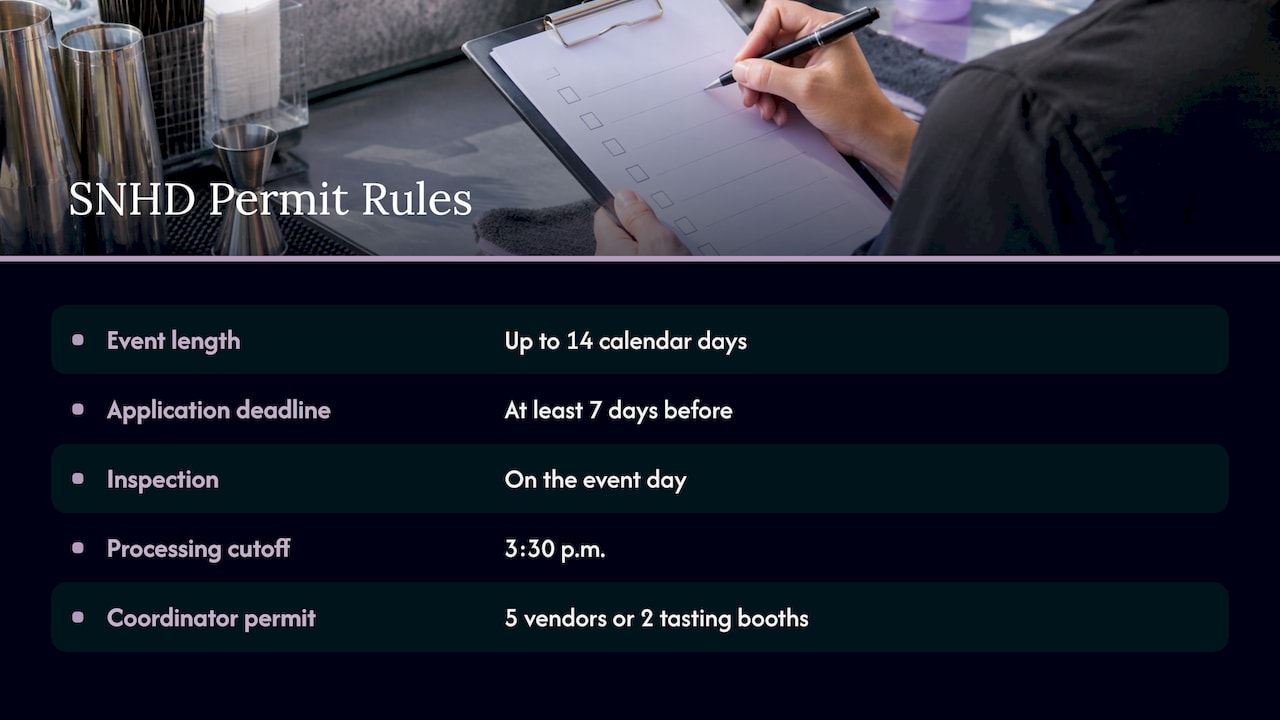
The SNHD treats a special event as a temporary public gathering with at least one temporary food establishment and a defined start and stop date of no more than 14 calendar days. Temporary permit applications are due no later than 7 calendar days before the event, with late fees after that, and every temporary permit is inspected on the day of the event under the SNHD 2023 Food Regulations. Applications are not processed after 3:30 p.m. Whether your specific wedding, corporate party or venue buyout needs its own permit depends on the venue and the setup, so confirm it with your venue and the SNHD early rather than the week of the event.
Nevada law gives the same idea a legal footing. NRS Chapter 580 defines a temporary food establishment as one operating at a fixed location for a temporary period of up to two weeks in connection with a celebration or similar transitory gathering. Permits can be issued for up to 14 days and are not transferable. The same chapter requires any food establishment selling alcohol by the drink for on-premises consumption to post a health warning sign about drinking during pregnancy, in English and Spanish.
Two more points help planners. The SNHD’s 2023 changes moved special events and temporary food establishments into Chapter 14, previously Chapter 15, according to its 2023 change document. That document also requires an event coordinator permit for events with five or more permitted food vendors or two or more tasting booths. If your event is a large corporate expo or a convention with many booths, that coordinator layer is where the sanitation requirements are collected and enforced.
If you want the permit and layout side in more detail, our bar station layout guide covers filing early, and our bar safety checklist covers the wider safety picture for Las Vegas and Henderson events.
Before the event: the setup checklist
Setup is where most sanitation problems are prevented. Walk the bar with this list before guests arrive.
Name a person in charge
The SNHD’s temporary food establishment checklist requires a person in charge who is available the whole time the booth operates. At a wedding bar that is the lead bartender. At a corporate event it should be someone who can answer an inspector’s questions on the spot, not a person who left after load-in.
Build a proper hand-wash station
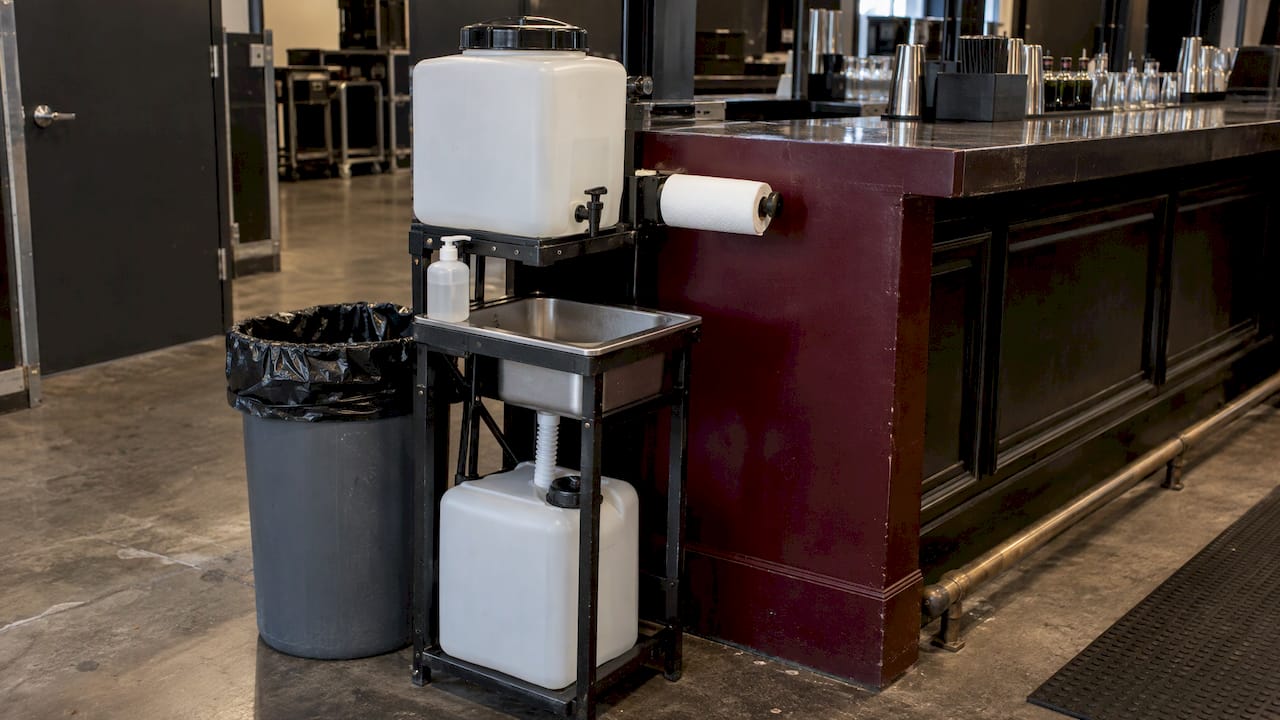
This is the item most often misunderstood. The same SNHD checklist asks for a hand-wash station within 10 feet of the bar. That means a portable sink or gravity-fed hot water at 90 to 110°F with at least a 5-gallon supply, ideally hands-free. It also needs liquid soap, disposable paper towels, a trash can and a container to catch wastewater. The checklist is explicit that gloves and hand sanitizer do not replace hand washing.
The SNHD’s tasting event checklist adds detail: hands-free continuous flow of warm water at 100°F or higher, and a wastewater container 15% larger than the fresh water supply. A sanitizer bottle on the bar top does not meet any of this.
Set up the sanitizer bucket and test strips
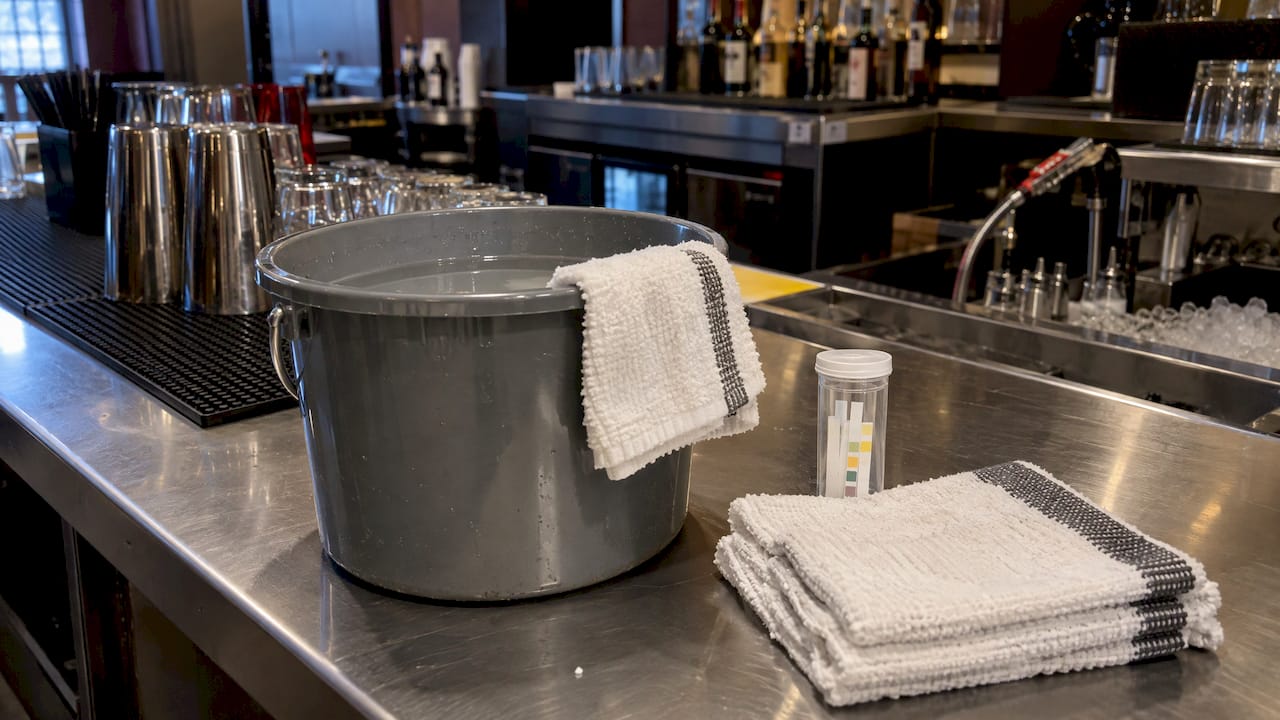
A sanitizer bucket with wiping cloths must be at the bar at all times, with test strips on hand. The SNHD checklist lists bleach solution at 50 to 100 ppm or quaternary ammonia at 200 ppm, or the manufacturer’s recommendation. Mix it, test it, and write the time on the bucket. More on concentrations in the table below.
Stage the bar off the ground and away from chemicals
The SNHD checklist calls for food, equipment and single-service items such as cups and straws to be stored six inches off the ground, with overhead protection where applicable. Keep drinks, personal items and chemicals away from food and food-contact surfaces. That means the cleaning spray does not sit beside the garnish tray, and the bartenders’ own water bottles stay in a designated spot. No eating or smoking in the bar area.
Check ice, garnish and glassware
- Ice comes from an approved source and is stored in a clean, sanitized bin or well, off the ground. The Central Nevada Health District’s temporary event self-inspection list asks for ice protected from bare hands and stored six inches off the ground. Use a scoop, never a glass or bare hand.
- Garnish is cut with clean tools onto clean trays and kept covered.
- Glassware arrives clean, is stored upside down or covered, and is kept away from drips and dust.
- Use separate utensils for raw items and ready-to-eat items, per the SNHD checklist.
Confirm toilets and signage
For larger gatherings, the SNHD tasting event checklist wants toilets at least 50 feet from food operations, with a hand-wash sink for every group of five toilets. Under Nevada Administrative Code 444.825, special event operators must supply clean toilet facilities with adequate toilet tissue at all times, scaled to peak hourly attendance and length of stay. Finally, post the health-warning sign. Under NRS 580.510 it is at least 8.5 by 11 inches, with HEALTH WARNING in 40-point type and the rest in 30-point type.
During service: keeping the bar clean while it is busy
A bar is cleanest at 6 p.m. and most at risk at 9 p.m. The service checklist is about habits that hold when the line is five deep.
- Wipe as you go. Cloths live in the sanitizer bucket, not on a shoulder. The Central Nevada Health District list asks for the bucket to be changed at least every two hours, using 2 to 3 teaspoons of bleach per 2 gallons of water with no soap added, checked with test strips.
- Sanitize the bar top on a schedule. A bar health inspection guide from a restaurant software company suggests every four hours. At a wedding with a long cocktail hour, a quick wipe after each guest is better still.
- Switch out tools every four hours. The SNHD checklist requires utensils to be switched out or washed, rinsed and sanitized every four hours. Having a second set of shakers, strainers, tongs and scoops makes this simple.
- Keep hands off ready-to-eat items. The tasting event checklist prohibits bare-hand contact with ready-to-eat foods, which includes garnishes such as citrus wheels and cherries.
- Clean spills immediately. Wet floors behind the bar are a slip risk and a contamination risk. Keep a dry towel and a mop close.
- Wash hands at the station. Before starting, after handling trash, cash or phones, and any time hands are dirty.
- Handle waste correctly. The SNHD checklist asks for proper waste disposal, with wastewater going to an approved sewer or holding tank, never onto the ground or into a storm drain. Our bar waste plan covers how that works at Las Vegas and Henderson events.
One point for planners: the more guests who touch the bar surface, glasses, ice and garnishes, the more the bartender’s sanitation habits matter. A bar with a clear barrier between the guest side and the work side, and a bartender who does the handling, keeps those risks low.
After the last pour: the breakdown checklist
Closing is where sloppy bars cut corners, because everyone is tired and the venue wants the room back. A full close includes the following.
- Empty ice wells and bins, wash, rinse and sanitize them, and leave them open to air-dry. A closing checklist from a cleaning marketplace describes this sequence, along with soaking soda gun nozzles and holsters.
- Wash, rinse and sanitize shakers, strainers, pour spouts, tongs and garnish trays, then air-dry. Do not towel-dry.
- Discard cut garnish and open mixers that will not be used, and empty trash.
- Pour hot water down any drain used at the bar and scrub drain covers.
- Wipe down bottles and speed rails.
- Dump wastewater from the hand-wash station the approved way and clean the tanks.
- Sanitize the bar top and any rental bar surfaces before loading out.
The warewashing sequence is described by the New York State Department of Labor’s bartender task standard: empty glasses, wash in hot water with detergent, rinse in a second sink, then sanitize in a separate sink. For countertops, remove food particles, apply sanitizer, and remove excess moisture with a clean squeegee and microfiber cloth. At an event with no three-compartment sink on site, this is the reason professional bars bring clean glassware in and take dirty glassware out rather than washing on location.
For the full load-out sequence at Las Vegas venues, see our bar cleanup after events guide.
Sanitizer concentrations and contact times
Sanitizer only works at the right strength for long enough. The SNHD’s published figures are below. Always follow the label on the product you actually use.
| Sanitizer | Concentration | Contact time | Source note |
|---|---|---|---|
| Chlorine (bleach) in a bucket | 50 to 100 ppm | 10 seconds | SNHD temporary permit checklist and 2023 training |
| Chlorine for washed and rinsed equipment | At least 50 ppm, or per manufacturer | 10 seconds | SNHD 2023 change document |
| Quaternary ammonia in a bucket | 200 ppm, or per manufacturer | 30 seconds, or per label | SNHD temporary permit checklist |
| Iodine | 12.5 to 25 ppm at the manufacturer’s pH and temperature | Per label | SNHD 2023 change document |
The contact times come from the SNHD’s 2023 regulation training, which also notes that chlorine at 25 to 49 ppm is acceptable only if the table requirements are met and the concentration can be tested. Quaternary ammonium is generally not used in ware-washing machines unless the label specifies it. Test strips are what turn this table into practice: they tell you the bucket is at strength, not guess it.
For glassware soaked by hand, Wood County Health in Wisconsin gives a simple home-bar-style benchmark in its bartender guidance: one tablespoon of bleach per gallon of cool water for at least one minute, verified with test strips, then air-dried. For soda guns, sanitize the handle, sheath and drip cup daily, and soak the removed nozzle and gun in sanitizing solution for two minutes weekly.
Safe use matters as much as strength. Never mix bleach with other cleaners, store chemicals away from food and drinks, and keep them out of reach of guests.
How often, and who signs off
A checklist only works when each task has an owner and a frequency. Use this as a working split for an event bar.
| Task | When | Who |
|---|---|---|
| Hand-wash station stocked and temperature checked | Before opening, and refill as needed | Lead bartender |
| Sanitizer mixed and tested | At setup, and at least every 2 hours | Lead bartender |
| Bar top and cloths | Continuously, at least every 4 hours | Bartender on the bar |
| Tool swap or re-sanitize | At least every 4 hours | Bartender and barback |
| Ice well and scoop | Setup, and again if contaminated | Barback |
| Garnish trays and juices | Setup, and replace as needed | Bartender |
| Soda gun handle and drip cup | Daily | Bartender |
| Drains, wells and bar top | Closing | Whole team, signed by the lead |
The four-hour and two-hour intervals come from the SNHD and Central Nevada Health District checklists cited above. The rest is a sensible assignment, not a legal requirement. The point is the signature: one named person confirms the checklist is complete, which matches the person-in-charge requirement. Shift-based checklists, such as the opening, during-shift and closing structure in Toast’s bar cleaning guide, work well when the lead initials each stage.
What we have seen matters most at weddings and corporate events
Event bars fail on the same few things: no real hand-wash station, no test strips, and nobody clearly in charge. A wedding has one chance to get the bar right, and a corporate event has a client watching. That is why we build sanitation into the plan from the first conversation instead of treating it as a last-minute add-on.
We work only in Las Vegas and Henderson, and we are fully licensed and insured, with over 20 years of experience and strict compliance with Las Vegas municipal code. We coordinate with venues and offer turnkey packages, so the hand-wash setup, the permit conversation and the load-out are agreed before the day instead of improvised on it.
If you take one thing from this checklist, make it this: ask who is the person in charge at the bar, where the hand-wash station will sit, and how the bar will be broken down. A good bar team has an answer to all three without hesitating.
Brennon
Hand the checklist to a team that already works this way
If you would rather not run this checklist yourself, our team handles bartending and liquor catering for weddings and corporate events in Las Vegas and Henderson, with custom package options, bar branding and venue coordination. See our wedding bar services or our corporate event bartending, or start from our mobile bartending and liquor catering page to tell us about your date and venue.
We also offer bar rental packages and dry hire staffing for hosts who already have the liquor and need experienced bartenders.
FAQ
Do I need a health permit for a bar at my wedding or corporate event in Las Vegas?
It depends on the venue and the setup. The SNHD defines a special event as a temporary public gathering with at least one temporary food establishment, and temporary permit applications are due at least seven calendar days before the event to avoid late fees. Check with your venue and the SNHD early, and ask your bar provider how they handle it.
What must a hand-wash station at an event bar include?
The SNHD requires one within 10 feet of the bar, with a minimum 5-gallon supply of warm water, liquid soap, disposable paper towels, a trash can and a wastewater catch container. Hands-free flow is preferred. Gloves and hand sanitizer do not replace hand washing.
How strong should bar sanitizer be?
The SNHD temporary permit checklist lists bleach solution at 50 to 100 ppm or quaternary ammonia at 200 ppm, or the manufacturer’s recommendation, with test strips available. Contact time is 10 seconds for chlorine and 30 seconds, or the label time, for other sanitizers.
Do we need a pregnancy warning sign at the bar?
Yes. Nevada law requires food establishments selling alcohol by the drink for on-premises consumption to post a health warning sign, in English and Spanish, stating that drinking alcohol during pregnancy can cause birth defects. The SNHD checklists also list the sign for liquor service at temporary events.
How often should bar tools be cleaned during an event?
The SNHD requires utensils to be switched out or washed, rinsed and sanitized at least every four hours. Wiping cloths should sit in a tested sanitizer bucket, which the Central Nevada Health District list asks to be changed at least every two hours.
Sources
- Special Events, Southern Nevada Health District
- NRS Chapter 580, Food Establishments
- SNHD 2023 Food Regulation Change Document
- SNHD Temporary Food Establishment Quick Reference Checklist
- SNHD Event Coordinator Checklist for Tasting Events
- Nevada Administrative Code 444.825
- Central Nevada Health District Self-Inspection Check List
- Bar Health Inspection Checklist
- Bar cleaning checklist: closing, weekly and monthly
- NY State DOL bartender task standard
- SNHD 2023 Regulation Training
- Wood County Health, Bartenders
- Toast, Bar Cleaning Checklist