
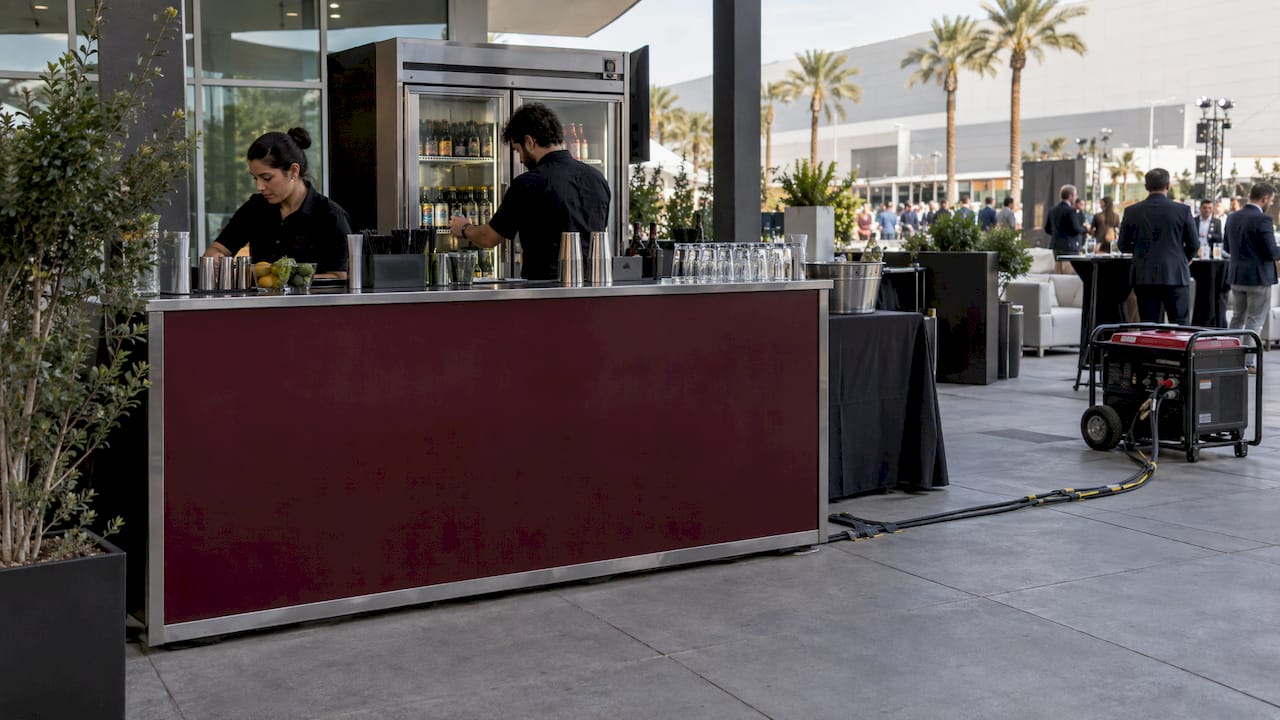
Most mobile bars need somewhere between a few hundred watts and a few thousand watts, and the number that matters is the peak, not the average. A bar with only lights, a small cooler and a speaker can run on one standard 20-amp outlet. A bar with refrigeration, an ice maker, blenders and a draft system needs dedicated circuits or a properly sized generator. Below we show how to add up the load, what to ask your venue, and what Las Vegas and Henderson expect when temporary power is involved.
TL;DR
- Add up the running watts of every device that will be on at the same time, then add allowance for startup surges from compressors and motors.
- A standard 120V/20A circuit is 2,400W on paper, but plan continuous loads at about 80% of that, roughly 1,920W.
- Outdoor, tent or remote sites often need a generator sized at 125% to 150% of your calculated load.
- In Las Vegas, outdoor cords need GFCI protection, and spider boxes at a special event require an electrical permit pulled by a Nevada-licensed electrical contractor.
- Send your bar provider the venue’s outlet locations and amperage early, so the layout and the power plan match.
Table of Contents
- What counts as a mobile bar power load
- How much power each piece of bar equipment draws
- How to calculate your bar’s power needs step by step
- What to ask the venue about outlets and circuits
- When you need a generator
- Las Vegas and Henderson electrical rules to confirm
- Easy ways to keep the load down
- Perspective
- Let us plan the power with your bar
- FAQ
- Sources
What counts as a mobile bar power load
A mobile bar is a small kitchen on wheels, and the electricity goes to a short list of things. Refrigeration is the largest constant draw. After that come ice makers, draft or tap systems, cocktail machines, blenders, lighting, sound and a point-of-sale tablet. Water pumps and hand sinks add small motors to the list.
A Dutch mobile-bar knowledge base ranks refrigeration as the biggest constant factor, followed by taps and lighting, then cocktail machines and ice makers. The same article puts an overall mobile-bar load at roughly 2,000 to 6,000 watts of peak power depending on scale, and notes that average consumption in practice is lower. That range is a planning frame, not a promise for your event.
For a simple wedding bar serving beer, wine and a short cocktail menu, the real load is often at the low end. A full cocktail bar with a draft tower and a blender station moves toward the high end. If you want to see how the physical bar, back bar and storage fit together first, our guide on how mobile bar setup works walks through it.
How much power each piece of bar equipment draws
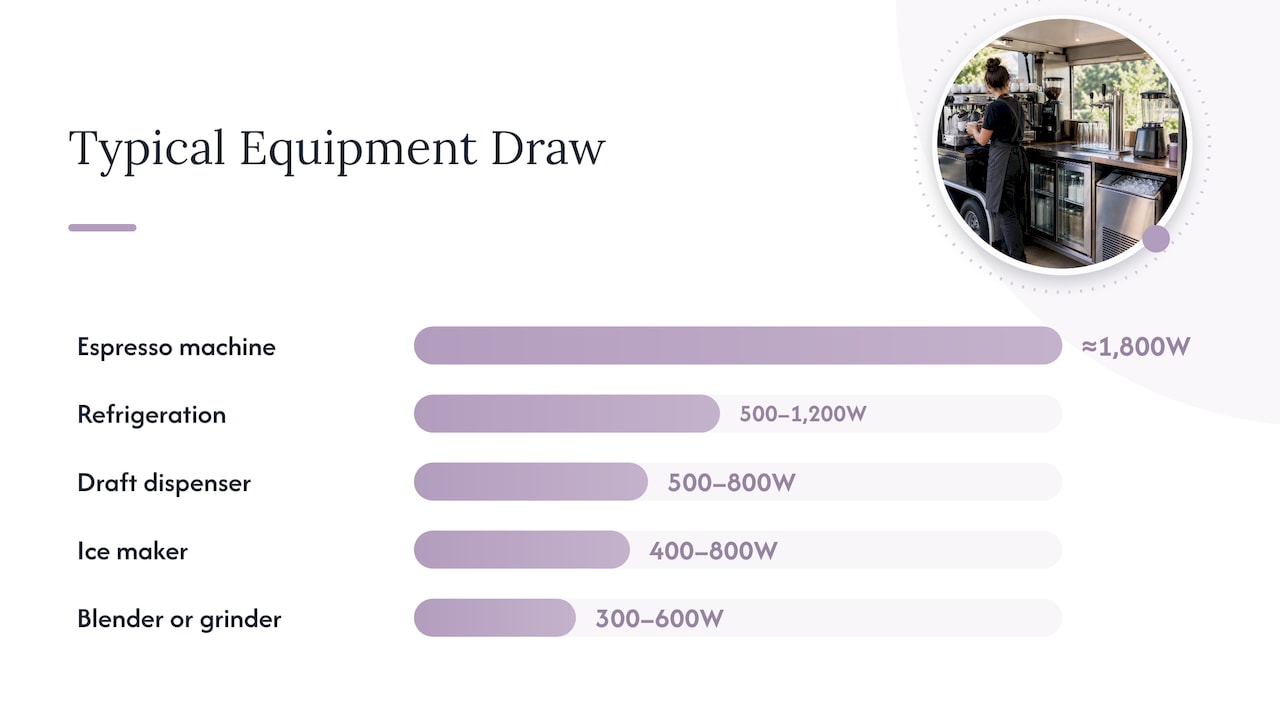
Nameplate figures vary by brand, so read the label on each unit. These ranges give you a feel for scale.
| Equipment | Typical running draw | Startup note |
|---|---|---|
| Draft beer dispenser | about 500 to 800W | Cooling cycles on and off |
| Ice maker | about 400 to 800W | Compressor surge at start |
| Refrigeration | about 500 to 1,200W | Compressor surge at start |
| Small items (lights, charger) | about 200W combined | Negligible |
| Blender or grinder | 300 to 600W | Up to 1,800W at startup |
| Espresso machine | about 1,800W | About 2,160W at startup |
The first four rows come from an indicative appliance list for catering trailers, which says values vary by brand and model. The last two rows come from a vendor booth power guide that also gives a commercial refrigerator at about 150 running watts but 700 to 1,000 watts at startup.
One packaged example: a portable bar with built-in refrigeration, LED task lighting and a hand sink is listed at 13.3 amps on a 120V connection, which is about 1,200W at maximum draw. That one bar alone takes most of what a single circuit should carry continuously.
Why startup surge matters more than the running number
Compressors and motors pull a burst of current when they start. A mobile coffee power guide separates running watts from starting watts and warns that sizing only for running watts can make a generator shut down. The same applies to a bar: the fridge and the ice maker cycling on while a blender spins is exactly the moment a breaker trips mid-toast.
The practical rule is to size for the highest surge that could land on top of everything already running.
How to calculate your bar’s power needs step by step
- List every device. Include lights, speakers, tablets, chargers and anything the caterer or DJ will plug into the same circuit.
- Record volts, amps and watts. An event power checklist advises noting startup surge too, and converting amps to watts with W = V × A when only amps are given.
- Total the running watts of everything that can be on at once.
- Add surge allowance for each compressor or motor that could start at the same moment.
- Apply headroom. The same checklist suggests leaving a 20% to 30% circuit buffer and allowing up to 50% for high-surge gear.
- Compare the total with the circuit or generator capacity you will actually have.
One event power calculator describes adding running watts, applying a demand factor (its example is 75%, because cycling equipment does not all draw full rating at once), then adding about 25% headroom so a generator is not run near its limit. It also says to include starting watts of motors and compressors.
A worked example
The numbers below are illustrative, not measurements of any specific unit. Check your own nameplates.
| Item | Running watts | Startup watts |
|---|---|---|
| Undercounter refrigeration | 600 | 1,000 |
| Ice maker | 600 | 900 |
| LED bar and back-bar lighting | 150 | 150 |
| Blender | 500 | 1,200 |
| Speaker and tablet | 150 | 150 |
| Total | 2,000 |
Running load is 2,000W. If the blender starts while the fridge and ice maker are already running, the peak is roughly 2,000W plus 700W of blender surge, so about 2,700W. A 120V/20A circuit offers 2,400W on paper and about 1,920W for continuous use, so this bar does not belong on one circuit. Split it across two separate circuits, or move the blender to a second outlet on a different breaker.
What to ask the venue about outlets and circuits
The bar’s wattage is only half of it. The other half is what the wall can deliver. Ask these before the walkthrough:
- How many outlets are within reach of the bar location, and what breaker does each sit on?
- Are they 15-amp or 20-amp circuits, and are they dedicated or shared with the kitchen, DJ or lighting?
- Are exterior outlets GFCI protected?
- Is there an approved spot for cords to run, and who supplies mats where guests walk?
- If power is not available, does the venue allow generators, and where?
A common failure is two vendors on the same circuit. The vendor checklist recommends keeping continuous loads below 80% of each circuit’s rated capacity, which is the 16A or 1,920W figure on a 20-amp, 120V circuit, and grouping vendors by the panel or generator output they share.
If you are still touring spaces, a list of questions to ask on a venue visit helps you cover power alongside parking, load-in and curfew. For the physical footprint your bar needs next to those outlets, see our guide to mobile bar space requirements, and for placement and permits see bar station layout for Las Vegas events.
Lighting is a small load but affects layout. Our piece on bar lighting setups covers options that keep bartenders working fast without adding much draw.
When you need a generator
Outdoor, tent and remote locations often need one. Desert venues, backyard weddings in Henderson and pop-up corporate activations are typical cases. The event power checklist recommends sizing a generator at 125% to 150% of the calculated load, with 25% to 30% spare capacity over peak, or up to 50% for high-surge gear.
United Rentals’ outdoor event guidance says to list every asset that needs electricity, total the wattages, and include at least a 20% safety margin for inrush current. An event power distribution article adds that where the grid is not available, you establish the required amperage and voltage first and keep a backup plan.
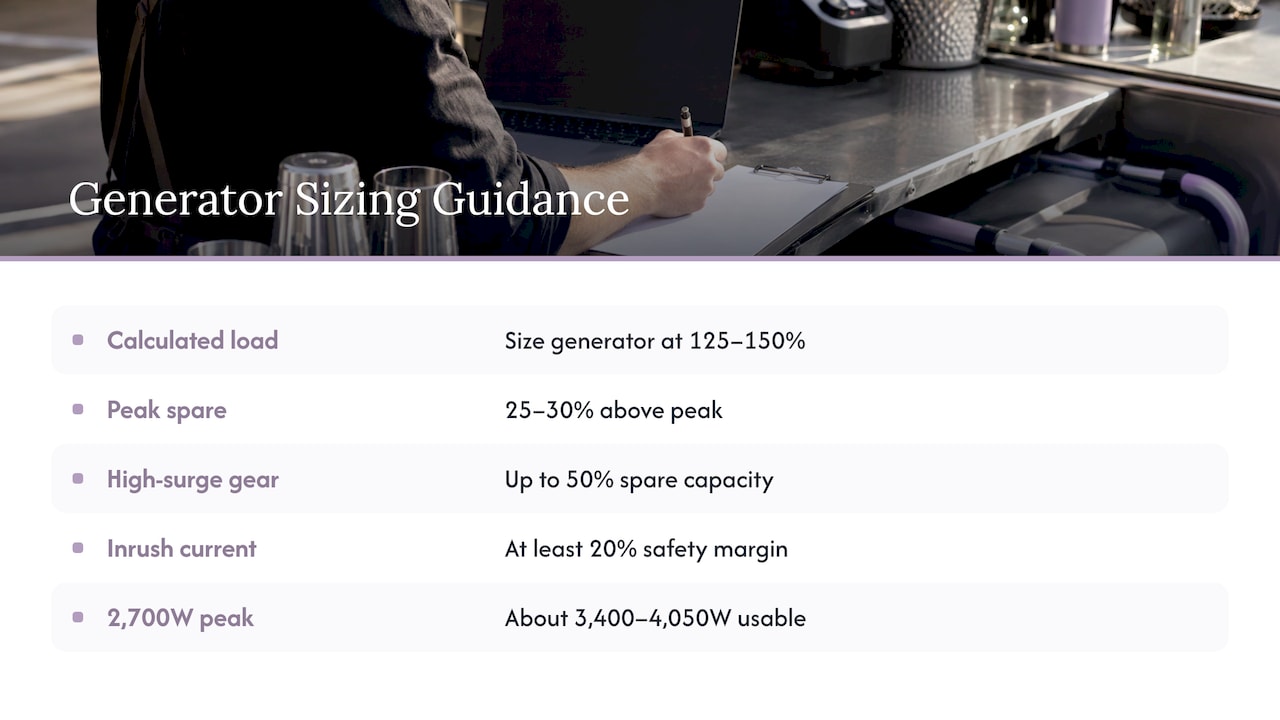
Applied to the earlier example, a 2,700W peak at 125% to 150% points to a generator in the range of about 3,400 to 4,050W of usable output, and that is before the DJ or caterer joins in. Share the plan with every vendor so the generator is sized for the whole event, not just the bar.
Quick generator checks
- Confirm the venue permits generators and where they may sit.
- Place the generator away from tents, guests and air intakes, and never run one indoors or in an enclosed space.
- Make sure it is properly grounded.
- Plug equipment straight into the generator’s outlets where possible, which affects permitting (see below).
Las Vegas and Henderson electrical rules to confirm
These rules are written for temporary power at special events. Requirements and fees change, so confirm with the city office before you commit. The documents cited here carry their publication years.
City of Las Vegas
- GFCI and cords. The City’s special events handbook (2016) says exterior electrical use must be on GFI-protected receptacles, outdoor extension cords must be rated for that use, and heavy rubber mats must cover cords crossing pedestrian or vehicular paths.
- Spider and function boxes. The same handbook says these require a Nevada-licensed electrical contractor to pull an event electrical permit, and Building & Safety decides whether additional distribution needs a permit.
- Temporary distribution. The Building Safety guideline based on the 2008 NEC calls for a permit for temporary electrical distribution at special events, issued only to a Nevada-licensed electrical contractor, and describes GFCI protection under Article 525.23, including where the GFCI may sit in the cord.
- Generators. Las Vegas permit guidelines for special events (2014) say that equipment plugged directly into a generator’s outlet needs no permit. If spider boxes are plugged into the generator and equipment plugs into them, a permit is required and the generator must be properly grounded.
- Inspections. The City lists temporary generators and temporary distribution for special events among inspections required with electrical permits.
Henderson
Henderson publishes electrical design details, including temporary power (E-102) and temporary power service (E-105), on its Electrical Information page, under 2024 codes effective 2 January 2026. If your event needs temporary service beyond ordinary outlets, ask the venue and Building and Fire Safety which of those details apply. Our guide on why Henderson venues allow mobile bars covers the venue side of that conversation.
The simplest path is to use the venue’s own power with a load plan that stays within circuit limits. That avoids permits entirely in most cases.
Easy ways to keep the load down
- Pre-chill and pre-ice. Starting with cold beverages and delivered ice means the refrigeration works less and an ice maker may not be needed.
- Stagger startups. Power equipment on one piece at a time during setup, not all at once.
- Use LED lighting. It adds little draw next to refrigeration.
- Skip duplicate appliances. One blender station is plenty for most guest counts.
- Keep the bar’s circuit to itself. Do not share it with a DJ, lighting rig or caterer’s warmers.
- Use rated cords. Short, heavy-gauge, outdoor-rated cords, covered where people walk.
Perspective
Power is the part of a bar plan that nobody sees until it fails. We have seen couples pour money into décor and then discover the garden has two outlets on one breaker. Our approach is to ask about power at the very first venue conversation, not the week before.
We plan around the peak, not the average, and we keep the bar’s equipment list as lean as the menu allows. Every Las Vegas and Henderson event we take is built to comply with the municipal code, and we coordinate with the venue on outlets, cord routing and load-in so the lights stay on and the ice stays cold.
If you tell us your guest count, menu and venue, we can tell you what the bar will need, and we handle the logistics so you do not have to learn amperage on your wedding day.
Brennon
Let us plan the power with your bar
Liquid Courage is a mobile bartending and liquor catering company working only in Las Vegas and Henderson, Nevada. We provide fully licensed, insured service with over 20 years of experience, flexible menu and bar branding options, and venue coordination for weddings, corporate events and private parties.

If you want the bar and its power plan handled together, look at our bar rental packages, or tell us about your date and venue through our mobile bartending and liquor catering page. Planning a wedding or a company event? See our pages for Las Vegas weddings and corporate events.
FAQ
How many watts does a mobile bar need?
It depends on the equipment. A knowledge-base estimate puts mobile bars at roughly 2,000 to 6,000 watts of peak power, while a bar with only lights and a cooler needs far less. Add up running watts, add surge allowance for compressors and blenders, then leave headroom.
Can a mobile bar run on one standard outlet?
Only a light setup can. A 120V/20A circuit is 2,400W on paper, and checklists advise keeping continuous loads near 80%, about 1,920W. Bars with refrigeration, an ice maker and blenders usually need two circuits or a generator.
Do I need a generator for a wedding bar?
Often for outdoor, tent or remote sites, and not for venues with enough circuits. A common recommendation is to size a generator at 125% to 150% of your calculated load. Ask the venue about available outlets first.
Do I need a permit to use a generator in Las Vegas?
City guidance says that equipment plugged directly into the generator’s outlet does not need a permit. If spider boxes are plugged into the generator, a permit is required and the generator must be grounded. Confirm current rules with City of Las Vegas Building and Safety.
What should I ask my venue about power?
Ask how many outlets are near the bar, their amperage and breakers, whether exterior outlets are GFCI protected, and whether generators are allowed. Also ask what else will share those circuits, such as DJ gear or catering equipment.
Sources
- EventBar: how much power a mobile bar needs
- Appliance power consumption in a catering trailer
- Vendor booth power supply guide
- Portable bar with hand sink specifications
- Mobile coffee cart power requirements guide
- Event power needs vendor checklist
- Event power calculator
- Planning generators for outdoor events
- Entertainment power distribution guides and tips
- City of Las Vegas special events handbook
- Las Vegas electrical inspection guideline for special events
- Las Vegas permit guidelines for special events
- Las Vegas inspections required with electrical permits
- Henderson electrical information