
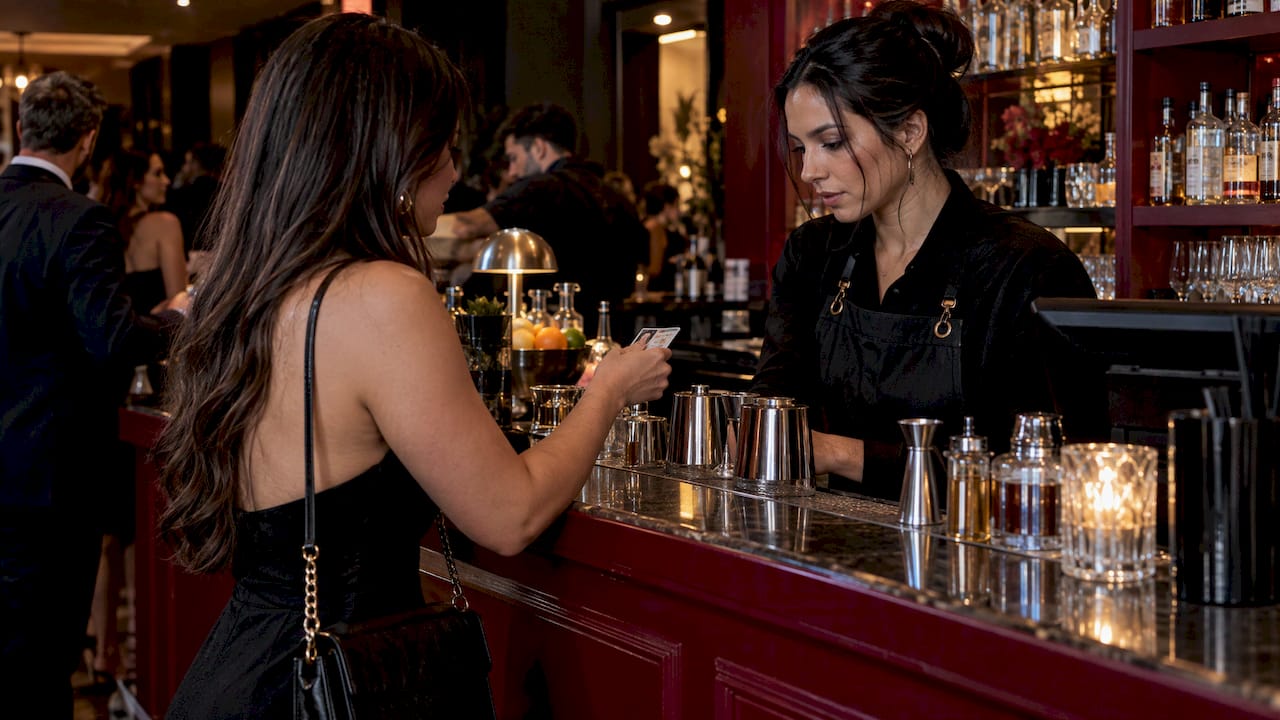
Event ID checking means verifying that every guest who orders alcohol at your wedding, corporate event or private party is 21 or older, before the drink is poured. The bartender does it at the bar, you set the policy in advance, and a simple plan keeps the line moving. In Nevada the stakes are real: under NRS 202.020, a person under 21 who buys or drinks alcohol on premises where it is served commits a misdemeanor. This guide shows hosts and planners in Las Vegas and Henderson how to set it up.
TL;DR
- Every guest who orders alcohol gets carded unless your bartender and you have agreed on a clear, consistent policy in advance. Consistency protects guests and protects you.
- Decide before the event: who checks IDs, what counts as acceptable ID, and what happens when a guest is refused.
- Put the policy on the invitation, the registration page or the wristband plan so guests arrive prepared.
- Use wristbands or a single check point for big crowds, and keep the bar line free for ordering.
- A professional mobile bartending team trained for Las Vegas and Henderson events handles the checking so your hosts do not have to.
Table of Contents
- Why ID checking matters at a private event
- Who is responsible for checking IDs
- What to check on an ID
- How to run the check without slowing the bar
- Planning ID checks for weddings
- Planning ID checks for corporate events
- What to do when a guest is refused
- Perspective: why we card everyone, every time
- Alcohol service hours and permits
- An ID checking checklist you can copy
- Our bar services in Las Vegas and Henderson
- FAQ
- Sources
Why ID checking matters at a private event
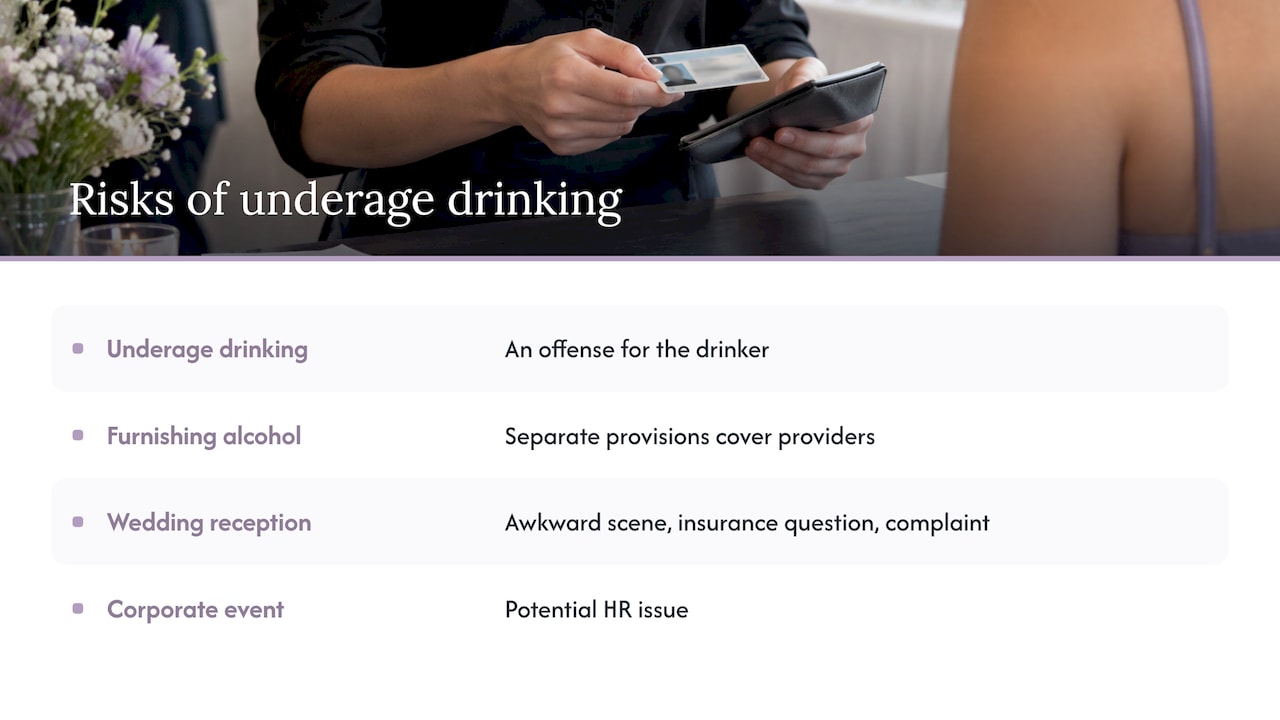
People assume a private event, with a guest list and a hosted bar, is relaxed about carding. It is not a different category. Nevada law treats underage drinking as an offense for the drinker, and the person pouring or providing the drink carries risk too. The statute above covers the person under 21. Separate provisions cover those who furnish alcohol to minors, so confirm specifics for your event with your venue and your licensed bartending provider.
There is also a practical side. A single underage guest with a drink at a wedding reception can turn into an awkward scene, an insurance question, or a venue complaint. At a corporate event, it can become an HR issue. Checking IDs calmly, the same way for everyone, avoids all of that.
We built our service around this. As we describe in our own positioning, Liquid Courage operates as a fully licensed and insured mobile bartending company with strict compliance with Las Vegas municipal code, and ID checking is part of how our bartenders run a bar.
Who is responsible for checking IDs
The short answer: the person serving. The bartender at your bar is the last point of control, and a good bartender does not hand the decision to a host, a bride’s father or a team lead.
That said, hosts have a role. You decide the policy, you communicate it, and you back up your bartender when a guest pushes back. If you hire a professional bartending team, the arrangement works like this:
- You decide the age rule (21 and over for alcohol), who is on the guest list, and whether any guests are known minors.
- Your bartender checks identification at the bar, refuses service when needed, and handles it politely.
- Your venue may have its own rules on top, so ask what they require before you finalize your plan.
If you hire a dry hire staffing arrangement, where you supply the alcohol and we supply the bartenders, the same division applies. See our dry hire staffing page for how that works.
What to check on an ID
A bartender is not a forensic examiner, but a consistent routine catches most problems. Here is the routine we recommend for any bar.
- Ask for the ID in the guest’s hand. Do not accept a photo on a phone or a promise that it is in the car.
- Look at the photo. Does the face match the person standing in front of you?
- Check the date of birth. Do the math, rather than guessing from the year. Many licenses also print a prominent “21 on” date.
- Check the expiration date. An expired card is not a valid proof of age.
- Feel and tilt the card. Look for damage, peeling lamination, or a card that feels different from the others you have seen.
- Hand it back and pour. Keep the exchange short and friendly.
If anything seems off, ask a second question: “What is your zip code?” or “What is your birth date?” A real cardholder answers instantly. A person using someone else’s card often hesitates.
Which IDs to accept
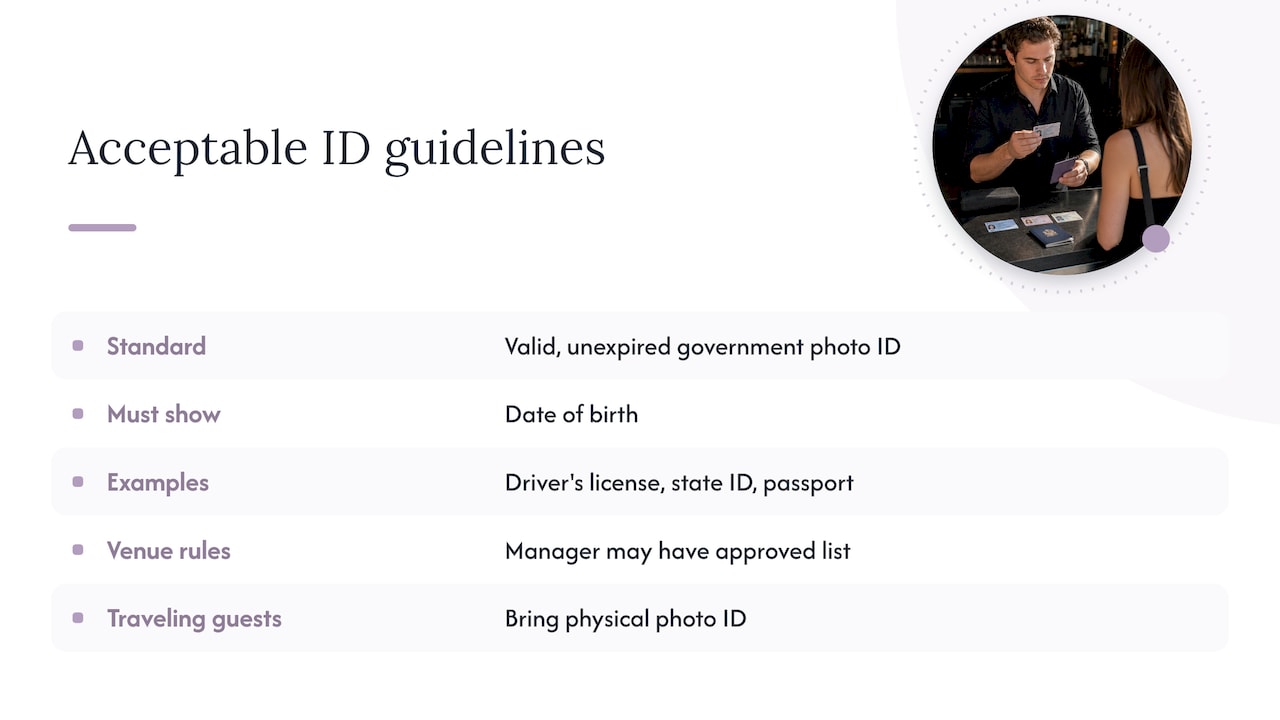
Set the list of acceptable ID with your bartender before the event. In general, a valid, unexpired, government-issued photo ID that shows a date of birth is the standard to use, such as a driver’s license, state ID card or passport. Because the rules of a specific venue can be stricter, ask your venue manager whether they have an approved list, and pass that on to your bartending team in writing.
A tip for wedding guests who travel to Las Vegas: remind them to bring a physical photo ID. Out-of-town guests are the ones most likely to leave a wallet at the hotel. That is a recurring problem at destination weddings, and a note on the wedding website fixes it.
How to run the check without slowing the bar
The complaint we hear from planners is not about carding itself, it is about lines. A 200-guest cocktail hour with a single bartender checking every card at the bar will back up fast. The fix is staffing and layout, not skipping the check.
Option 1: Check at the bar
Best for smaller events, say under 60 guests, with a bar staffed by two or more bartenders. Each bartender checks the card as part of taking the order. The cost is a few seconds per guest.
Option 2: Wristband check point
Best for larger events, open-bar receptions and corporate mixers. A staff member or bartender checks IDs at a table near the entrance and puts a wristband on every guest who is 21 or older. At the bar, the bartender glances at the band and pours. It moves faster, but only works if bands cannot be swapped easily and if the bartender still uses judgment on anyone who looks underage.
Option 3: Hybrid
Use bands for the main crowd and have the bartender card anyone who looks under 30 or who is not wearing a band. It is a good middle path for weddings with a mix of ages.
Whichever you choose, put the plan in the event contract or the event brief so everyone is working from the same page. Our wedding liquor catering contract checklist covers what to confirm with your bartending provider before you sign.
Planning ID checks for weddings
Weddings have a mix of ages, from toddlers to grandparents, and a lot of emotion. Three points matter most.
- Know your underage guests. If there are guests between 18 and 20, such as cousins or college friends, talk to them ahead of time and make sure they know the bar is closed to them. Offer a good non-alcoholic option so they are not left out.
- Tell your family. The most awkward moment is a relative saying “she’s with me” at the bar. A short word beforehand that the bartenders will card everyone, and that nobody is being singled out, prevents it.
- Plan for the toast. Champagne toasts are often passed on trays. Ask your bartenders to handle the pour and the hand-off, so glasses do not end up in the wrong hands.
Our team supports couples through the whole bar plan on our wedding events page, and our wedding beverage catering guide walks through menu and service choices.
Planning ID checks for corporate events
Corporate events have a different risk: coworkers, clients, interns, and sometimes plus-ones you have never met. The checking rule should be the same for every person, from the CEO to the newest hire.
A few practical points:
- Interns and young hires. Many are under 21. Make the policy known in the invitation, and have a good non-alcoholic menu ready.
- Client guests. Nobody is offended by a polite card request if it is done evenly. A planner who says “our bartenders card everyone, it’s our policy” ends the conversation.
- Conventions and conferences. Large crowds benefit from a wristband station near registration. See our convention bartending package guide for how we think about staffing at that scale.
- Drink tickets. If you use tickets, issue them only at the check point, after the ID check, so the ticket doubles as proof the person is of age.
Our corporate events page describes the services we offer to Las Vegas and Henderson planners.
What to do when a guest is refused
Refusals will happen at some point. The way they are handled decides whether it becomes a story at the after-party.
- Stay calm and quiet. The bartender declines privately, not in front of the line.
- Offer an alternative. A mocktail, soda or sparkling water makes the moment smaller.
- Do not argue the rule. “I’m sorry, I can’t serve without a valid ID” is the complete answer.
- Bring in the host if needed. If a guest keeps pushing, the bartender signals the planner or point person, and the host steps in. The bartender should never be left to argue.
- Note it. Keep a short record of any refusals and incidents for your event file.
A host who backs the bartender is the best insurance there is. If a guest complains to you, your answer is the same: the rule applies to everyone.
Perspective: why we card everyone, every time
After many years behind bars at weddings and corporate events across the Las Vegas valley, we have learned that a good ID policy is invisible to most guests. It is simple, consistent and friendly.
We card everyone who looks like they might be close to the line, and we agree the policy with our clients in advance so there are no surprises. Our approach is built on being fully licensed and insured and on following Las Vegas municipal code, because a host should never have to wonder whether the bar is being run correctly.
We also think the best way to handle a refusal is to have an alternative ready. A bar that has a good non-alcoholic menu turns a “no” into a “how about this?” That is part of what our custom bar packages and menu options are for.
If you are planning an event in Las Vegas or Henderson, tell us your guest count and your age mix, and we will build the ID plan into your bar plan from the start.
Brennon
Alcohol service hours and permits
ID checking is one piece of a larger compliance picture. Service hours, permits and venue rules also affect your bar plan. Our guide for planners on alcohol service hours by state is a good companion read, and if your venue is dry hire, see how to avoid doubled permit fees at dry hire venues in Las Vegas.
Before your event, confirm with your venue manager and your bartending provider what is required for your specific date and location. Rules and venue policies can differ between Las Vegas and Henderson, and between venues.
An ID checking checklist you can copy
Use this list when you brief your bartending team.
| Item | What to decide | Who owns it |
|---|---|---|
| Age rule | 21 and over for alcohol | Host |
| Acceptable ID | Valid, unexpired government photo ID with date of birth | Host and bartender |
| Check method | At the bar, wristband station, or hybrid | Host and bartender |
| Guest notice | Invitation, website or registration page | Host |
| Non-alcoholic menu | At least two options on the bar | Host and bartender |
| Refusal plan | Bartender declines, point person steps in | Host and bartender |
| Venue rules | Any extra requirements from the venue | Host |
| Incident log | Short note of any refusals | Bartender |
Send the filled-in table to your bartending provider a week before the event.
Our bar services in Las Vegas and Henderson
We are a mobile bartending company that works only in Las Vegas and Henderson, Nevada. We provide liquor catering and bartending for weddings, corporate events and private parties, with custom package options, bar branding and venue coordination.
If you want a team that treats ID checking as part of the service, not an afterthought, start with our mobile bartending and liquor catering page, or look at our bar rental packages and private bartender services. Tell us your date, venue and guest count, and we will plan the bar, the staffing and the ID check together.

FAQ
Do I have to check IDs at a private party or wedding?
Yes, the bar should check anyone who may be under 21 before serving alcohol. Nevada law makes it a misdemeanor for a person under 21 to buy or drink alcohol where it is sold, as set out in NRS 202.020. A private guest list does not change the age rule, so the safest plan is to agree on a consistent carding policy with your bartender.
What happens if a guest forgets their ID?
The bartender does not serve alcohol to that guest. Offer a non-alcoholic drink and, if the guest is clearly of age and a host knows them, let the host decide whether they can retrieve the ID. The bartender should not make exceptions on a promise or a phone photo.
Is a wristband system better than checking at the bar?
For large events, usually yes, because it moves the check away from the bar and shortens lines. For small gatherings, checking at the bar is simpler. A hybrid works well at weddings with mixed ages. Your bartending team can recommend the best fit for your guest count and venue.
Should I tell guests about the ID policy ahead of time?
Yes. A line on the invitation, wedding website or registration page saying that a valid photo ID is required to be served alcohol saves time and avoids awkward moments. Out-of-town guests especially benefit from the reminder.
Who is responsible if an underage guest gets a drink?
Responsibility can reach the person who served or furnished the drink and the host, depending on the facts, so check with your venue and your insurer. Working with a licensed and insured bartending provider who follows a clear carding routine reduces the chance it happens at all.