
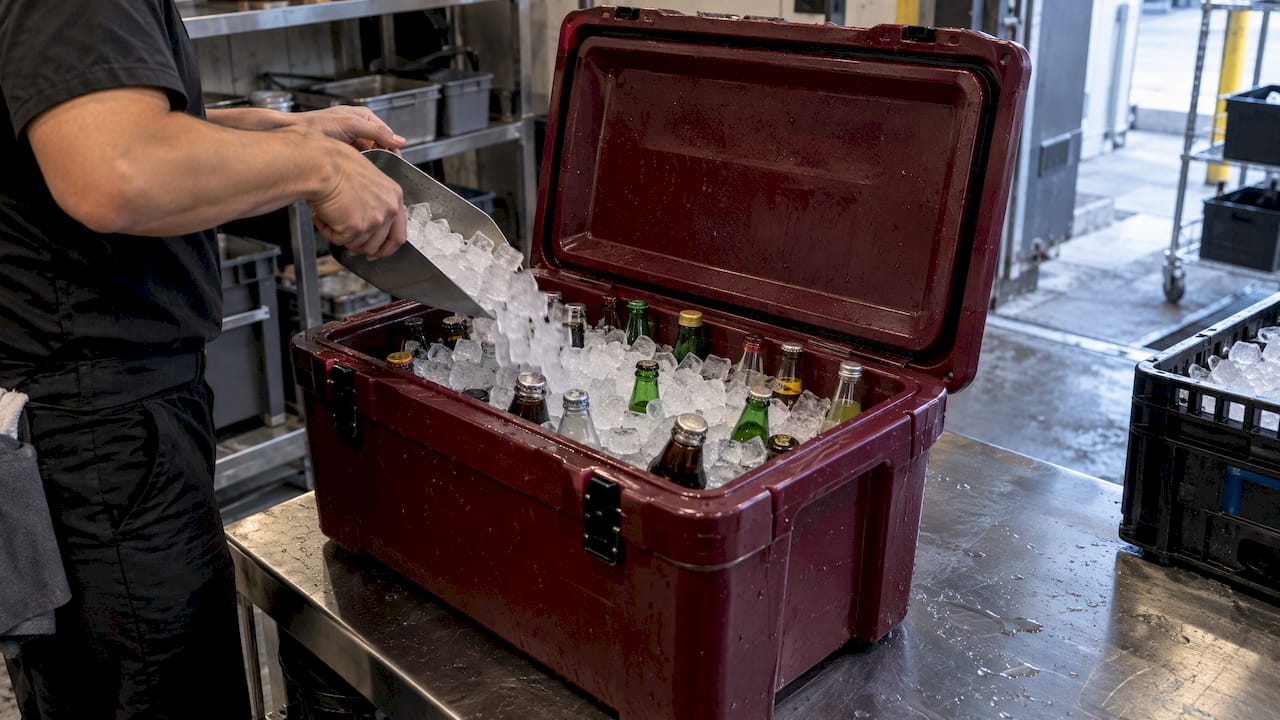
Pack a bar cooler in four moves: pre-chill the cooler and the drinks, use roughly two parts ice to one part drinks, layer so the most-requested drinks sit on top, and keep the lid shut as much as possible. In Las Vegas and Henderson, add a fifth: plan a restock, because the desert heat will outrun any single load of ice.
This guide is written for the person running the drinks at a wedding, corporate event or private party. It covers a back-of-house cooler setup the way a working bartender would build it, with the numbers behind each step.
TL;DR
- Chill the empty cooler the night before and refrigerate every can and bottle before it goes in. Warm drinks drain the ice.
- Aim for about two parts ice to one part drinks, with cubes around the bottles and a base of blocks or ice packs underneath.
- Stand bottles upright, bury cans in the ice, and put the drinks guests ask for first near the top.
- Keep food and drinks in separate coolers, and keep any perishables at 40°F or below.
- In a Las Vegas summer, shade the bar, buy more ice than the math says, and schedule restocking from the start.
Table of Contents
- Start by pre-chilling the cooler and the drinks
- How much ice you actually need
- How to arrange cans, bottles and ice
- Las Vegas and Henderson heat changes the plan
- When the cooler also holds perishables
- Adjusting the setup by event type
- A worked example: a 100-guest evening party
- Our perspective
- Let us handle the cooler plan
- FAQ
- Sources
Start by pre-chilling the cooler and the drinks
A warm cooler is a heat sink. The first bag of ice you pour in spends itself cooling the plastic and foam, not your drinks.
Wirecutter’s cooler guide suggests letting the cooler sit overnight in a refrigerator or filled with a few bags of cubed ice. REI gives the same advice: fill it with a bag of ice or hose it down with cold water the evening before. Dump that sacrificial ice before you pack.
The drinks matter just as much. Coleman’s usage guide says 10 cans, or a gallon of liquid, will use about 2.5 pounds of ice just to cool down from room temperature. At a 200-guest event with several hundred cans and bottles, that adds up fast. Move everything into a fridge or a cold room the day before.
A practical sequence for the day before an event:
- Clean and drain every cooler, then fill each with ice or cold water to pre-chill.
- Move all canned and bottled drinks into refrigeration.
- Freeze water bottles about 80% full, so the ice has room to expand, to use as extra cold packs. Euhomy’s packing guide recommends this.
- Buy the ice as late as you can, and keep it somewhere cold until loading.
How much ice you actually need
The rule most manufacturers agree on is two parts ice to one part contents. YETI advises a 2:1 ratio of ice to chilled contents, and says to fill any leftover space with towels, rags or more ice, because empty pockets hold warm air that melts ice faster. America’s Test Kitchen notes manufacturers generally suggest two-thirds ice and one-third food and drinks for the best ice retention.
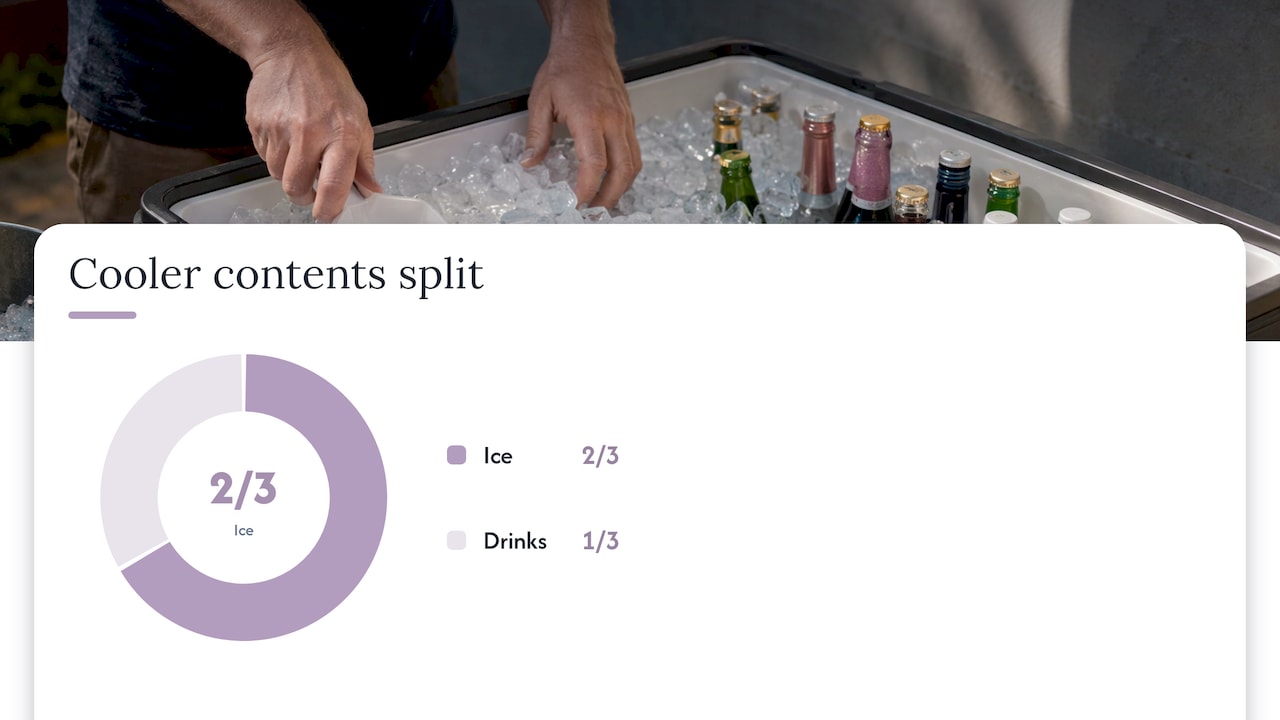
It feels wasteful to give two-thirds of a cooler to ice. It is the reason the last drink out is as cold as the first.
Cubes, blocks or packs
Each form does a different job:
| Cold source | Best for | What to know |
|---|---|---|
| Cubed or bagged ice | Chilling drinks fast and filling gaps | Coleman says cubes cool quickly; America’s Test Kitchen found bagged ice brought drinks to 33°F and kept them about 10 degrees colder than any ice pack over 36 hours |
| Block ice | Holding cold longer | Works well as a base layer; it melts slower than cubes |
| Reusable ice packs | Multi-day use, or keeping things dry | Serious Eats found a gel-based pack stayed frozen for 48 hours; a rule of thumb there is about three medium to large packs for an average cooler |
| Frozen water bottles | Extra cold plus drinking water later | Leave room in each bottle for expansion |
For a bar, the answer is usually a block or pack base with cubed ice around the drinks. Cubes pull heat out of warm cans quickly, and the base keeps the cooler cold once the cubes shrink.
Don’t drain the water too early either. Coleman points out that recently melted ice keeps contents cold better than empty air space. Drain it only when the water level gets high enough to soak cardboard or labels.
If you are sizing ice for the whole event, not one cooler, our ice per guest guide takes you from a pound per guest up to full bar stock.
How to arrange cans, bottles and ice
This is where most home setups go wrong: drinks tossed in loose, ice dumped on top, air everywhere. Build it in layers instead.
- Base layer. Lay blocks or hard ice packs on the bottom. Cold air sinks, so this layer works down low and up through the load.
- Reserve drinks. Place the drinks you won’t need for a while, such as backup cases of sparkling water or the second case of beer, directly on the base.
- Ice between layers. Pour cubed ice over the reserve layer so it fills the spaces between cans.
- Grab-first drinks. Put the popular items on top, where a bartender can reach them without digging.
- Fill every gap. Top off with cubes or frozen bottles. Euhomy’s guide describes the same order: cold base, reserve drinks, ice between layers, grab-first drinks on top.
A few handling notes from the bar side:
- Bottles stand upright. Tasting Table’s cooler tips say to sink tall-necked bottles into the ice until just the neck shows, and to bury cans with only the tops above the ice. More surface contact means faster chilling.
- Pre-bag by day or by shift. If the event runs several hours, pack smaller bagged groups so you open one stash at a time instead of digging through everything.
- Keep labels dry. Cans and glass are fine in meltwater. Cardboard cartons and paper labels are not, so unbox beforehand.
- Use more than one cooler. REI recommends a dedicated drink cooler separate from food, because people reach for drinks far more often, and every opening lets cold out and heat in.
On a real bar, that translates into a working cooler near the bartender, stocked for the next hour, and a reserve cooler behind the bar that stays closed. Refill the working cooler from the reserve, not from a hot truck.
Las Vegas and Henderson heat changes the plan
Cooler advice written for campers assumes a shady campsite and a weekend. A Las Vegas patio at 4 p.m. in July is a different problem.
Masterpiece Cuisine, a Las Vegas caterer, stresses that ice supply is easy to underestimate at outdoor events. Its advice is to plan for more than you think you need, confirm restocking is built into the service schedule from the beginning, and use shaded bar setups. We agree on all three.
Here is how we translate that into a plan:
- Shade first. Put coolers under the bar, a tent or a wall’s shadow. Direct sun on a cooler lid can undo your pre-chilling quickly.
- Cover the cooler. A towel or blanket over a closed lid adds insulation, and wet towels can help when the sun is unavoidable.
- Schedule the restock. Decide who brings more ice, when, and where the delivery drops off. For a long outdoor reception, assume at least one refill.
- Keep a reserve cooler closed. Don’t open it until you need it. Heat is a cost you pay every time the lid goes up.
- Mind the venue. Many venues have limited freezer or ice machine access, so ask during planning, not on the day.
Need a ready-made setup instead of a pile of coolers? Our guide to what a portable bar unit is explains how a self-contained bar handles ice and drink storage, and welcome drink logistics covers timing and quantities for the first pour.
When the cooler also holds perishables
Bar coolers often end up holding garnishes, dairy for cocktails, or a few catering items. Food rules then apply, not just drink rules.
- The FDA Food Code, as summarized by Xenia, requires cold time/temperature control for safety (TCS) food to be held at 41°F or below, and food held in the 41°F to 135°F danger zone without temperature control must be discarded after 4 hours.
- The USDA says perishables should not be left out more than two hours.
- Mississippi State University Extension suggests putting an appliance thermometer in the cooler to confirm cold food stays at 40°F or below, and returning perishables to the cooler within 1 hour when the outside temperature is 90°F or above. In a Las Vegas summer, that one-hour window is the one that applies.
Keep cut fruit, cream and similar items in a food-only cooler, not the drink cooler that gets opened all night. Our garnish storage safety guide lays out a two-hour par and 24-hour toss routine for bar garnishes.
Adjusting the setup by event type
Weddings
Weddings have long gaps between peaks: a cocktail hour rush, dinner, then a dance-floor surge. Hold most of your stock closed during dinner, then restock before the dancing starts. Hand champagne and sparkling water placement to the person closest to the bar, and keep a cooler of water out of guests’ sight. If you are planning drinks for a ceremony and reception, our wedding bartending in Las Vegas page explains how we approach it.
Corporate events
Corporate crowds arrive in a wave, usually right after the last session ends. Pre-load the working cooler before doors open, and stock more non-alcoholic options than you expect. If you are building a lineup for guests who skip alcohol, these happy hour alternatives for work are worth a look, and those drinks need cold space too. For a full corporate setup, see our corporate event bartending page.
Private parties
Backyard parties are where a single big cooler is most tempting. Resist it: use one for drinks you open constantly and one for backup. Freeze a few jugs of water ahead, which doubles as a cold pack and meltwater you can drink.
A worked example: a 100-guest evening party
Here is how the numbers might look for a 100-guest outdoor party running four hours. This is a planning illustration, not a rule.
- Use two coolers for drinks: a working cooler at the bar and a reserve cooler behind it, both pre-chilled the night before.
- Load the working cooler with a base of ice packs or a block, then the drinks to serve in the first hour, then cubes to about two-thirds of the volume.
- Keep the reserve cooler shut, loaded the same way, and refill the working cooler from it at the one-hour mark.
- Schedule a ice delivery or restock around the midpoint, since melt speeds up in direct heat.
- Keep a separate small cooler for garnishes and dairy, with a thermometer inside.
If the numbers feel too complicated to manage on top of hosting, that is the problem a bartending team solves.
Our perspective
After more than 20 years of working bars in this valley, the biggest cooler mistake we see is treating ice as an afterthought. Hosts will spend weeks on the menu and then buy ice the morning of the event, in July, from a gas station.
We build the cooler plan before we build the drink list. That means pre-chilled stock, a working cooler and a reserve cooler, shade for the bar, and a restock built into the timeline. When an event is hot, long or both, it is the plan that keeps service fast, not any single piece of gear.
That is also why we offer turnkey packages and bar rentals for events in Las Vegas and Henderson. We handle the setup, stay in compliance with Las Vegas municipal code, and keep the bar moving, so the host doesn’t spend the night checking coolers.
Brennon
Let us handle the cooler plan
If you would rather focus on your guests than on ice and cooler layers, we can run the whole bar. Liquid Courage provides licensed, insured mobile bartending and liquor catering for weddings, corporate events and private parties in Las Vegas and Henderson, with custom packages and venue coordination. Explore our bar rental packages or contact us through our main page to talk through your event.
For events where you already have the drinks and need staff, our dry hire staffing option puts professional bartenders behind your bar.
FAQ
What is the best ratio of ice to drinks in a cooler?
The common guideline is two parts ice to one part drinks. YETI recommends 2:1 and says to fill leftover space with more ice or towels. Use cubes around the cans and bottles, and blocks or packs underneath.
Should I use cubed ice or block ice for a bar cooler?
Use both when you can. Cubes chill warm drinks quickly, while blocks last longer, so blocks on the bottom and cubes around the drinks is a strong combination. For a cooler holding mostly drinks, one retailer’s cooler guide says cubes are the best way to pack everything in and keep it cold.
Should drinks go in the same cooler as food?
No. People open a drink cooler far more often, and each opening lets cold out. Use a dedicated drink cooler and a separate food cooler, and keep perishables at 40°F or below.
How long will ice last at an outdoor Las Vegas event?
It depends on the cooler, the shade and how often it is opened, so there is no single number. In peak summer, plan on restocking at least once during a long event and keep the coolers shaded. Las Vegas average July highs sit near 104°F.
Sources
- How to Pack a Cooler So You Don’t End Up With Soggy Food (Wirecutter)
- How to Pack Your Cooler (REI)
- Coleman Coolers Use and Cleaning Guide
- How to Pack a Cooler With Ice and Drinks (Euhomy)
- How to Keep Your YETI Hard Cooler Cold for Longer
- 10 Tips on How to Pack a Cooler (America’s Test Kitchen)
- The Best Ice Packs (America’s Test Kitchen)
- The 4 Best Ice Packs for Coolers (Serious Eats)
- How To Keep Your Drinks Ice Cold In Your Cooler (Tasting Table)
- Cooler Packing Tips (Butcher Boy Market)
- Outdoor Event Catering in Las Vegas (Masterpiece Cuisine)
- Food Holding Temperature: FDA Hot and Cold Ranges (Xenia)
- Cold 1 – Hot 2 (USDA)
- How to Keep Food Safe in a Cooler (Mississippi State University Extension)
- Freezer Trailer Rentals in Las Vegas (KryoFridge)
- Happy Hour Alternatives for Work