
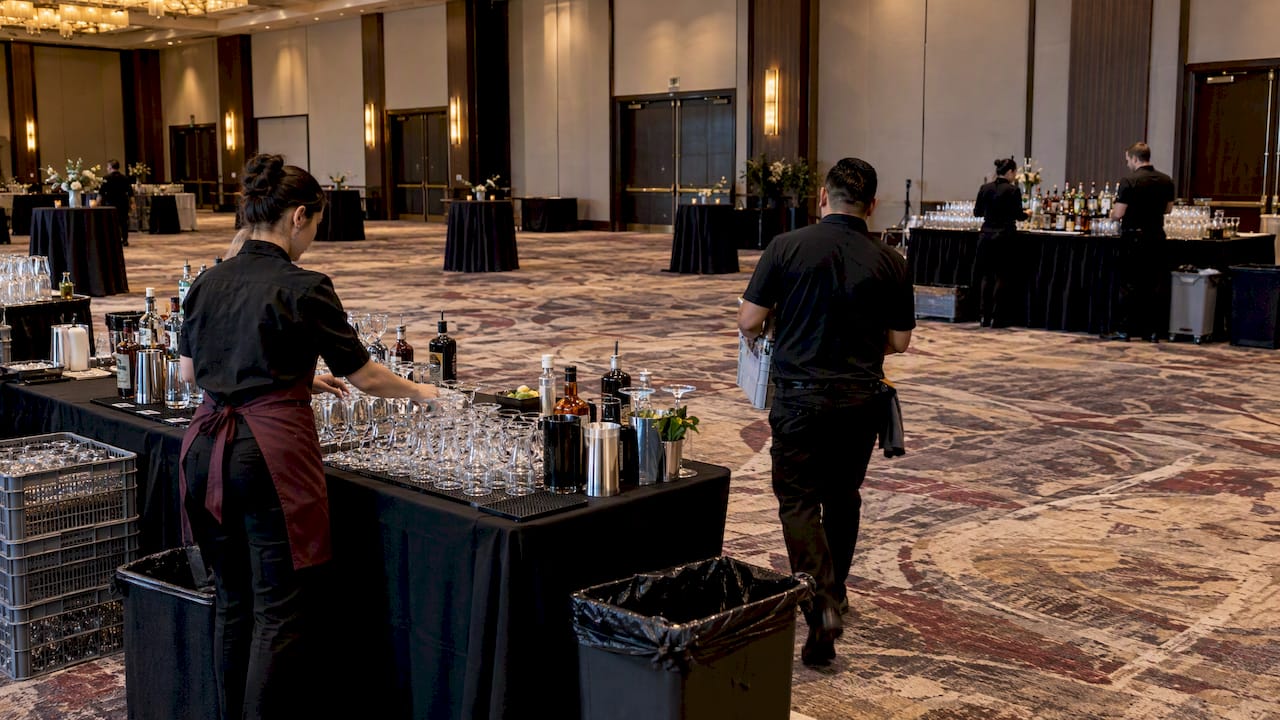
High volume bar service means a bar built to pour for 150 guests or more without a line. In Las Vegas and Henderson that takes four things: enough bartenders plus barbacks, more than one service point, a menu simplified for speed, and the permit and staff paperwork in order before the day. Get those right and guests wait a minute or two. Get them wrong and the bar becomes the thing people remember.
This guide is for couples, corporate planners and hosts who are sizing a bar for a big guest list. It covers the numbers we plan around and the local rules that catch people out.
TL;DR
- Plan roughly one bartender per 50 guests, and add a barback once you pass 100. Signature cocktails push the count up.
- Two or three bar stations beat one long bar. Speed comes from short lines, not from heroic bartenders.
- A tight menu (beer, wine, a few spirits and one or two cocktails) is the cheapest way to add capacity.
- In Las Vegas, alcohol service needs a licensed liquor caterer or a permit, and staff need alcohol education cards. Start 15 to 90 days ahead.
- Ask for the staff list, permits and insurance in writing before you sign.
Table of Contents
- What counts as high volume
- How many bartenders you need
- Design the bar for speed
- Las Vegas rules that shape a large bar
- Planning timeline
- Wedding, corporate or private party: what changes
- Our perspective
- Work with us on a large event
- FAQ
- Sources
What counts as high volume
There is no legal threshold. In practice, a bar turns high volume when one bartender and a single table can no longer keep the line under a couple of minutes. For most events that tipping point sits around 100 to 150 guests. It arrives sooner when everyone arrives at once, such as a ceremony ending into cocktail hour, a conference break or a convention reception.
Three things drive the load more than headcount alone:
- Arrival pattern. A wedding cocktail hour hits the bar all at once. A networking mixer trickles in over two hours.
- Menu complexity. A beer or wine pour takes seconds. A shaken cocktail takes much longer.
- Event length and venue layout. A bar tucked in a corner of a ballroom forces long walks and bottlenecks.
How many bartenders you need
A widely used planning rule is one bartender per 50 guests. One event bar staffing guide puts 200 guests at four bartenders and two barbacks. Another ratio guide suggests a bartender plus a barback for 50 to 100 guests, or two bartenders if you are serving signature cocktails. For 100 to 150 guests it suggests two bartenders, ideally with a barback.
Here is how we think about it in Las Vegas:
| Guests | Simple menu (beer, wine, basic mixed drinks) | With signature cocktails |
|---|---|---|
| Up to 50 | 1 bartender | 1 bartender |
| 50 to 100 | 1 bartender and 1 barback | 2 bartenders |
| 100 to 150 | 2 bartenders and a barback | 2 to 3 bartenders and a barback |
| 150 to 200 | 3 bartenders and a barback | 3 to 4 bartenders and 1 to 2 barbacks |
| 200+ | Add a second bar station | Add a second bar station and a runner |
Treat this as a starting point, not a formula. The final number depends on the menu, the layout, the schedule and where the bars sit.
Why the barback matters
The barback is the cheapest speed upgrade at a large event. They handle ice, glassware, garnishes and restocking, so the bartender never leaves the pour. One source says that support can raise a bartender’s service speed by roughly 30%. Las Vegas events run long and hot, so ice alone can drain a bar team. Nobody should be walking to a back hallway for it mid-rush.
Design the bar for speed
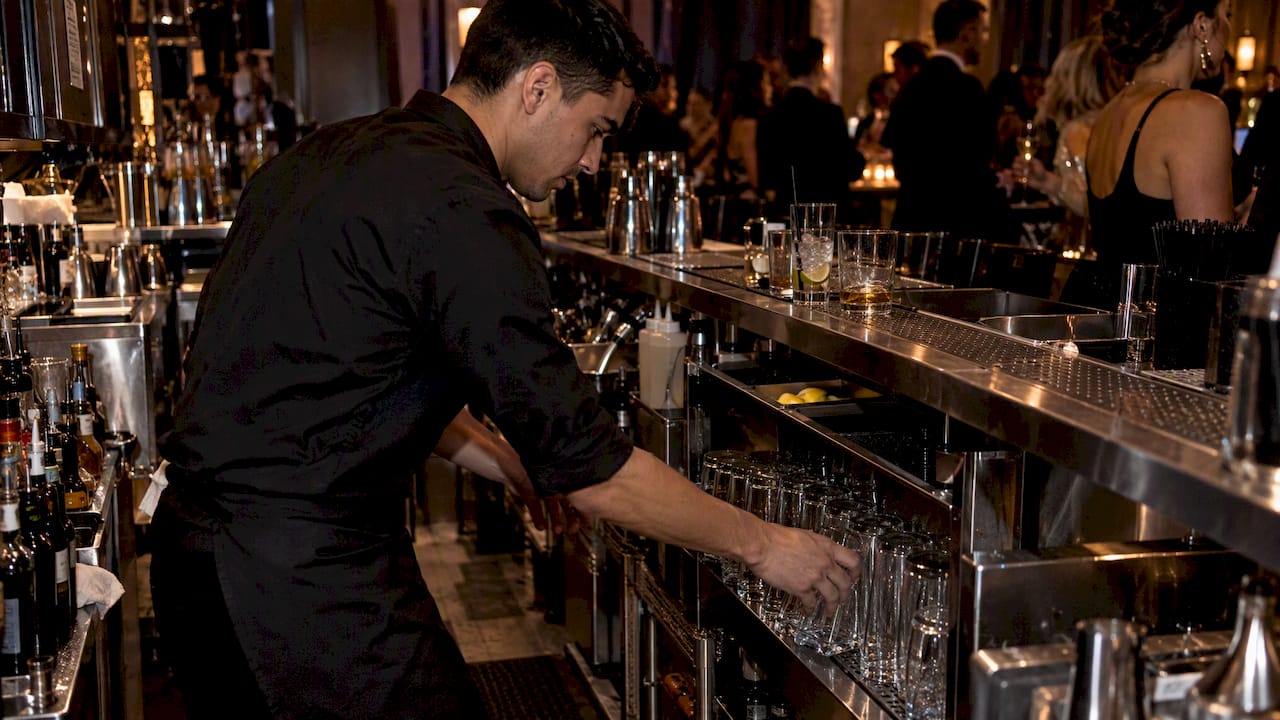
Use more stations, not longer bars
One 8-foot bar with three bartenders crowds them and forces guests into a single queue. Two or three separate stations split the crowd. Place them away from the entrance and away from each other, with room for guests to step aside once served.
For weddings, we often put one full bar near the reception and a secondary beer and wine station near the ceremony space or lounge. For corporate events, a second station by the registration or stage area keeps people from clustering at one spot. Our bar rental packages cover the physical bars, and we can brand them to match your event.
Cut the menu to raise capacity
A full-service menu is not the fastest one. These changes add capacity without adding staff:
- Limit signature cocktails to two. Pre-batch the mixers so each drink is a pour and a garnish.
- Offer a short core list. One or two beers, red and white wine, and a handful of spirits.
- Pre-pour the first round. Champagne or a welcome drink on a tray clears the first rush before guests reach the bar.
- Serve in sturdy cups where the venue allows. Glass breakage and polishing slow a large bar.
- Stock ice and cold storage generously. Running out mid-event stops service for everyone.
For a deeper look at what goes into a package, see what a bar package includes. For the first hour of a reception, our planner’s guide to cocktail hour explains why a staffed bar matters most then.
Las Vegas rules that shape a large bar
This is where large events in Southern Nevada differ from other markets. Check current rules with the city or county before you book, because fees and procedures change.
Licensed caterer or event permit
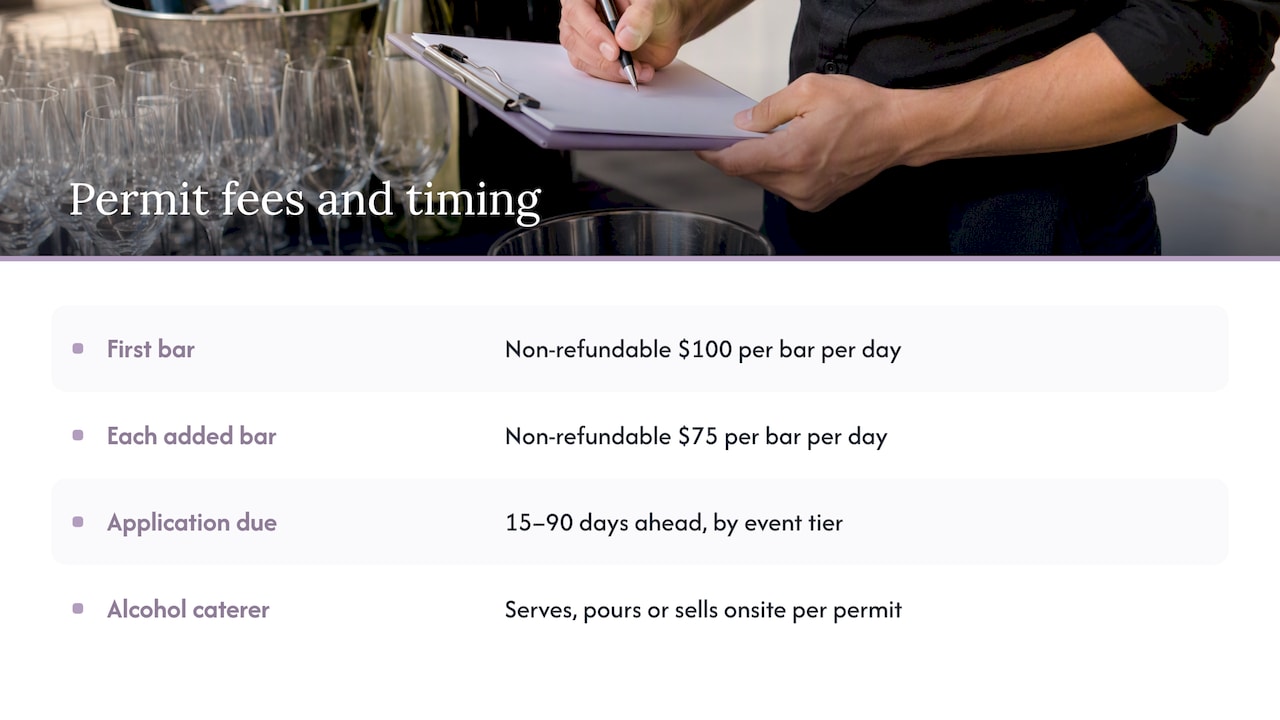
Under the City of Las Vegas liquor code, if you are not using a licensed liquor caterer, you need an Off-Premise Liquor Permit or a Special Event Alcohol Permit. That permit carries a non-refundable fee of $100 for the first bar per day and $75 for each additional bar per day. Applications are due 15 to 90 days ahead, depending on the event tier.
The code defines an alcohol caterer as a person who serves, pours or sells alcohol for consumption on the premises, during the times, dates and places specified by permit. The city’s own alcohol license information sheet shows that a licensed alcoholic beverage caterer works under a permit for each bar and each day. Added bars mean added paperwork, so decide your station count early. Henderson is a separate jurisdiction with its own business licensing, so confirm requirements with the city if your venue is there.
Staff documentation
Las Vegas code requires a list of everyone working the event, with work card and health card numbers. It must be available on site for inspection by Metro Police and the Department of Business License. A bartending team that can’t produce that list on request is a risk to your event, not just an inconvenience.
Alcohol education cards
Nevada requires employees who serve or sell alcohol to hold a valid alcohol education card under NRS 369.630. It applies in counties with a population of 100,000 or more, including Clark County. Violations are subject to fines from $500 to $5,000. Ask any provider whether every bartender and barback on your event holds one.
Compliance as protection
Keeping training records, permits and an alcohol control plan on file also protects you as the host. The Nevada Department of Taxation’s general liquor information outlines how the state regulates liquor distribution. Documented training and controls are what you point to if something goes wrong. Consult an attorney or your insurer if you have specific liability questions for a large corporate event.
Responsible service also means pacing. Food, a water station and a clear last-call time help more than any policy memo. If your event has a sound or entertainment plan, coordinate it with the bar team. A DJ who knows when last call happens can help guide the room, and event DJ and venue planning resources are worth a look when you’re lining up vendors for a big night.
Planning timeline
Work backward from the event date:
- 90 days out. Confirm guest count, venue rules and whether the venue has its own liquor license or requires an outside caterer. Request quotes.
- 60 days out. Sign the contract. Lock the menu and bar count. Start any permit paperwork if no licensed caterer is involved.
- 30 days out. Finalize the staff list and credentials. Confirm load-in times, power, water and ice access.
- 1 week out. Confirm the final headcount and any VIP or open-bar timing.
- Event day. Arrive early for setup, run a short walk-through with your coordinator, and keep a printed copy of permits and the staff list at the bar.
For weddings, our liquor catering contract checklist for couples lists what to confirm before you sign.
Wedding, corporate or private party: what changes
Weddings. The pressure comes after the ceremony and during toasts. Plan a station near the cocktail space and a welcome drink to ease the first rush. See our wedding events page and the Las Vegas wedding beverage guide.
Corporate events. Convention receptions and company parties tend to be short, with a hard start and a hard stop. That compresses demand into one or two peaks, so staffing leans higher per guest. A branded menu or cocktail can double as a talking point. We cover this in branded cocktails for corporate events and in our convention bartending package guide.
Networking events. Guests arrive across a longer window, but they stand in line holding a name tag and a conversation. Keep drinks simple. See how to plan networking event bar service.
Our perspective
Most high volume problems we see are planning problems, not bartending problems. A host trims the staff to save money, then adds a complicated cocktail list, and the bar can’t keep up by the first hour. The better trade is almost always a simpler menu and an extra barback.
We work only in Las Vegas and Henderson, so the local paperwork is routine for us, not a scramble. We run fully licensed and insured, with more than 20 years of experience, and we plan to the Las Vegas municipal code. For big events we start from the guest count and the arrival pattern, then work out stations, staff and a menu that fits. Compliance is part of how a good bar runs, and having permits and staff records in order is a sign a provider takes the event seriously.
— Brennon
Work with us on a large event
If you’re planning a wedding, corporate event or private party in Las Vegas or Henderson with a big guest list, we can help. Our mobile bartending and liquor catering services come with custom packages, bar branding and venue coordination. We don’t publish prices because each event differs, so tell us your date, venue and guest count and we’ll build around them. For corporate groups, start with our corporate events page. If you already have a team and just need hands behind the bar, see dry hire staffing.
FAQ
How many bartenders should you have for 150 people?
A common ratio is one bartender per 50 guests, so three for 150. One staffing guide suggests two bartenders ideally with a barback for 100 to 150 guests. With signature cocktails or a short cocktail hour, add a bartender.
Do private bartenders provide alcohol?
It depends on the provider and the contract. Some supply bartenders only, which is dry hire, and you buy the alcohol. Others provide liquor catering with the alcohol included. Ask which model you’re being quoted before you compare prices.
Do bartenders in Las Vegas need a special card?
Yes. Nevada requires employees who serve alcohol in counties of 100,000 or more, including Clark County, to hold an alcohol education card. Ask your provider to confirm it for every person on your event.
Do I need a permit for an event bar in Las Vegas?
If you don’t use a licensed liquor caterer, the city requires an Off-Premise Liquor Permit or Special Event Alcohol Permit. Applications can be due 15 to 90 days ahead. Check the current rules with the city or, for Henderson, with the city of Henderson.
Sources
- Las Vegas Code of Ordinances, Chapter 6.50 Liquor Control
- City of Las Vegas, Alcohol Licenses General Information
- Nevada Department of Taxation, Tax Notes Issue 178
- Nevada Department of Taxation, Intoxicating Liquor: Licenses and Taxes NRS 369
- How Many Bartenders Do You Need for 50, 100 or 200 Guests?
- How Many Bartenders Do I Need? Calculator and Guide