
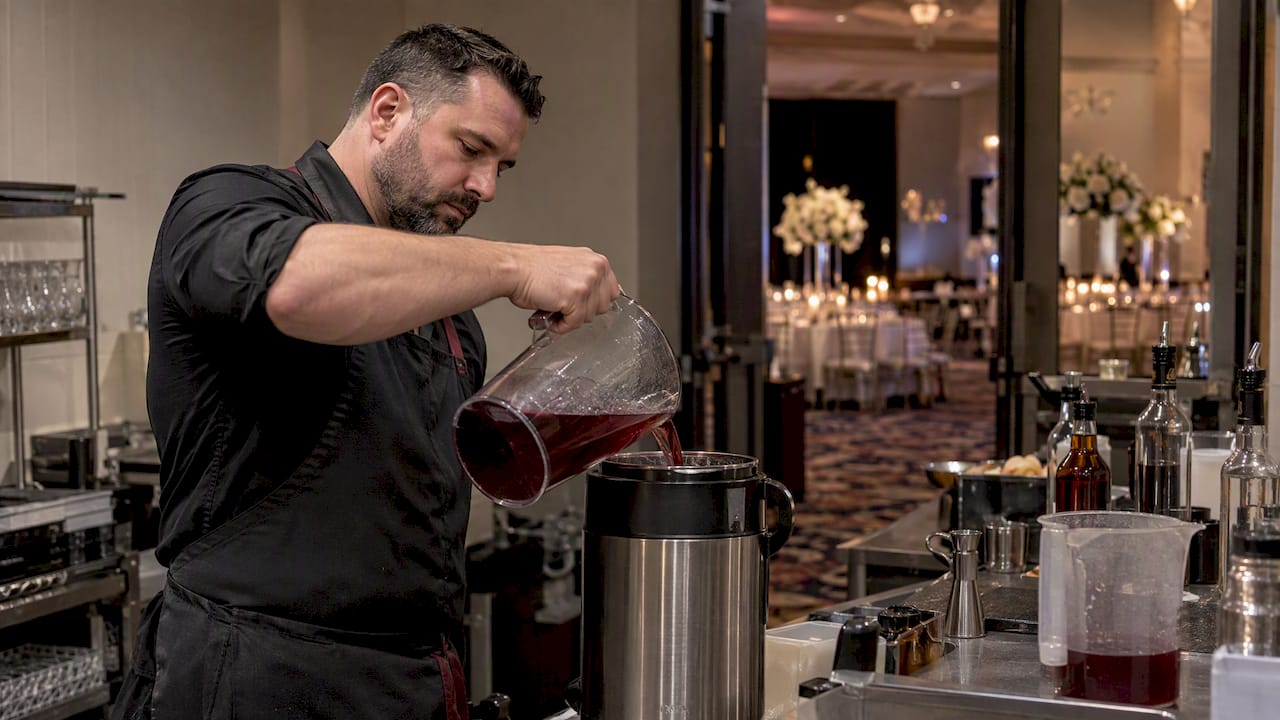
The three fastest changes to speed up bar service are cutting the menu to 2 to 4 signature drinks, staging a tight mise en place so bartenders never leave the rail, and pre-batching high-volume cocktails before the first guest arrives. Together these moves eliminate the seconds that pile up into long lines. The sections below walk through exactly how to put each one to work.
TL;DR:
- Keep each recipe to four ingredients or fewer, remove specialty tools, and make drinks with fresh citrus, muddled fruit, or delicate garnishes to order.
- Batch cocktails with stable ingredients only after accounting for dilution from ice; taste batches, label their dates and contents, and verify balance before service.
- Plan one bartender per 30 to 50 guests at cocktail receptions, increase coverage for heavy spirits menus or peak hours, and assign distinct roles.
- Open bars shortly before cocktail hour, stagger ceremony exits, dinner releases, and toasts, and use welcome drinks or satellite stations to spread demand.
- Before each shift, stage glassware, ice, and portioned garnishes within reach, then run a timed drill for 10 to 15 minutes building rounds.
Table of Contents
- Design a speed-first menu: pick fewer, clearer options
- Set up bar logistics and mise en place to eliminate wasted steps
- Round-building, batching, and pre-pour techniques that save seconds
- Staffing and role templates: assign tasks so bartenders stay on the rail
- Layout and satellite stations: reduce queue pressure with service points
- Equipment and POS choices that keep the bartender facing guests
- Practice drills and quick training routines to elevate baseline speed
- Timing and scheduling to avoid peak crowding
- Efficient order taking and communication protocols among bartenders
- Using technology for order management and speed tracking
- Techniques for rapid drink garnish preparation
- Inventory management during events to prevent delays
- Strategies for managing high-volume guest influx
- Event-practitioner notes from Brennon and Liquid Courage LV
- When hiring a mobile bartending team removes the guesswork
- FAQ
- Sources
Design a speed-first menu: pick fewer, clearer options
A long cocktail list is the single biggest hidden cause of slow bar service. Every extra option adds hesitation at the point of order and extra motion behind the bar. Industry guidance from the FIU Chaplin School of Hospitality points to a small, tightly managed list, generally 2 to 4 signature drinks, as the most reliable way to make bartenders faster while keeping builds consistent. Everything outside that short list should default to simple pours: wine, beer, a spirit and mixer, nothing that requires a recipe card.
Menu layout matters almost as much as menu length. A board with high-contrast text, short category names, and a type size readable from six feet away lets guests decide before they reach the front of the line. We’ve found that templated menus speed this process considerably, and you can see sample layouts in this bar menu for wedding guide built for exactly this purpose.
Deciding what to batch versus build to order comes down to two factors: garnish complexity and dilution sensitivity. A drink with a muddled fruit garnish or a delicate herbal float usually needs to stay made to order. A spirit-forward cocktail with stable, shelf-safe ingredients batches cleanly.
Use this quick checklist when revising a menu:
- Cut any drink that needs more than four ingredients or a specialty tool.
- Keep one not-too-sweet and one spirit-forward option to cover most tastes.
- Flag any drink with fresh citrus or muddled fruit as made-to-order only.
- Confirm every remaining recipe can be built in under 45 seconds.
Set up bar logistics and mise en place to eliminate wasted steps
Most wasted time at a bar comes from bartenders turning away from the rail to grab something they should have had in arm’s reach. Professional beverage directors describe an economy of movement, building every drink in front of the well with a consistent mise en place, as the core discipline behind high-speed service according to SevenFifty Daily. That means a speed rack stocked in the same order every shift, garnishes prepped and portioned before doors open, glassware staged within reach, and ice managed so no one is chipping or scooping mid-rush.
Placement rules reinforce the habit: build directly in front of the well, designate a landing zone for finished drinks, keep a waste bowl within reach instead of walking to a trash can, and pre-portion backbar items so nothing requires measuring twice. These station principles mirror what professional kitchens teach, where a clear landing zone and constant cleaning as you go keep a line moving, a translation Serious Eats lays out clearly for any high-volume workstation.
Run this setup routine before every shift:
- Stock the speed rack in identical order, left to right, every time.
- Portion and tray garnishes for the first two hours of service.
- Stage glassware by drink type within arm’s reach.
- Fill ice wells and check backup ice access.
- Wipe down the rail and set the waste bowl and bar towel.
- Walk the station once, pretending to build your three most common drinks.
Pro Tip: Set a phone timer for a 60-second reset every time there’s a lull. Wipe the rail, restock garnishes, and check ice before the next wave hits.
Round-building, batching, and pre-pour techniques that save seconds
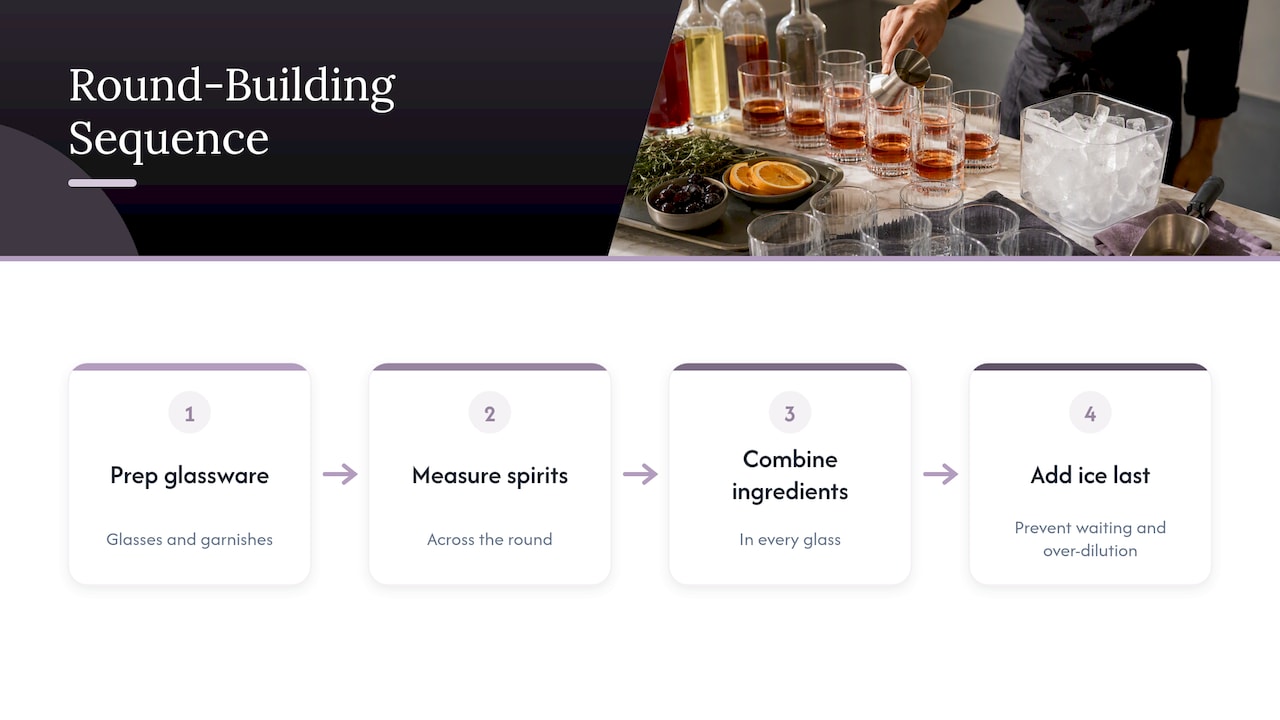
Round-building is the technique that keeps a bartender from finishing one drink while three more sit half-built. The order matters: prep the glass and garnish first, measure every spirit for the round, combine ingredients across all glasses, and add ice last across the entire round so no finished drink sits waiting and over-dilutes while others catch up, a sequence recommended by SevenFifty Daily.
Batching removes even more friction for high-volume moments. Not every cocktail batches well: the key is accounting for dilution. Serious Eats recommends measuring how much water a single stirred or shaken drink would normally pick up from ice, then scaling that water into the batch recipe so the poured drink balances correctly over ice at service. GatherRound notes that batching non-perishable ingredients also reduces the number of touches per drink and lets less experienced staff pour consistent cocktails during a rush. We put several batchable recipes to work regularly, including the pours covered in our bachelorette party drinks guide.
A tightly managed menu and batched high-volume drinks let fewer bartenders serve more guests without sacrificing consistency, according to SevenFifty Daily.
Before service, taste-test every batch, label it with the build date and contents, and pour a small sample to confirm balance. Toast service and cocktail hour are ideal batching windows since guests expect a quick pour; a complex, citrus-forward cocktail with a delicate garnish is the one case where batching should wait.
Staffing and role templates: assign tasks so bartenders stay on the rail
Clear roles matter as much as headcount. A common ratio for cocktail-heavy receptions runs one bartender per 30 to 50 guests, with adjustments for a heavier spirits list or a packed cocktail hour. Dividing labor, assigned pouring, garnish, and payment roles, keeps each bartender focused on building drinks instead of juggling every task, a division SevenFifty Daily ties directly to faster service.
A useful role breakdown for a mid-size event:
- Order-taker/expediter: manages the line, calls out orders, and keeps the queue visible.
- Pourer: builds drinks exclusively, never leaves the well.
- Garnish/finish: preps garnishes and finishes drinks for pickup.
- Barback/restocker: replenishes ice, garnishes, and backbar stock without interrupting pourers.
Junior staff benefit from short, repeatable drills: a pour-test to confirm consistent measures, a walkthrough of the batching procedure, and a timed round-building practice run. Briefing the team before doors open, covering the menu, the batch plan, and each person’s role, then collecting a quick post-shift note on what slowed things down turns every event into a chance to tighten the next one. Our cocktail hour guide covers how staffing decisions shift once cocktail hour starts.
Layout and satellite stations: reduce queue pressure with service points
Lines usually form because one bar is asked to do too much. Adding a second bar or satellite station becomes worth it once guest count or venue layout starts bottlenecking a single point, a planning fix Sortra recommends well before a line gets visibly long.
Satellite options worth considering:
- A self-serve beer and wine table that pulls simple orders off the main bar.
- A welcome-drink stand at arrival so guests aren’t funneled straight to one line.
- A pre-batched signature-drink kiosk near the dance floor or lounge area.
- A coffee or non-alcoholic station for guests winding down, which also spreads foot traffic; wedding coffee bar ideas cover setups that scale to 150 to 200 guests.
Floorplan choices matter too: keep bars away from jammed doorways, give the queue room to form without blocking walkways, and spread stations so traffic doesn’t funnel to one corner. Clear signage and a visible menu board at each station let guests decide before they’re next in line, which keeps the whole system moving.
Equipment and POS choices that keep the bartender facing guests
Every time a bartender turns away from the rail to run a card or hunt for a tool, the whole line slows down. The equipment choices below keep attention on the guests in front of the bar:
- Use a handheld POS or a tap system near the rail so payment never pulls a bartender away from pouring.
- Stock speed pourers and pre-measured pour spouts on every bottle in regular rotation.
- Keep a dedicated glass chiller or frozen glassware supply for cocktails that call for it.
- Confirm ice volume and backup ice access before the first guest arrives.
- Vet any new equipment for its footprint, power needs, and whether it adds a staffing step instead of removing one.
Automated dispensing systems or dedicated drink stations can be worth exploring for very high-volume events, but they only pay off when they reduce touches rather than adding another piece of gear to manage.
Practice drills and quick training routines to elevate baseline speed
Speed is a trained habit, not a personality trait. A 10 to 15 minute timed round-building drill, building the same three drinks back to back while tracking time, gives staff a baseline to beat. Pair it with a quick pour-test to confirm measures stay consistent under pressure.
Run this routine before every shift:
- Walk the station for 15 minutes to catch any layout or supply gap.
- Run one timed round-building drill with the full team.
- Spot-check two batches for taste and dilution.
- Confirm every role assignment out loud before doors open.
Track a few simple metrics across events: average ticket time, how long the queue runs at its peak, and how guests describe the wait afterward. None of these require special software, just a notebook and a consistent habit of checking them.
Pro Tip: Small gains compound fast: shaving five seconds off every drink build adds up to minutes of saved queue time an hour once volume picks up.
Timing and scheduling to avoid peak crowding
Most bar lines form not because service is slow but because every guest arrives at the bar at once. Staggering obvious triggers, the end of a ceremony, the start of dinner, a toast, a first dance, spreads demand instead of letting it collide. Opening the bar a few minutes before a cocktail hour officially starts absorbs the first wave before it becomes a line.
Scheduling drink service around these predictable spikes is one of the simplest planning fixes available, and Sortra points to it as a practical tactic alongside satellite stations and staffing adjustments. A welcome drink handed out at the door, for instance, pulls thirsty arrivals away from the main bar during the busiest ten minutes of any event.
Music and announcements play a role too: a DJ who staggers table releases for dinner or times a toast announcement a few minutes after the bar reopens keeps guests from funneling toward the same spot simultaneously. Coordinating that timing with whoever runs the event’s music, as outlined in this cocktail hour playlist resource, turns scheduling into another lever for crowd control rather than an afterthought.
Efficient order taking and communication protocols among bartenders
Confusion at the point of order costs more time than slow pouring ever does. A clear, repeatable protocol for calling out and confirming orders keeps multiple bartenders working the same well without collisions, something SevenFifty Daily ties directly to a consistent bar layout and shared economy of movement.
A workable protocol looks like this: the order-taker calls the drink out loud once, the pourer repeats it back while building, and the garnish station confirms the finish before handoff. This three-step loop prevents remakes, which are far more costly than a few extra seconds of communication up front.
When two or more bartenders share a well, assigning each a side of the station and a default drink category, spirits on one end, wine and beer on the other, avoids the step-on-each-other shuffle that slows down a packed rail. A hand signal or short verbal cue for “behind” or “coming through” keeps movement predictable even when the bar gets loud.
Using technology for order management and speed tracking
Technology helps most when it removes a step rather than adding one. A tablet-based tab system that lets a bartender open and close a tab without stepping away from the rail keeps hands on bottles instead of on a register. For events with pre-paid packages, a simple wristband or ticket system at the door avoids any payment conversation at the bar entirely, which is often the single biggest time cost per guest.
Tracking speed doesn’t require specialized software. A phone timer during a round-building drill, a tally of how many drinks go out per ten-minute stretch, or a quick count of queue length at set intervals throughout the night all give usable data. Comparing those numbers across events shows whether a menu change or a new station layout is actually working, rather than guessing.
Techniques for rapid drink garnish preparation
Garnish prep is one of the easiest places to save real time, because nearly all of it can happen before a single guest arrives. Citrus wheels, wedges, and twists should be cut and stored in portioned trays rather than sliced to order. Herbs like mint get rinsed, dried, and bundled in advance so a bartender grabs a sprig instead of pulling leaves one at a time mid-rush.
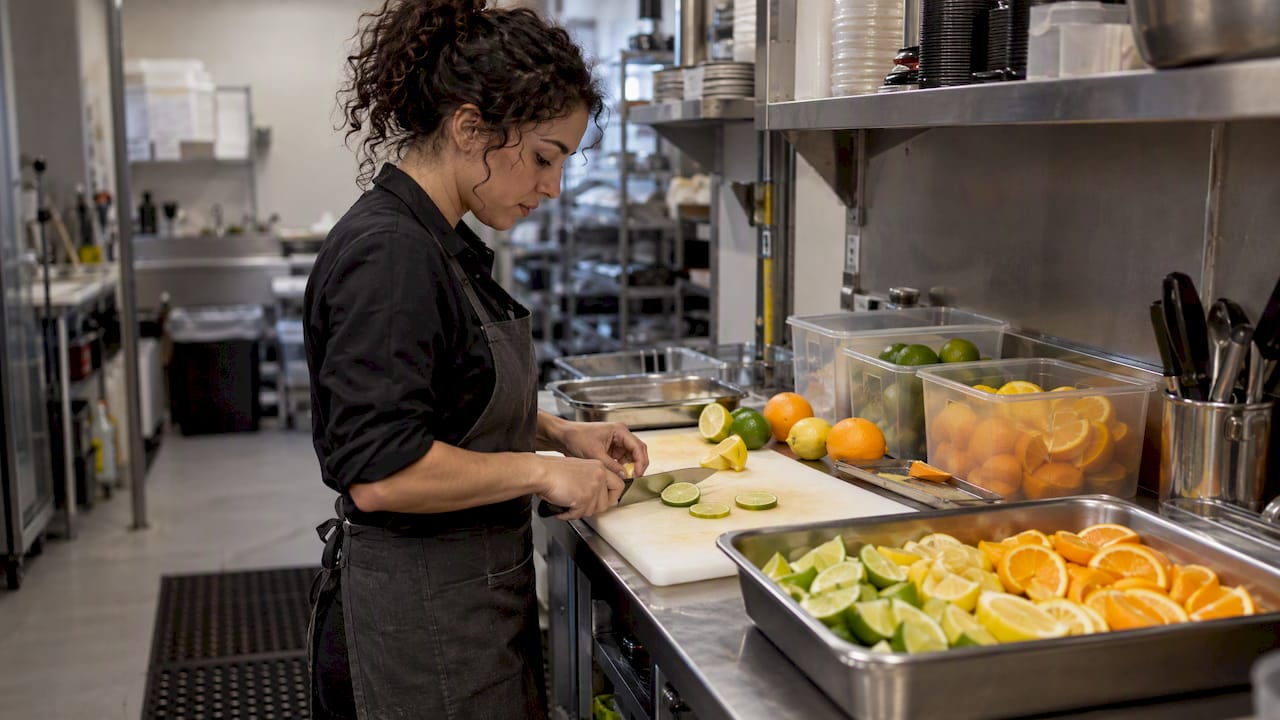
Garnish complexity is also the clearest signal for what stays made-to-order versus what moves into a batch. A drink needing a muddled fruit garnish or a flamed citrus twist needs a dedicated finishing step every time, while a simple citrus wheel or olive can be pre-skewered in bulk and held in a tray at the garnish station.
Keeping garnish trays within arm’s reach of the pour station, rather than requiring a walk to a prep area, is one of the station principles Serious Eats emphasizes when translating kitchen workflow to a bar. A dedicated garnish and finish role, as covered in the staffing section above, keeps this prep work from ever competing with pouring.
Inventory management during events to prevent delays
Running out of ice, a core spirit, or garnish mid-event is one of the few problems that can stall service entirely, not just slow it down. A pre-event count, confirming bottle levels, ice volume, and garnish quantities against expected guest count, catches shortages before doors open rather than mid-rush.
Beverage quantity planning should scale to the guest list and event length rather than a flat guess; a venue-tested beverage calculator for a 100-guest event offers a useful reference point for planners sizing out a bar order. Building in a buffer, rather than ordering to the exact expected count, avoids a mid-service scramble.
During service, a barback dedicated to restocking, rather than splitting that duty with pouring, keeps supply checks from interrupting the rail. A quick mid-event count of ice and key spirits, timed around the 60-second reset habit covered earlier, flags a looming shortage with enough runway to fix it quietly instead of after the bar runs dry in front of a line.
Strategies for managing high-volume guest influx
The busiest ten minutes of any event, the rush right after a ceremony ends or a first course clears, is where every earlier change gets tested at once. A tight menu, staged mise en place, and pre-batched signature drinks all exist to absorb exactly this kind of spike without the line stretching across the room.
Opening a satellite station or a second bar, as covered earlier, matters most during these windows: Sortra notes that deploying multiple service points is a direct, practical fix for the long lines that form during a planning-related crowding problem, not a staffing shortfall. Pairing that with a welcome drink or pre-batched option at the door pulls volume away from the main bar before the rush even starts.
Staff communication becomes critical here too: a clear call-and-confirm order protocol, assigned roles that don’t shift mid-rush, and a barback restocking without interruption all matter more in a ten-minute spike than during a steady lull. The events that handle high-volume influx well are rarely the ones with the most bartenders; they’re the ones where every bartender already knows exactly what to do when the room fills at once.
Event-practitioner notes from Brennon and Liquid Courage LV
Working mobile bars at private events, we’ve watched the same pattern repeat: arrivals hit in waves, not a steady trickle, so staging a welcome-drink table near the entrance absorbs that first wave before it ever reaches the main bar. At cocktail hour, pre-batched signature drinks poured the moment guests round the corner keep a line from forming at all. Quick staff choreography, one pourer per well, one dedicated restocker, matters more than headcount once a room fills.
When hiring a mobile bartending team removes the guesswork
Every tactic above works, but putting them all in place takes practice, staffing decisions, and equipment most event hosts don’t handle every week. We build our mobile bartending services around exactly this: a licensed, insured team that brings the menu design, staging, batching, and staffing ratios covered above to your event already dialed in.
- Private events get a customized bar package sized to guest count and venue layout.
- Weddings and corporate events each get staffing and menu plans suited to the crowd, from wedding bar service to corporate event bartending.
- Hosts who already have staff but need extra hands can book dry hire staffing instead of a full turnkey package.
If your event is small and your team is confident running the drills above, the operational fixes in this guide will take you far. If you’d rather hand the planning, staffing, and setup to a team that does it every week, get a quote for your event and skip the line problem entirely.
FAQ
What is the 50% rule in bartending?
Cost control is the focus more than speed, and the details vary by bar and region, so check it against your own supplier pricing before applying it.
How much should you pay a private bartender?
Private bartender pricing depends on event length, guest count, and package inclusions, and it’s not publicly standardized across the industry. Our own private bartender services pricing is available on request based on your event details.
How can I learn to bartend faster?
Practice round-building with a timer, prep your mise en place before every shift, and run pour-tests until your measures stay consistent under pressure. Building drinks in front of the well with everything staged in arm’s reach, rather than reaching or walking for ingredients, is the habit SevenFifty Daily ties most directly to faster service.
Can bartenders make good money working events?
Earnings vary widely by market, event type, and whether a bartender works independently or through an agency, and no single figure applies across the board. Tips and event rates both play a role, so it’s worth comparing offers in your own market rather than relying on a general number.
Sources
- The simple operational changes that can speed up bar service | SevenFifty Daily
- How to batch cocktails for parties | GatherRound