
Most Las Vegas venues require a Certificate of Insurance showing a minimum standard level of general liability coverage, with the venue named as Additional Insured on a primary and non-contributory basis. That single endorsement, not just a certificate listing the venue’s name, is what actually protects the property and gets your event approved. Some rooms, pool decks, and high-traffic resorts ask for more. The next section breaks down exactly what to request from your broker.
TL;DR:
- Most Las Vegas venues require a certificate of insurance with an endorsement adding them as an Additional Insured on a primary, non-contributory basis, not just listing their name.
- Standard venue requirements typically include at least $1 million per occurrence and $2 million total coverage, with some high-risk spaces requesting higher limits up to $3 million or $5 million.
- Public property events need permits from Clark County or the City of Las Vegas, requiring proof of insurance from an authorized Nevada insurer at least 30 days before the event.
- Vendors such as AV crews or security may need separate certificates and higher limits than the host’s policy, with timely submission crucial for approval.
- Missing a correct endorsement, mismatched legal names, or late, unauthorized filings are the most common reasons for rejection of COIs.
Table of Contents
- Standard COI elements Las Vegas venues expect
- Where requirements vary: venue examples and higher-limit cases
- Official permits and county/city special-event insurance requirements
- How to get a venue-ready COI: step-by-step checklist for organizers and vendors
- Vendor and contractor COI expectations when you hire third parties
- Common mistakes and red flags that cause COI rejections
- Practitioner perspective: how a Las Vegas bartending vendor coordinates COIs
- How Liquid Courage LV helps with COIs and venue coordination
- Sources
- FAQ
Standard COI elements Las Vegas venues expect
A venue-ready COI has four moving parts, and missing any one of them is the most common reason a submission bounces back.
- Limits: The usual minimum coverage includes general liability with specified limits; an umbrella or excess policy fills gaps when a venue asks for coverage beyond the base limits.
- Additional Insured endorsement: naming the venue as “certificate holder” does nothing for coverage. The venue must be added as an Additional Insured, a formal endorsement that actually extends protection to them, a distinction explained in detail by Mr. Niceday in the context of event rentals.
- Primary and non-contributory wording: this tells the venue’s own insurer that your policy pays first, and that carriers are authorized to do business in Nevada.
- ACORD 25 form: the standard certificate format venues expect, with the legal entity name matching your contract exactly.
Resorts World Las Vegas requires Commercial General Liability of $1,000,000 per occurrence and $2,000,000 aggregate, additional insured status for the resort and its affiliates, a carrier rated at least A-VII by A.M. Best, and primary and non-contributory language, according to its contractor guidelines for conferences and events. That combination, limits plus endorsement plus rating, is close to the Las Vegas standard. For a fuller rundown of what different property types expect, see our overview of event insurance requirements for Las Vegas venues.
Where requirements vary: venue examples and higher-limit cases
Baseline limits cover most banquet rooms and ballrooms, but several categories of Las Vegas venues ask for more, and the right number depends on the space and the activity planned inside it.
- Resorts World Las Vegas sets its floor at $1 million per occurrence and $2 million aggregate, with an A.M. Best A-VII carrier rating and additional insured status for the resort and its affiliates, per its meeting planner contractor guidelines.
- MGM Grand’s vendor policy lists higher limits for certain contractors, in some cases $3 million to $5 million per occurrence, and separately requires commercial auto and workers’ compensation where applicable, according to its Conference Center vendor policy.
- High-risk spaces such as pool decks, nightclubs, and loading docks tend to draw higher limit requests because of water exposure, crowd density, or heavy equipment movement.
- Convention-scale facilities often layer in extra endorsements for general sessions versus exhibit floors.
Always confirm exact wording and current limits with the property’s Catering or Conference Services Manager before you order a certificate. Policy minimums change, and a generic COI built for a backyard party will not pass muster at a resort ballroom.
Official permits and county/city special-event insurance requirements
A venue’s COI rules are only half the picture. If your event sits on public property, in a park, or along a public right of way, Clark County or the City of Las Vegas will also require proof of insurance as part of the permit package, and the permit will not be issued without it.
- Confirm jurisdiction first. Clark County, the City of Las Vegas, and the City of Henderson each run their own permit processes; an event spanning multiple boundaries may need more than one approval.
- Submit the Special Event Permit package early. Clark County’s SEP package, which bundles the application, a hold harmless agreement, a traffic control plan, and a COI naming Clark County and the Las Vegas Metropolitan Police Department as additional insured, can be filed as early as 120 days out but no later than 30 days before the event, according to the Clark County Special Event Permit Package.
- Use an authorized carrier. Clark County specifies that the comprehensive general liability policy come from an insurer authorized to do business in Nevada, and notes that meeting the minimums in Title 16, Chapter 16.06 does not relieve the permittee of its own indemnification duties.
- Check city-specific rules too. The City of Las Vegas publishes its own insurance requirements for parks and permitted events, which list coverage types and naming conventions separate from the county’s SEP.
- Factor in health permits. Events involving food or alcohol service on public land may also trigger a special event review from the Southern Nevada Health District.
Missing the 30-day county window, or naming the wrong agency on the COI, is enough to stall a permit that otherwise looks complete.
How to get a venue-ready COI: step-by-step checklist for organizers and vendors
Getting the paperwork right is mostly a timing problem. Start too late and you will be chasing your broker the week of the event.
- Start the moment you sign the venue contract. Give your broker the venue’s exact additional insured wording, limits, and any special endorsements right away.
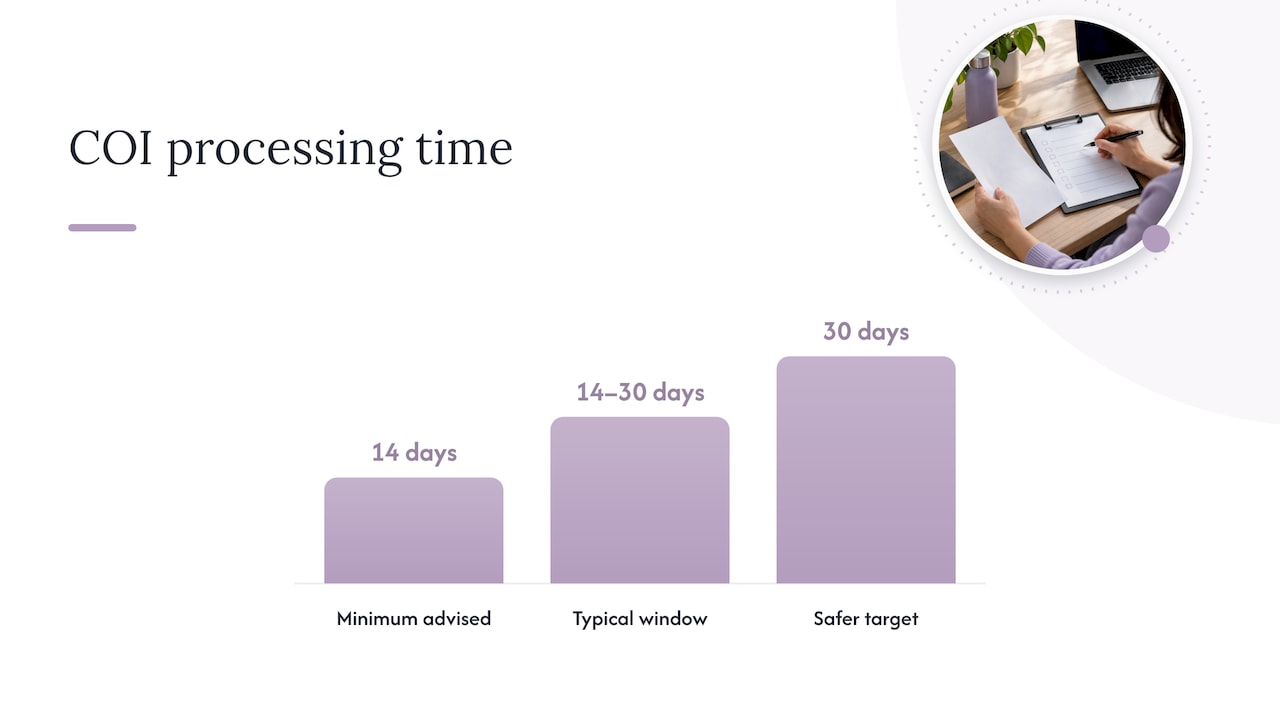
- Build in 14 to 30 days of processing time. Resorts and large conference centers often want the final COI on file well before move-in day, so treat 30 days as the safer target.
- Request the right fields on ACORD 25. The form should show your correct legal entity name, the venue as Additional Insured (not just certificate holder), primary and non-contributory language, and a carrier rating that meets the venue’s A.M. Best threshold.
- Separate vendor coverage from your own. If you are hiring caterers, AV crews, or rental companies, confirm which of them need to submit their own COI directly to the venue, and which fall under your umbrella.
- Submit through the venue’s preferred channel. Most properties want the COI emailed to the Catering or Conference Services Manager, sometimes through a credentialing portal, with a confirmation request so you have a paper trail.
- Follow up in writing. A short email confirming receipt protects you if a document gets lost in a shared inbox.
Pro Tip: Email your broker the venue’s insurance page or PDF directly, word for word, instead of summarizing it. Brokers can match exact endorsement language faster than they can guess at a paraphrase.
For a venue-by-venue breakdown of what Las Vegas properties typically request, our guide to event insurance requirements walks through hotel, resort, and banquet-hall differences in more depth.
Vendor and contractor COI expectations when you hire third parties
The host usually carries the primary COI, but that does not always cover every vendor working the event. Venues frequently want separate certificates from higher-risk contractors even when the host’s policy is on file.
- Audiovisual crews, riggers, security staff, and sometimes onsite caterers are the vendors most often asked for their own COI.
- Typical vendor-level requirements include commercial auto liability, workers’ compensation, and employers liability, on top of general liability.
- Some vendor categories face higher limit requests than the host’s own policy, particularly where heavy equipment or structural work is involved.
- Collect vendor COIs well before event week and keep them in one folder so nothing is missing when the venue asks.
Our breakdown of what event insurance covers for bartending services walks through how this applies specifically to beverage vendors.
Common mistakes and red flags that cause COI rejections
Most rejected COIs fail for the same handful of reasons, and nearly all of them are fixable before submission.
- Certificate holder instead of Additional Insured: listing the venue as the certificate holder does not extend coverage to them; the endorsement is what matters.
- Mismatched legal entity names: a parent company name on the COI when the contract lists the operating subsidiary (or vice versa) is an easy, common error.
- Missing primary and non-contributory wording: without it, the venue’s own carrier may dispute who pays first.
- Unauthorized carriers or late filing: a carrier not licensed in Nevada, or a certificate submitted after the venue’s cutoff, both stall approval.
Pro Tip: Ask the venue for a sample COI or policy PDF and hand it straight to your broker; matching their exact template eliminates most rejection risk.
Practitioner perspective: how a Las Vegas bartending vendor coordinates COIs
Working events across Las Vegas and Henderson, the pattern repeats: the earlier a vendor supplies its COI, the smoother the venue walkthrough goes. Once a host signs a bartending contract, the realistic next step is the vendor sending its own certificate straight to the venue’s coordinator while looping in the host, so nobody is left tracking down paperwork the week of the event.
— Brennon
How Liquid Courage LV helps with COIs and venue coordination
Chasing down vendor insurance paperwork on top of planning a wedding or corporate event adds a layer of stress most hosts would rather skip. Liquid Courage LV handles that piece as part of booking, so you are not the one emailing a resort’s conference services office at 11 PM trying to match endorsement wording.
- Mobile bartending and liquor catering for weddings, corporate events, and private parties.
- Bar rental packages built to fit various venue requirements.
- Venue coordination that includes supplying a COI directly to the property’s conference or catering manager.
If you are booking a wedding, corporate event, or private party and need a bartending team experienced with venue insurance paperwork, start with a services overview and the team can assist with the COI process.
Sources
Keep these on hand when you are confirming requirements or attaching documents to a permit application.
- Contractor guidelines for conferences & events — Resorts World Las Vegas (Meeting Planner Guide, 2025)
- Clark County Special Event Permit Package — Clark County Public Works
- MGM Grand Conference Center vendor policy (vendor/contractor insurance obligations)
FAQ
Does your venue require vendors to have a COI?
Many Las Vegas venues require each vendor to carry its own Certificate of Insurance, especially for higher-risk work like audiovisual, rigging, or security, even when the host already has a primary policy on file. Confirm directly with the venue’s conference or catering manager which vendors are covered under the host’s COI and which need to submit their own.
What type of insurance does a venue need?
Most Las Vegas venues expect commercial general liability with the venue named as Additional Insured on a primary and non-contributory basis, commonly at $1 million per occurrence and $2 million aggregate, as outlined in Resorts World’s contractor guidelines. Some vendors also need commercial auto and workers’ compensation depending on the work involved.
What is event insurance in Las Vegas, Nevada?
Event insurance in Las Vegas generally refers to a general liability policy, sometimes paired with a short-term event policy, that covers injury or property damage tied to a specific gathering. Hosts typically secure this through a broker and then have the venue added as Additional Insured before the event date.
How do I obtain a COI for an event?
Contact your insurance broker as soon as you sign a venue contract and give them the exact additional insured wording, limits, and endorsement language the venue requests. Ask for the certificate on an ACORD 25 form with your correct legal entity name, and plan for 14 to 30 days of processing before the event.