

If you’re selling or serving alcohol at a Nevada event venue that doesn’t hold its own liquor license, you must secure an off-premise (special event) liquor permit from the local licensing office, whether that’s Clark County Department of Business License, the City of Las Vegas Business Licensing division, or Henderson’s Special Events unit, through Henderson Police. The immediate move is simple: confirm your coordinating liquor license, identify which jurisdiction covers your venue, and start that office’s application right away.
TL;DR:
- Off-premise liquor permits in Nevada require a valid coordinating license held by the event vendor, with different fees and processing times depending on jurisdiction.
- Application submission must include staff credentials, site diagrams, proof of insurance, and outside approvals if applicable, with early timing crucial for complex or multi-day permits.
- Clark County offers the fastest approval process for straightforward events, with permits usually processed within two working days, while city and Henderson permits involve longer reviews.
- Enforcement relies heavily on maintaining a chain of custody with signed delivery manifests, secure storage, and designated staff responsible for compliance during the event.
- Vendors should clarify permit filing responsibility, include staff training and insurance proof in contracts, and prepare complete documentation to avoid common application pitfalls.
Table of Contents
- What an off-premise liquor permit covers and who issues it
- How to apply: step-by-step workflow and who to contact
- Fees, timelines and processing expectations
- Jurisdiction differences: Clark County vs. Las Vegas vs. Henderson
- On-site compliance and handling rules
- Required documents, staffing credentials, and staff training
- Common mistakes and a one-page compliance checklist
- Liquid Courage LV’s local experience with permitting and timing
- What planners should prioritize when hiring a bartender or caterer
- How Liquid Courage LV helps with permitting and compliant service
- Primary sources: official forms and statutes to bookmark
- Sources
- FAQ
What an off-premise liquor permit covers and who issues it
An off-premise liquor permit authorizes alcohol service at a location that doesn’t already hold its own liquor license, such as a private residence, a rented warehouse, a park pavilion, or a corporate office. This differs from retail off-premise sales, which refers to stores selling sealed alcohol for consumption elsewhere. For events, the permit is tied to a specific date, address, and set of service stations, not a standing license.
Clark County issues permits in three tiers based on what’s being served, and the Off-Premise Liquor Permit Application requires the applicant to already hold a valid liquor license before the county will process the request. This coordinating license, usually held by the caterer or bartending company, is what the county checks against before granting the event-specific permit.
Standard permit restrictions typically include:
- A fixed start and end time matching the event schedule, not open-ended hours.
- A site map or diagram showing where alcohol will be served and stored.
- A cap on the number of service stations tied to the fee paid.
- Proof that the applicant’s coordinating license is active and in good standing.
Nonprofits follow a related but distinct track. Clark County’s charitable organization off-premise application asks for charitable registration numbers alongside the standard event details.
How to apply: step-by-step workflow and who to contact
Getting the paperwork right the first time saves weeks. Follow this order:
- Confirm jurisdiction first. Determine whether your venue sits in unincorporated Clark County, inside Las Vegas city limits, or within Henderson, since each office has its own form and routing.
- Gather your coordinating license details. You’ll need the current liquor license number tied to your bartending or catering operation.
- Build the event packet. Prepare the event address, a site diagram, estimated attendance, and the number of planned service stations.
- Compile staff credentials. List every server by name with their work card number and Alcohol Awareness Training completion date.
- Assemble insurance and supplemental documents. Attach proof of liability coverage and, where relevant, TTB paperwork for the alcohol source.
- Secure outside approvals if needed. Events on county or city park property generally require a parks department approval letter attached to the permit application, a detail covered in more depth in guidance on serving alcohol in Las Vegas parks.
- Submit to the correct office. File with Clark County Business License, City of Las Vegas Business Licensing, or Henderson’s Special Events desk (routed through Henderson Police for the alcohol component).
- Pay the applicable fee at submission, since most offices will not process an incomplete or unpaid application.
- Confirm receipt and processing timeline directly with the office, since county and city systems don’t always cross-notify each other.
Clark County’s liquor and gaming forms page hosts the current Off-Premise application along with submission guidance, and it’s worth bookmarking alongside the City of Las Vegas’s alcoholic caterer instruction sheet if your event falls inside city limits.
Fees, timelines and processing expectations
Budgeting for permit fees is straightforward once you know which tier applies. Clark County charges fixed fees per event day based on the permit type — lower for beer-only, moderate for beer and wine, and higher for full liquor — as listed in the Off-Premise Liquor Permit Application. That figure sets your baseline cost for a single-day event; multi-day events pay the daily rate for each day of service.
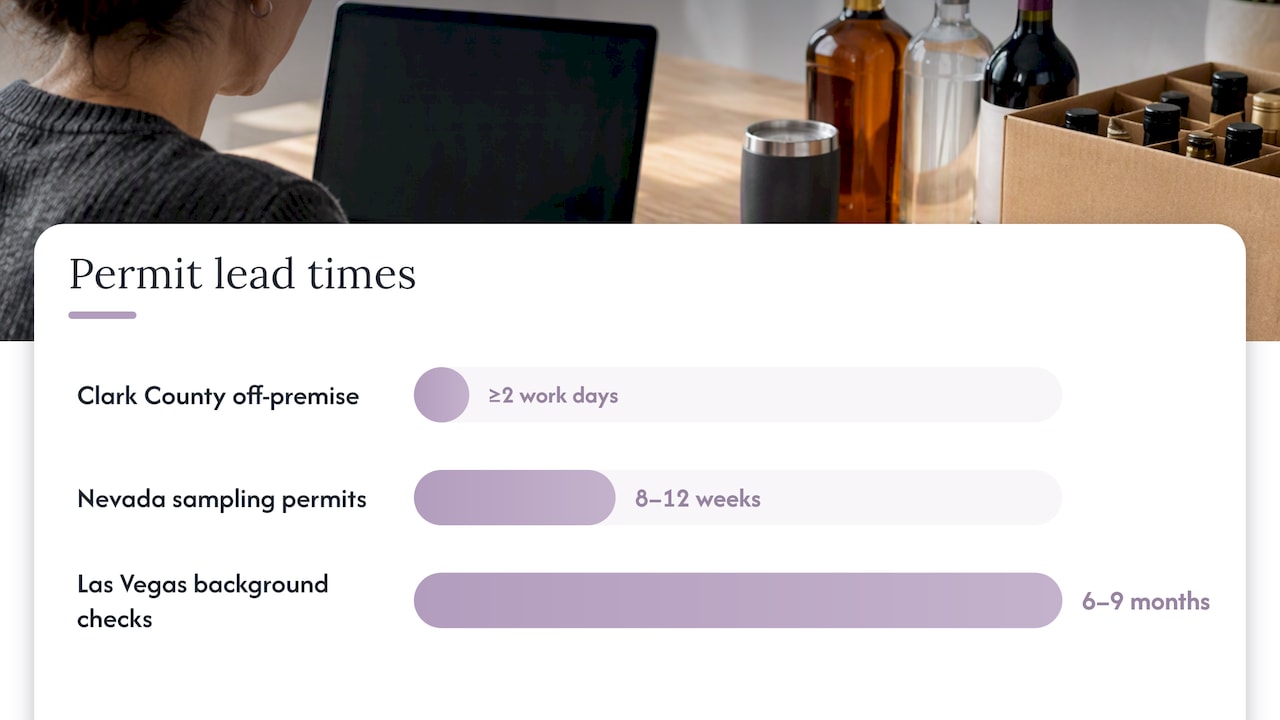
City of Las Vegas fees run higher when a full alcoholic caterer license is involved, and the Business Licensing instruction sheet notes that principal background investigations and suitability approvals can average six to nine months, a different animal from a simple per-event county permit.
Lead times vary sharply by permit type. Clark County generally wants Off-Premise applications submitted at least two working days before the event, per its forms page guidance. Sampling permits move much slower: Liquid Courage LV’s own tracking of Nevada alcohol sampling permits shows 8 to 12 weeks is typical for that category, so don’t confuse the two timelines when scheduling a launch event or brand activation.
Beyond the base fee, expect business license fees, and in some cases a surety bond or security deposit tied to the venue or event type.
Jurisdiction differences: Clark County vs. Las Vegas vs. Henderson
Where your event sits changes almost everything about the process. Clark County handles unincorporated areas through its Business License division and generally moves fastest for straightforward off-premise permits. The City of Las Vegas routes alcoholic caterer and full liquor licensing through its own Business Licensing office, and that path can involve zoning checks and background investigations absent from a county-only event. Henderson requires alcohol service at events to go through Special Events and Film Permit approval, with Henderson Police signing off on the alcohol component and requiring a designee present for the duration of service.
Key differences to plan around:
- Clark County: fastest turnaround, minimal outside sign-off unless the event is on county park property.
- City of Las Vegas: longer timelines, higher fees, and background checks tied to full liquor licensing.
- Henderson: police-level review is built into the permit, and a named designee must be on-site the entire time alcohol is served.
State filings enter the picture when a new liquor license is being established rather than a one-day event permit. NRS Chapter 369 gives the Department of Taxation authority over liquor licensing statewide and confirms that local jurisdictions can layer additional permit requirements on top of state rules.
On-site compliance and handling rules
The permit holder, usually the licensed caterer or bartending company, keeps custody of alcohol from the moment it’s delivered until disposal at the end of the event. That custody chain matters to enforcement officers as much as the paperwork does.
Expect to maintain:
- Locked or continuously supervised storage for all alcohol on-site, with beer and wine kept chilled separately from ice meant for drinks.
- Signed delivery manifests and photographs of sealed cases at drop-off, creating a paper trail if questions arise later.
- A supervisor’s signature confirming receipt of product at delivery.
- A designated on-site supervisor responsible for age verification, staff oversight, and keeping service inside the boundaries shown on the posted map.
- Liability insurance that meets or exceeds the minimum the issuing jurisdiction requires.
Pro Tip: Keep a printed copy of your site diagram taped near the bar itself, since inspectors often check it against where service is actually happening.
Required documents, staffing credentials, and staff training
Your application packet and your event-day binder should contain the same core documents, so build them together.
- A copy of the coordinating liquor license held by the caterer or bartending company.
- The completed off-premise application form for the correct jurisdiction.
- An event map or diagram showing service and storage locations.
- Proof of liability insurance, and TTB documentation when the alcohol source requires it.
- A staff roster listing every server’s name, work card number, and Alcohol Awareness Training expiration date.
- Written designation of the on-site liquor supervisor, including a direct contact number.
If your staff list runs long, attach extra pages rather than trimming names, since a missing server credential is one of the fastest ways to trigger a compliance flag.
Common mistakes and a one-page compliance checklist
Most permit denials and event-day citations trace back to a handful of repeat mistakes.
- Assuming a coordinating liquor license covers every venue, when in fact each address needs its own event-specific permit.
- Submitting the application too close to the event date, leaving no buffer if a document is missing.
- Leaving staff work card numbers or training dates off the roster.
- Carrying insurance below the jurisdiction’s stated minimum.
- Skipping the site map or diagram entirely.
- Accepting deliveries without a signed manifest or photo record.
Watch for doubled fees too. Some events unintentionally trigger both a permit fee and a separate catering tax obligation, a trap covered in detail in guidance on avoiding doubled permit fees and alcohol catering tax in Nevada.
For event day, keep this short list on hand: permit copy, insurance certificate, signed delivery manifest, staff training records, named supervisor contact, and the posted service-area map.
Liquid Courage LV’s local experience with permitting and timing
A licensed mobile bartending and liquor catering company operating in Las Vegas and Henderson works inside these permit rules on a recurring basis. Sampling permits and certain event approvals often take 8 to 12 weeks to clear, a timeline worth building into any launch or activation schedule well before the guest list is finalized.
Signed delivery manifests, sealed-case photographs at drop-off, and a named supervisor with a working phone number solve more compliance disputes than any single form ever will.
What planners should prioritize when hiring a bartender or caterer
Ask any vendor early who files the permit and who covers the fee. Insist on contract language covering delivery windows, a signed receipt process, and proof of staff training and insurance before signing anything.
— Brennon
How Liquid Courage LV helps with permitting and compliant service
Planning a wedding, corporate event, or private party in Las Vegas or Henderson gets simpler when the bartending team already knows which office to file with and how long each approval actually takes. Experience with jurisdiction-specific requirements and trained staff with delivery manifests helps keep the permitting process smooth and the paper trail clean for bookings.
- Full-service mobile bartending and liquor catering for weddings, corporate events, and private parties.
- Staff trained on Nevada service rules, with permit paperwork handled as part of the booking process.
- Bar rental packages and private bartender services for events of any size.
Confirm your event’s jurisdiction and lead time first, then reach out through Liquidcouragelv to request a quote and get the permitting conversation started early.
Primary sources: official forms and statutes to bookmark
- Clark County Off-Premise Liquor Permit Application and the liquor and gaming forms page.
- Nevada State Liquor License Application (EXC-F065) and NRS Chapter 369.
- City of Henderson Special Event and Film Permit information and the City of Las Vegas alcoholic caterer instructions.
- For parking logistics tied to event permitting, see this guide to day-of-event parking permits.
Sources
- Off-Premise Liquor Permit Application (rev. 12.2024) — Clark County Department of Business License
- Clark County — Liquor and gaming miscellaneous forms
- Business license instruction: Alcoholic caterer — City of Las Vegas
- Special Event and Film Permit information — City of Henderson
- NRS 369 — Intoxicating liquor: licenses and taxes
FAQ
How much does a liquor license cost in Nevada?
Costs depend heavily on the license type: Clark County’s off-premise event permits run $50 per day for beer, $75 per day for beer and wine, and $150 per day for full liquor, according to the Off-Premise Liquor Permit Application. A full alcoholic caterer or standing liquor license through the City of Las Vegas involves higher fees and a longer background review process.
What does off premise alcohol sales mean?
Off-premise alcohol sales refers to alcohol sold or served at a location that doesn’t hold its own standing liquor license, such as a rented venue, private home, or park space. In the event context, it requires a temporary permit tied to a specific date and address rather than an ongoing retail license.
Is it cheaper to buy liquor in California or Nevada?
This article covers Nevada’s event permitting process rather than retail pricing comparisons between states, and no sourced figures here address that question. Anyone planning an event should focus instead on the permit fees and lead times specific to their venue’s jurisdiction.
Can I walk around with alcohol in Las Vegas?
Open container rules for public streets and the Las Vegas Strip are governed by local ordinance and fall outside the scope of the off-premise event permit process covered here. Event organizers should confirm service-area boundaries with the issuing jurisdiction, since permits authorize alcohol only within the mapped and approved service area, not open movement beyond it.