

Most alcohol entering Nevada must go to a licensed importer or wholesaler, moved by a common carrier, a regularly operating contract carrier, or a vehicle holding a special permit under Nevada’s liquor tax rules. The main personal exceptions cover wine shipped directly to a resident (up to 12 cases a year) and small personal imports, with a 21-plus age requirement throughout Event operators and mobile bartenders need county permits and, for wholesale transfers, the Department’s EXC-F023 transport affidavit before liquor moves anywhere.
TL;DR:
- Liquor must be shipped through licensed Nevada importers or wholesalers, with direct-to-venue shipments prohibited for commercial orders.
- Moving wholesale liquor requires a special vehicle permit and detailed shipment documentation, which unlicensed mobile bartenders cannot obtain.
- Event alcohol permits in Clark County should be filed at least 10 working days before the event, and sampling permits can take eight to twelve weeks to process.
- Nevada residents can receive up to 12 cases of wine annually with proper tax payment, but all other alcohol types must go through licensed channels.
- Accurate shipment reporting and timely tax payments are essential to avoid license suspensions or criminal penalties in Nevada.
Table of Contents
- Nevada’s Three-Tier System and the Basic Rule for Shipments
- Who Can Legally Move Wholesale Liquor Across Nevada
- Getting Permits to Pour Alcohol at Your Event
- When Can a Nevada Resident Receive Alcohol Directly?
- Reporting Shipments and Paying Liquor Excise Tax on Time
- What Happens When Businesses Get Alcohol Transport Wrong
- What Local Event Experience Teaches About Nevada Alcohol Rules
- How Liquid Courage Handles the Permit Work for You
- Official Statutes, Guidance, and Forms Worth Bookmarking
- Sources
- FAQ
Nevada’s Three-Tier System and the Basic Rule for Shipments
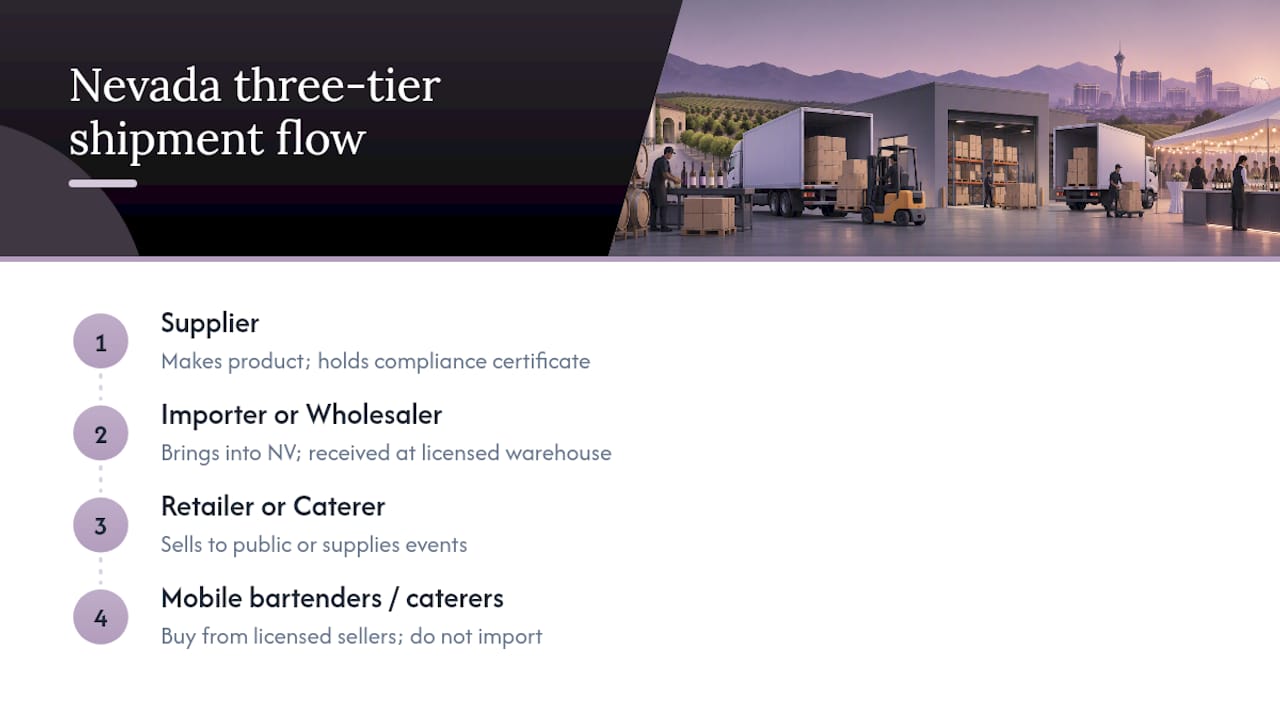
Nevada runs on a three-tier structure: suppliers make the product, importers and wholesalers bring it into the state and distribute it, and retailers sell it to the public. Each tier is licensed separately, and the law generally bars a supplier from skipping a tier to sell straight to a bar, caterer, or consumer.
That structure is why commercial shipments must be directed to a licensed Nevada importer or wholesaler at an approved warehouse location rather than to an event site or a private address. A supplier holds a certificate of compliance that limits exactly who it may ship to, and shipping outside that authorization risks the certificate itself.
For event planners, the practical takeaway is simple: you cannot have a distillery or out-of-state supplier send cases straight to your venue. Liquor has to pass through a licensed wholesaler first, then reach the retailer or caterer through normal, permitted channels. Mobile bartending companies and caterers buy finished, already-imported product from licensed retailers or wholesalers rather than attempting to import it themselves, which keeps them outside the transport-permit requirements that apply to wholesale movement.
Who Can Legally Move Wholesale Liquor Across Nevada
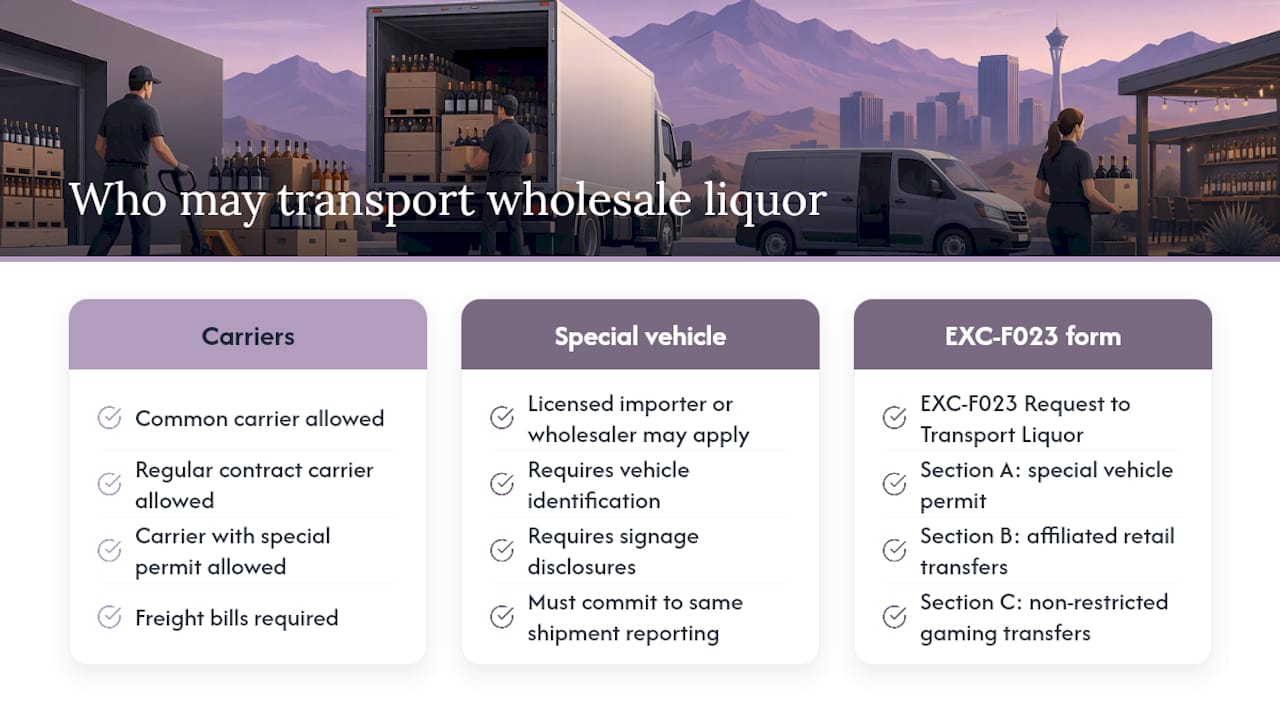
NRS 369.450 states that liquor cannot be imported into Nevada except by a common carrier, a regularly operating contract carrier, or a carrier holding a special permit. Whichever category applies, the carrier must keep freight bills or statements available for every shipment showing the consignor, the consignee, the date received, and the destination.
A licensed importer or wholesaler that needs to move liquor by its own vehicle, rather than through a commercial carrier, applies for a special vehicle permit from the Department. That application requires vehicle identification, signage disclosures, and a commitment to the same shipment reporting that applies to other carriers.
The Department’s EXC-F023 Request to Transport Liquor affidavit is the form behind that permit. Section A covers the special vehicle permit itself, Section B addresses transfers between affiliated retail locations, and Section C covers transfers involving non-restricted gaming licensees. Each section carries its own certification language, and the form notes limits on beer transfers between affiliate retail locations. This form is built for licensed wholesalers and similar entities: an unlicensed mobile bartender or caterer cannot use it to move wholesale stock on their own.
Getting Permits to Pour Alcohol at Your Event
Serving alcohol at a private event in Clark County almost always means a Liquor Caterer Permit, priced at $10 per service station. The county recommends filing the application well in advance before the event, as submissions made late typically incur double the fee.
The permit works differently depending on who is running the bar. A licensed caterer serving alcohol under its own liquor license files the Liquor Caterer Permit for the event. A for-profit organizer without its own liquor license instead needs an off-premises permit tied to a licensed retailer, which carries a separate set of documentation requirements.
Before submitting anything, confirm these items are ready:
- The venue’s special-event permit is already approved, since the county treats the liquor permit as supplemental to it.
- Your liquor license number and business details are on hand for the application.
- A list of employees working the bar, including work card numbers, is attached.
- Proof of alcohol awareness training for staff is included with the paperwork.
- Fees are paid on submission, not left for the day of the event.
Pro Tip: File the liquor caterer permit the moment your event date and venue are locked in. Ten working days is a minimum, not a target, and incomplete applications get returned rather than corrected on the spot.
When Can a Nevada Resident Receive Alcohol Directly?
Following SB 307, suppliers may ship wine directly to a Nevada resident, capped at 12 cases per year, with the supplier responsible for the associated excise tax. This exception applies only to wine. Beer and spirits still have to move through a licensed importer or wholesaler before reaching a consumer.
Separately, Department guidance recognizes a small personal import allowance of roughly one gallon per month for household use. Any recipient in either case must be 21 or older, and carriers typically require an adult signature on delivery. Neither exception opens a path for commercial quantities: a caterer or bar buying stock for an event cannot rely on the personal-use rules to receive product directly from an out-of-state supplier.
Reporting Shipments and Paying Liquor Excise Tax on Time
NAC 369.016 requires suppliers to file a shipment report for each delivery into Nevada. The report needs the consignee’s name and address, the kind and quantity of liquor in gallons rounded to the nearest one-hundredth, the percentage of alcohol by volume, and the date the liquor was shipped.
These reports tie directly to excise tax filing, and missing a filing or a payment deadline is not a minor paperwork slip: the regulation allows suspension of a supplier’s certificate of compliance for failure to comply. For businesses handling regular shipments, a clean recordkeeping habit avoids this entirely. Keep a simple log with one row per shipment, matching the exact fields the regulation asks for, and reconcile it against invoices before each filing period. Save copies of every freight bill and signed delivery receipt, since those documents back up the shipment report if the Department asks questions later.
What Happens When Businesses Get Alcohol Transport Wrong
Violations here carry real weight. The Department can suspend a certificate of compliance or a license, and separate state law imposes criminal penalties for furnishing alcohol to minors or for driving under the influence, which remains a 0.08% BAC standard for operators regardless of who is transporting or serving the alcohol.
The most common traps are avoidable. Moving wholesale quantities without a special vehicle permit, skipping the county event permit because “it’s a small party,” checking IDs casually instead of consistently, and failing to keep delivery paperwork all invite enforcement attention. The fix is procedural rather than complicated: work with licensed carriers, keep every signed delivery record, file shipment and tax reports on schedule, and build permit deadlines into your event timeline the same way you’d schedule a caterer or a rental delivery.
What Local Event Experience Teaches About Nevada Alcohol Rules
Running mobile bar service across Las Vegas and Henderson makes one thing obvious: the businesses that get burned by Nevada’s alcohol rules aren’t ignoring them, they’re underestimating the lead time. A liquor caterer permit filed nine working days out gets bounced right back, and a sampling permit request submitted the month before an event is often already too late.
A workable order of operations looks like this: lock the venue’s special-event permit first, file the liquor caterer permit at least 10 working days ahead, confirm staff work cards and alcohol awareness training, verify carrier and transport arrangements for any wholesale product, and finalize insurance and contract terms last. Sampling-permit approvals in particular can run 8 to 12 weeks in practice, so that step belongs on the calendar from day one, not the week before.
— Brennon
How Liquid Courage Handles the Permit Work for You
Coordinating venue permits, county paperwork, and staff certifications on top of planning a wedding or a corporate event is a lot to carry alone. Liquid Courage handles mobile bartending and liquor catering for Las Vegas and Henderson events, with insured staff and permit timelines built into the planning process rather than left for the last minute.

That means less time chasing forms and more certainty that your bar will be legal and ready when guests arrive. Our services include:
- Mobile bartending and full liquor catering for various events.
- Bar rental packages for organizers who want a turnkey setup.
- Permit and timeline coordination alongside private bartender services for your date.
The first step is simple: reach out with your event date and venue so we can start permit coordination early and confirm what your event specifically needs.
Official Statutes, Guidance, and Forms Worth Bookmarking
Save these directly from the source and check back before any event where alcohol changes hands:
- Liquor Tax guidance, Nevada Department of Taxation
- NRS 369.450, carrier and special permit rules
- EXC-F023 Request to Transport Liquor affidavit
- Clark County Liquor and Gaming permit forms
When a form or requirement is unclear, contact the Department of Taxation or the Clark County Department of Business License directly rather than guessing.
This article is general information, not a substitute for advice from a qualified lawyer. Consult a qualified legal professional about your own circumstances before acting on anything here.
Sources
- Liquor Tax – State of Nevada
- EXC-F023 Request to Transport Liquor Affidavit
- Nev. Admin. Code § 369.016 – Submission of report for shipments of liquor; failure to comply
FAQ
Can passengers drink alcohol in a car in Nevada?
No. Nevada law prohibits open containers of alcohol in the passenger area of a vehicle on a public highway, regardless of whether the driver or a passenger is drinking. This applies statewide, not just in specific cities.
What are the laws on alcohol in Nevada?
Alcohol in Nevada is governed by a three-tier distribution system requiring shipments to go through licensed importers or wholesalers, transport by authorized carriers under NRS 369.450, and a legal drinking and possession age of 21. Event alcohol service also requires county-level permits such as Clark County’s Liquor Caterer Permit.
Can you drink openly in Nevada?
Open container laws vary by jurisdiction within Nevada, and some areas, including parts of the Las Vegas Strip, allow limited open consumption in specific public zones while driving with an open container remains illegal everywhere. Check local Clark County ordinances for the exact boundaries before assuming a wider area is covered.
Can I buy liquor in grocery stores in Nevada?
Yes, Nevada allows the sale of beer, wine, and spirits in licensed grocery and convenience stores, unlike states that restrict spirits to dedicated liquor stores. Buyers must still be 21 or older, and retailers hold the appropriate license through Nevada’s licensing system.
What is the legal age for alcohol transport in Nevada?
Anyone receiving, transporting, or accepting delivery of alcohol in Nevada must be 21 or older, including for the personal wine shipment exception allowing up to 12 cases per year. Carriers delivering wine or personal-import quantities typically require an adult signature confirming age at the time of delivery.