
A backup bar plan is a written contingency that names who steps in if beverage service breaks down, what equipment or supplies they use, and how the handoff happens without guests noticing. The single most useful thing you can do right now is assign an on-call backup, whether a vendor or an internal staffer, and write down the exact trigger that activates them. From there, decide whether that backup looks like an on-call mobile bartender or a spare bar rental sitting ready in a truck.
TL;DR:
- Assign an on-call backup bartender or vendor and clearly define activation triggers such as no-shows over 15 minutes or equipment failure to ensure swift response.
- Keep a detailed, pre-written backup plan with roles, procedures, and a checklist ready to execute, minimizing service disruption under 20 minutes.
- Staff ratios should be one bartender per 30 to 50 guests, with additional support from barbacks for larger events to prevent stalls from staffing issues.
- Confirm permit responsibilities and have all required documentation, training, and signage accessible on-site to avoid legal complications during a backup replacement.
- Maintain an emergency kit with extra ice, supplies, and sealed bottles, and consider professional backup staffing to ensure seamless coverage in unexpected situations.
Table of Contents
- Practical backup options for keeping the bar open
- Copyable backup bar plan template and activation protocol
- Staffing ratios, barback support, and why bars stall
- Permits and safety checks your backup plan needs
- How Liquid Courage builds a backup bar plan that holds up
- Want a backup bar plan already built for you?
- Sources
- FAQ
Practical backup options for keeping the bar open
The right backup depends on how fast you need someone in place and how complicated your permit situation is. A corporate happy hour with a venue-held liquor license has different needs than a backyard wedding relying on a single hired bartender.
- On-call mobile bartending: a turnkey swap-in when you need licensed, insured staff who can legally pour within the hour.
- Designated backup bartender: a vendor float or internal team member who already knows your event, useful when continuity with the primary crew matters more than speed.
- Barback or floater staff: keeps pours moving during short interruptions like a restock run or a bathroom break gone long.
- Portable spare bar and dry-hire equipment: solves a broken tap, a cracked ice well, or a guest count that outgrew the original setup.
- Venue or caterer contingency: works when the venue holds the permit and can legally escalate service without a new application.
Time-sensitivity should drive the choice. If a no-show happens 20 minutes before doors open, an on-call bartender who can be there fast beats a rental delivery that takes an hour. If the equipment fails but staff are fine, a spare bar or dry-hire gear solves it faster than swapping people. For guest counts under 75, a single backup bartender is usually enough. Past that, pair a backup bartender with a barback so one person isn’t running drinks and pouring at the same time.
Copyable backup bar plan template and activation protocol
Every backup plan needs defined roles before it needs anything else. Write these into your run sheet exactly as follows:
- Event lead: authorizes the plan and makes the final call to activate a backup.
- Primary bartender: the person originally scheduled to run the bar.
- Backup on-call: a named vendor or staffer with a phone number, not a general contact.
- Barback: restocks, manages ice, and supports whoever is pouring.
- Security contact: handles intoxication or ID disputes.
- Venue contact: confirms permit status and can approve a temporary bar location change.
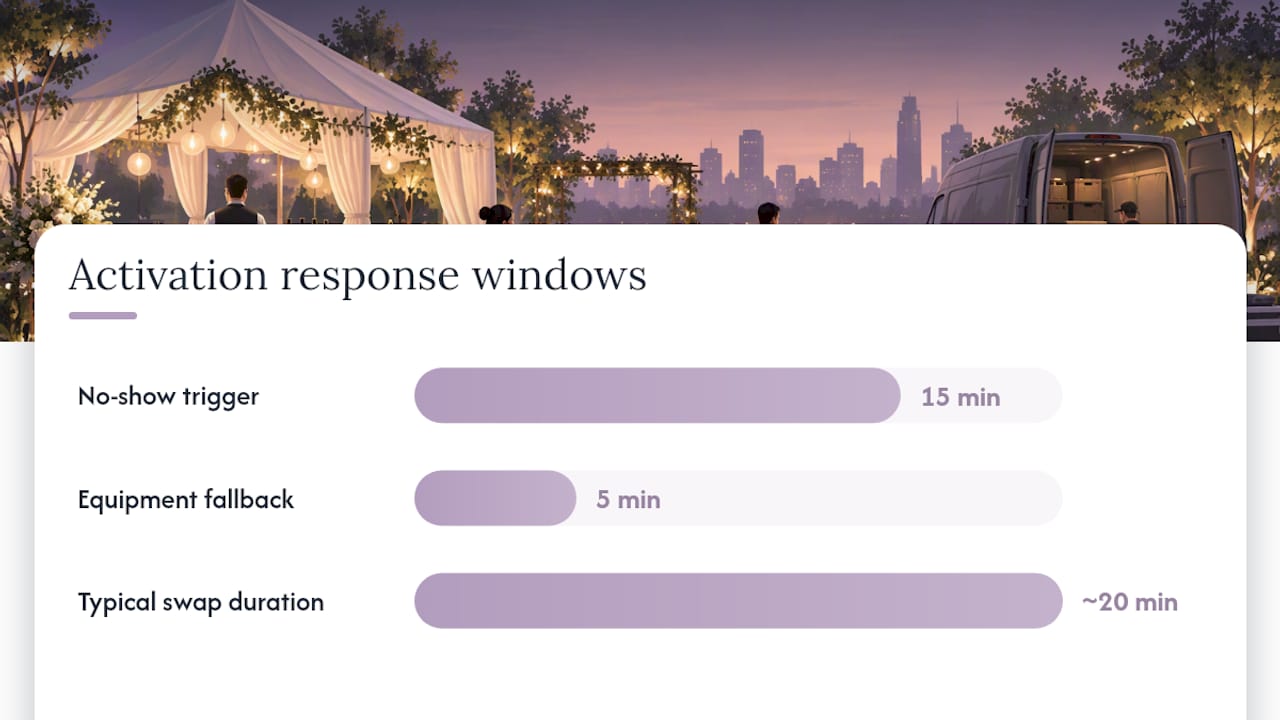
Set activation triggers with exact response windows, not vague language. A no-show past 15 minutes triggers a call to the backup on-call. Equipment failure, such as a broken tap or a dead POS system, triggers the barback to switch to a manual cash or card fallback within 5 minutes. A visible intoxication spike triggers the security contact and a temporary service pause. A permit or inspector stop triggers the venue contact to produce documentation immediately.
The handoff itself needs a checklist so nothing gets missed mid-swap:
- Take an inventory snapshot before the swap so nothing walks off unaccounted for.
- Hand over keys and POS access with a code or card, not a verbal promise to “figure it out.”
- Confirm the posted alcohol policy sign is still visible at the new station.
- Log the incident with time, reason, and who authorized the swap.
- Remind the incoming bartender to keep checking IDs without a pause in enforcement.
Communication matters as much as the checklist. The event lead calls the backup on-call, the backup confirms an ETA by text, and both meet at a pre-agreed spot near the bar rather than searching the venue. Build a rough timeline into your run sheet: identify the gap, call backup, confirm arrival, complete handoff, reopen. Most swaps should take under 20 minutes if the plan is written ahead of time.
Stock a small emergency kit before the event: ice in sufficient quantity to outlast a delivery delay, backup mixers, a spare card reader, extra glassware or disposable cups, replacement signage, and sealed spare bottles or kegs that don’t require a new order mid-event.
Pro Tip: Store your backup bar plan as a single printable page and give a copy to the venue contact, not just your own team, so anyone on-site can activate it.
Staffing ratios, barback support, and why bars stall
Most bar failures trace back to staffing math done wrong before the event even started. Liquid Courage recommends one bartender per 30 to 50 guests for VIP bar setups, a ratio built to keep pours fast without long lines. Open bars with mixed cocktails need staffing closer to the low end of that range since cocktails take longer to build than a beer or a pour of wine.
Barbacks matter more than most planners budget for. A bartender who leaves the station to grab ice or restock garnish can’t serve, so a stalled line is often a staffing problem, not a skill problem. A workable guideline is one barback for every two to three bartenders on a full bar, scaling up for open bars serving 150 or more guests.
Shift and float coverage should be designed into the schedule, not improvised. If a backup bartender needs to step in mid-shift, they should already know the bar layout, the drink menu, and where backup stock lives, which means a five-minute walkthrough before doors open rather than a cold start during a crisis.
Common failures and the plan item that fixes each:
- POS outage: a manual card reader or cash fallback documented in the handoff checklist.
- Ice shortage: a pre-counted ice quantity with a supplier on standby for emergency delivery.
- Staff illness: the on-call backup bartender activated by the same-day trigger.
- Permit inspection: permit copies and work card documentation kept on-site, not filed away off-site.
Pro Tip: Assign one barback specifically to ice and stock monitoring for events over 100 guests, since ice shortages are one of the most common and most preventable service stalls.
Permits and safety checks your backup plan needs
A backup plan that ignores permits can solve a staffing problem and create a legal one. Confirm in writing who holds the liquor permit on event day, whether that’s your caterer, the venue, or a licensed bartending company, and know how that party presents documentation if an inspector asks. In Clark County, Nevada, liquor caterer permits should be submitted at least ten calendar days before the event, with fees charged per service location, so any backup vendor swapped in needs to already hold that permit rather than apply the week of the event.
Server training and documentation should travel with any backup staff. Model alcohol management policies recommend professionally trained servers, a signed Server Responsibility Statement, and posted alcohol policies that stay visible even after a staff swap. TABC event safety guidance recommends seller or server certification, ID checkpoints, and clear authority for staff to refuse service, paired with coordination with security when a situation escalates.
Before the event, confirm this short list is ready:
- Permit copies accessible on-site, not just emailed to the event lead.
- Staff work cards or proof of training current and available for inspection.
- Posted signage for the alcohol policy and a planned service cut-off time.
- Safe-ride information posted or handed out near the bar.
One bartender per 30 to 50 guests is the working ratio Liquid Courage recommends for VIP bar setups, which gives backup staff a clear standard to match if they need to step in without disrupting the pace guests are used to.
Document every incident, including seized IDs or ejections, with time, staff name, and outcome, since Nightlife Association standards call for a venue-specific emergency procedure policy that keeps records consistent no matter who is behind the bar that night.
How Liquid Courage builds a backup bar plan that holds up
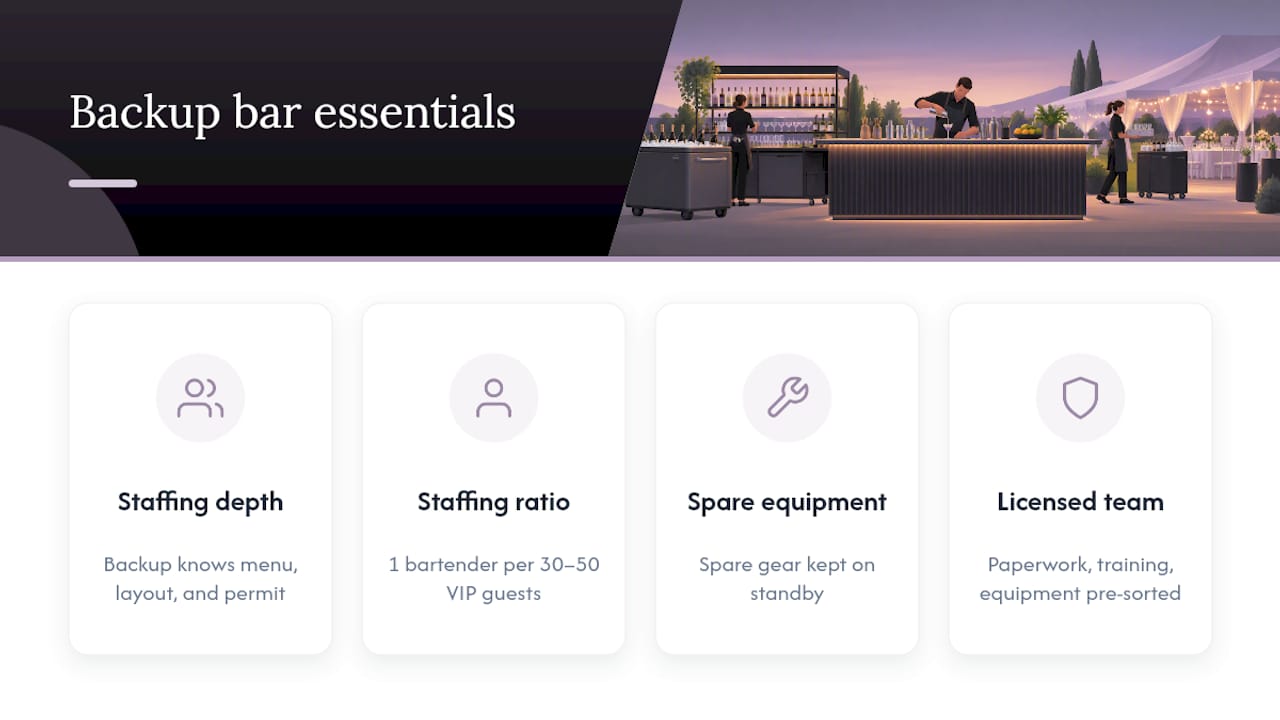
A backup plan is only as good as the team executing it. A reliable mobile bartending company builds staffing depth into every booking, so a backup bartender already knows the menu, the layout, and the permit status before they’re ever needed. Documented handoffs, spare equipment kept on standby, and permit-aware scheduling are standard practice, not an add-on.
The one bartender per 30 to 50 guest VIP ratio isn’t just a staffing rule, it’s what makes a same-night backup swap possible without slowing service. Hiring a licensed, insured mobile bartending team for backup coverage means the paperwork, training, and equipment are already sorted before something goes wrong.
— Brennon
Want a backup bar plan already built for you?
If you’re planning an event in Las Vegas or Henderson and want backup coverage handled rather than assembled from scratch, tell us your event date and time, your venue’s permit status, your guest count, and your primary vendor’s contact information.
- Licensed, insured bartenders ready as on-call backup or full-service staffing.
- Spare equipment and dry-hire bar rentals available for last-minute swaps.
- Documented handoff procedures and permit coordination handled before the event.
Reach out through Liquid Courage to request a quote, or check our Private Bartender Services and Corporate Events pages for packages that already build backup coverage into the plan.
Sources
For server language and incident logs, use the ABC-620-C model alcohol policies. For venue emergency procedures, see Nightlife Association standards. For permit timing, check Clark County’s liquor caterer permit page and TABC’s event safety guide. Since food service near the bar reduces intoxication risk, a resource like Wild Foodz’s event food planning guide pairs well with your bar plan.
- ABC-620-C, Model Alcohol Management Policies: A Guide to Responsible Business Practices for Fairs & Special Events
- Liquor caterer license and permit | Clark County, NV
- Industry Standards — Nightlife Association
- Event safety guidance — Texas Alcoholic Beverage Commission (TABC)
FAQ
What should trigger activating a backup bartender?
A clear trigger is a no-show past 15 minutes, an equipment failure like a broken tap or dead POS, a visible intoxication spike, or a permit inspector requesting documentation the on-site team can’t produce. Writing exact response windows into your run sheet, rather than leaving the call vague, keeps the swap fast.
How many bartenders do I need for backup coverage?
Liquid Courage recommends one bartender per 30 to 50 guests for VIP setups, which also works as a baseline for sizing backup coverage. Open bars serving mixed cocktails often need staffing closer to the lower end of that range.
Who is responsible for the liquor permit if a backup bartender steps in?
Whoever holds the liquor permit on event day, whether that’s the venue, the caterer, or the bartending company, remains responsible even if a backup staffer takes over service. In Clark County, permit applications should be submitted at least ten calendar days ahead, so any backup vendor needs to already hold that permit rather than apply last minute.
What supplies should be in an emergency bar kit?
A basic kit includes extra ice, backup mixers, a spare card reader, disposable cups or extra glassware, replacement signage, and sealed spare bottles or kegs that don’t require a new order. Keeping these on-site rather than on a supplier’s truck is what makes a fast handoff possible.
Does Liquid Courage provide on-call backup bartenders?
Yes, Liquid Courage offers Private Bartender Services and Dry Hire Staffing that can serve as on-call backup coverage for weddings, corporate events, and private parties in Las Vegas and Henderson. Contact the team directly with your event details to confirm availability.