
Hire a licensed liquor caterer, and confirm they will file a Clark County Liquor Caterer Event Permit at least 10 calendar days before your event. That’s the entire decision tree for serving alcohol at a private-residence wedding, reception, or party in Las Vegas or Henderson. A vendor like Liquid Courage LV handles the paperwork directly, which is exactly what you want, when the alternative is scrambling to file forms the week of your event.
TL;DR:
- Hiring a licensed liquor caterer to file the Clark County permit at least 10 days before the event prevents late filing fees and ensures legal alcohol service.
- The permit fee is $10 per service station, doubling if filed late, which can significantly increase costs for larger bars or last-minute submissions.
- Verify that your vendor holds a valid liquor license, proof of insurance, and staff with work cards and Alcohol Awareness Training before signing the contract.
- A private residence event requires a permit even if alcohol is supplied and served by staff, with the permit belonging to the caterer, not the homeowner.
- City licenses are also necessary in Las Vegas or Henderson, and confirming jurisdiction compliance avoids licensing issues and legal risks.
Table of Contents
- What Private Residence Alcohol Rules Actually Require in Clark County
- Do You Need a Liquor Caterer or an Off-Premise Permit?
- What to Require From a Licensed Mobile Bartending Vendor
- Timeline and Fees: Avoiding the Doubled-Fee Trap
- Staffing and Service Stations for a Home Event
- What to Expect for Compliance on Event Day
- Overview of Total Estimated Costs for Private Residence Alcohol Service
- Who’s Liable: The Host or the Liquor Caterer?
- How to Verify a Mobile Bartending Company Is Legitimate
- Open Bar, Cash Bar, or Drink Tickets: What’s Allowed
- Las Vegas and Henderson: When City Rules Add a Layer
- A Local Bartender’s Take on Permit Timing
- Book a Licensed Bartending Team for Your Private Residence Event
- Sources
- FAQ
What Private Residence Alcohol Rules Actually Require in Clark County
A Liquor Caterer Permit authorizes temporary retail alcohol service at a location that isn’t the caterer’s licensed premises, which covers exactly the situation of pouring drinks at someone’s backyard or living room. The permit doesn’t belong to the homeowner. It belongs to the licensed caterer, who applies on your event’s behalf.
Most private-residence events in Las Vegas or Henderson fall under this Liquor Caterer path rather than an Off-Premise Liquor Permit, which typically applies to different retail scenarios rather than a hosted party with staffed bar service. The application itself asks for specifics: the caterer’s liquor license number, the event sponsor and address, the number of service locations planned, and a full list of employees pouring alcohol, complete with work card numbers and Alcohol Awareness Training expiration dates.
Clark County’s Department of Business License processes these permits, and the caterer submits the paperwork, not you. If your event sits inside Las Vegas or Henderson city limits rather than unincorporated Clark County, the caterer also needs to hold the appropriate city business license on top of the county permit. That distinction trips up more organizers than any other part of this process.
Do You Need a Liquor Caterer or an Off-Premise Permit?
Run through these checkpoints before you sign anything:
- Who’s providing the alcohol? If your bartending vendor supplies and pours the drinks, you need a licensed Liquor Caterer. If you’re buying the alcohol yourself and just hiring pouring staff, ask the vendor directly which permit path they use. Practices vary here, and a licensed caterer should have a firm answer.
- Is the event open to outside guests or strictly private? A private, invite-only residence event still requires a permit if alcohol changes hands in any commercial sense (paid bartenders, a hired catering company).
- Is this a nonprofit or private-club function? Charitable events and true private-club gatherings sometimes fall under different exceptions in Nevada county code, and those cases warrant a direct call to Business License rather than guessing.
- Who’s filing the permit, and by when? Nail this down in writing before deposit. Ask what information they need from you (event address, date, guest count) so nothing holds up submission.
If your vendor can’t answer these clearly, that’s a sign to keep shopping.
What to Require From a Licensed Mobile Bartending Vendor
Vet any liquor caterer the same way you’d vet a contractor working on your house, because that’s essentially what’s happening in your kitchen or backyard for a few hours.
Before signing, request:
- Their liquor license number and confirmation they’ll handle the Clark County permit filing.
- Proof of general liability insurance covering the event date and address.
- Written confirmation that pouring staff hold current work cards and Alcohol Awareness Training.
- A contract specifying who pays permit fees, how many service stations are planned, service start and end times, and a clear policy on refusing service to visibly intoxicated guests.
Get the number of service stations in writing early, since that figure drives both staffing and the permit fee math you’ll see below. Ask, too, about their cleanup responsibilities and how they coordinate with your caterer or planner if multiple vendors are working the same event, referring to this catering workflow for large events for practical guidance on coordinating alcohol service and event operations.
Pro Tip: If your guest list runs past 75 people or the event includes an open bar with cocktails (not just beer and wine), ask specifically whether the vendor recommends adding a second bartender or station. Understaffed bars create the longest lines and the most guest complaints at private events.
Watch for red flags: a vendor who can’t produce a license number, one who tells you permits aren’t necessary for “private” events, or one unwilling to put staffing and station counts in the contract.
Timeline and Fees: Avoiding the Doubled-Fee Trap
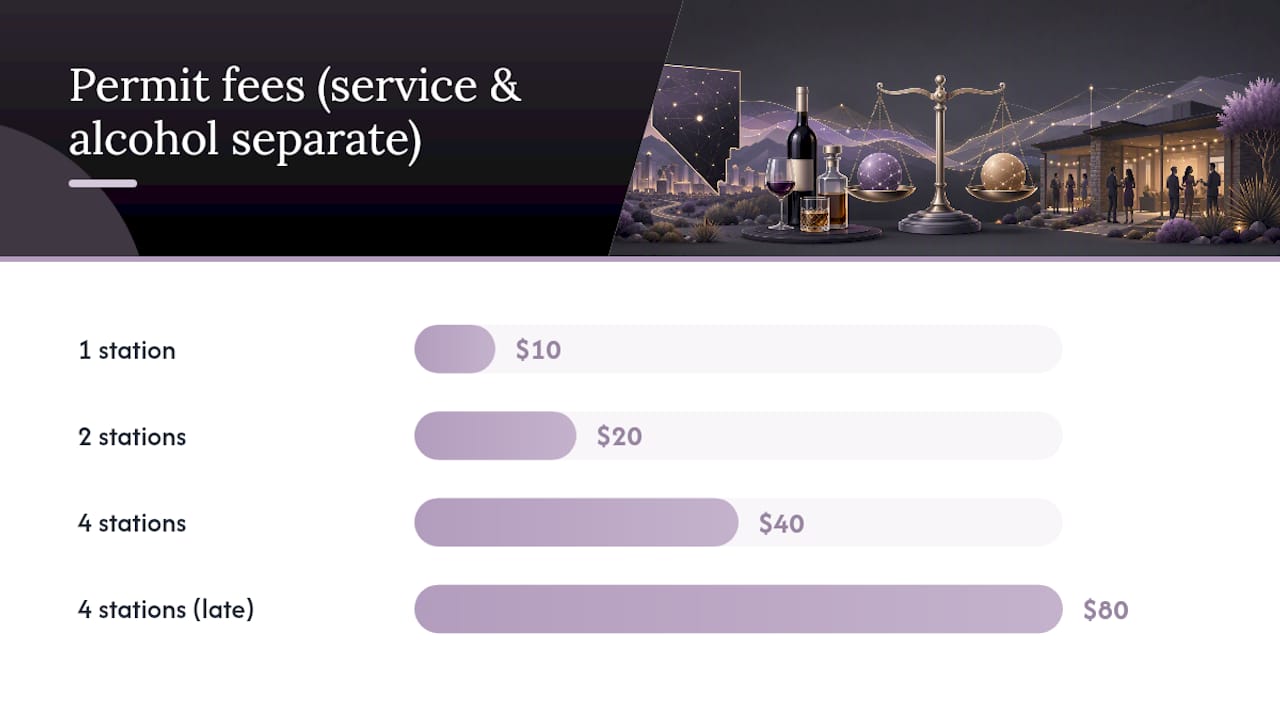
Clark County charges $10 per service station for a Liquor Caterer Event Permit, and that number only stays low if you file at least 10 calendar days before the event. Miss that window, and the county charges double the standard fee.
The math: A two-station bar setup costs $20 on time. File late, and that same setup jumps to $40. It’s a small dollar amount, but it’s an unnecessary one, and it’s a signal about how organized your vendor actually is.
A workable timeline looks like this:
- 8 to 12 weeks out: Book your bartending vendor and pay the deposit.
- 3 to 4 weeks out: Finalize guest count, bar style, and number of service stations.
- At least 10 calendar days out: Vendor submits the Liquor Caterer Event Permit application with your event address and sponsor details.
- Week of event: Confirm the vendor has the approved permit copy ready to bring on-site.
Licensed caterers typically file this themselves, but the organizer still needs to supply accurate event details fast. Delays on your end are the most common reason permits get filed late, more common than any paperwork issue on the vendor’s side.
Staffing and Service Stations for a Home Event
Industry practice generally runs about one bartender per several dozen guests, with the ratio adjusted depending on the complexity of the beverage service. A 60-person backyard wedding usually needs two bartenders and, in most cases, two service stations to keep lines short.
Placement matters as much as headcount. Put one station near the entrance for arrival drinks and a second near the dining or dance area so guests aren’t crossing the whole yard for a refill. Vendors typically supply the bar equipment, ice, mixers, and glassware; hosts usually cover the base alcohol unless the package includes it. Ask your vendor to confirm this split in writing, and build in a nonalcoholic station and water access, both good practice for guest safety regardless of party size.
What to Expect for Compliance on Event Day
Your bartending crew should arrive with a printed copy of the approved permit, the caterer’s liquor license information, and each staff member’s work card readily available if asked. This isn’t a formality. It’s what a compliance check looks for.
Staff should be actively checking IDs for any guest who looks under 30, and the crew should have a documented process for refusing service and logging any incident that occurs. If your event sits near a park or uses any additional special-event permit, make sure that paperwork is on-site too. Keep your own folder with the permit copy, the caterer’s license number, proof of insurance, and the vendor’s on-call contact number. You probably won’t need it, but if a neighbor complains or an inspector stops by, having it ready ends the conversation in under a minute.
Overview of Total Estimated Costs for Private Residence Alcohol Service
Three cost categories stack up for a private-residence event: bartending service fees, the alcohol itself, and the permit.
Bartending service fees vary based on hours, number of bartenders, and whether you want a curated cocktail menu versus straightforward beer and wine service. Liquid Courage LV and similar Las Vegas vendors price this by event size and service style rather than a flat rate, so get a written quote once your guest count and bar style are locked.
Alcohol costs depend entirely on what you’re pouring and whether the host or the caterer is supplying it. A full open bar with spirits, wine, and beer costs more than a beer-and-wine-only setup, and that’s true whether you’re buying retail or working with a caterer who sources it.
Permit fees are the smallest and most predictable line item: $10 per service station, filed on time. A two-station backyard bar runs $20 in county fees. A four-station setup for a larger reception runs $40. File late, and you’re looking at double those figures, which is real money left on the table for no reason other than a missed deadline.
The smart move is asking your vendor for a single quote that itemizes staffing, alcohol (if they’re supplying it), and permit handling separately. That transparency tells you whether you’re comparing apples to apples when you get quotes from more than one company, and it tells you exactly where your budget is going before the deposit is due.
Who’s Liable: The Host or the Liquor Caterer?
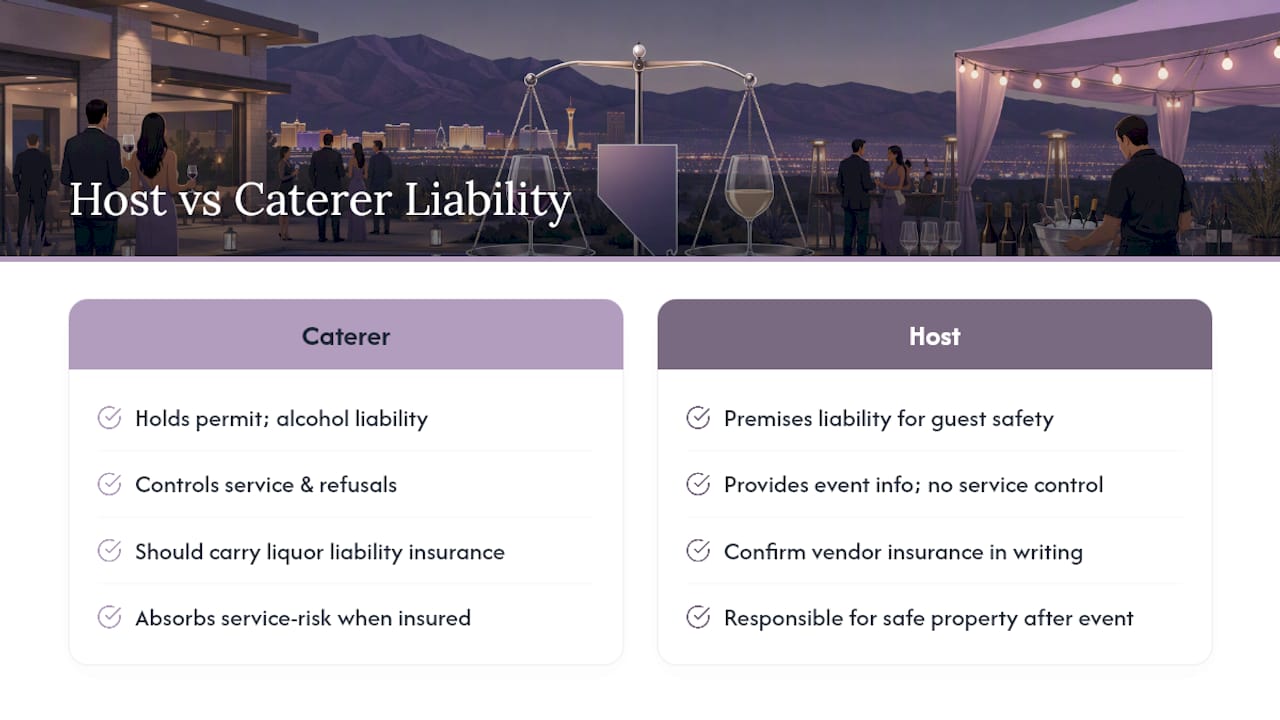
The licensed caterer carries the legal and regulatory responsibility for the permit, the alcohol service itself, and staff compliance with Nevada serving law. That’s the entire point of hiring a licensed vendor instead of asking a friend to pour drinks: the liability for over-service, underage sales, and permit violations sits with the business that holds the license, not with you as the homeowner.
That said, hosts aren’t fully insulated. As the property owner, you can still carry premises liability if something goes wrong on your land, particularly around guest safety after the party (a drunk-driving incident involving a guest who left your property, for instance). This is exactly why a written contract matters: it should spell out that the caterer is responsible for service decisions, refusal policy enforcement, and permit compliance, while you’re responsible for providing accurate event information and a safe physical space.
Ask your vendor directly whether their insurance covers liquor liability specifically, sometimes called dram shop coverage, not just general event insurance. A caterer who is licensed, permitted, and carrying the right insurance is absorbing risk you’d otherwise be holding alone. That’s worth confirming in writing before the event, not after something happens.
How to Verify a Mobile Bartending Company Is Legitimate
Ask for the liquor license number directly and don’t accept a vague answer. A legitimate Las Vegas or Henderson vendor should give you a number without hesitation, because Las Vegas business-license guidance requires alcoholic caterers to hold that credential before they can legally operate.
Beyond the license, check a few other things. Does the company have a real business address and a working phone number, not just an Instagram page? Can they produce a certificate of insurance on request? Do they mention Alcohol Awareness Training for staff without you having to ask twice?
Red flags worth walking away from: a vendor who quotes a price without asking about your guest count or service style, one who says permits “aren’t necessary for house parties,” or one who can’t name which entity files the Clark County paperwork. Any of those answers suggests a company operating outside the rules, and you’re the one holding the risk if an inspector or a neighbor’s complaint brings that into the open.
Checking online reviews helps, but treat them as one data point among several. A company with years of consistent Las Vegas event work and a clear answer to every licensing question you throw at them is a safer bet than one with flashy photos and vague credentials.
Open Bar, Cash Bar, or Drink Tickets: What’s Allowed
A Liquor Caterer Permit covers standard open-bar and hosted-bar service, meaning the host pays and guests drink for free, which is the most common format at private residence weddings and parties. Drink-ticket systems, where guests redeem a limited number of tickets for drinks, also fall under this same permit since the caterer is still the one selling and serving the alcohol.
Cash bars, where guests pay per drink directly, involve a different regulatory picture because the caterer is now conducting direct retail sales rather than catered service under a private event. Most private-residence events skip cash bar entirely for this reason, sticking with open bar, hosted bar with a spending cap, or drink tickets instead. If you’re set on a cash-bar format for a large private party, that’s a conversation to have directly with your caterer and, if needed, Clark County Business License before you commit to it in your event plan.
Whatever format you choose, the permit ties to the caterer’s license and the specific service stations they’ve listed on the application, not to a generic “we’re serving alcohol” statement. That’s why the station count and service style need to be locked before the permit gets filed, not adjusted afterward.
Las Vegas and Henderson: When City Rules Add a Layer
Clark County issues the Liquor Caterer Event Permit, but that’s not the only license your vendor needs if your residence sits inside Las Vegas or Henderson city limits rather than unincorporated county land. Both cities require their own business licensing for alcoholic caterers on top of the county permit, and Las Vegas specifically outlines zoning confirmation and inspection review steps as part of that city-level process.
Henderson runs a comparable municipal licensing structure, and the practical takeaway is the same either way: ask your vendor which city or county jurisdiction your address falls under, and confirm they hold licensing valid for that specific jurisdiction, not just a generic “Clark County permit” that may not cover a city-limits address. This is a detail plenty of first-time organizers miss, assuming one permit blankets the entire valley when it doesn’t.
If you’re unsure whether your address is inside city limits or unincorporated county land, a quick call to Clark County Business License or your city’s licensing office settles it in minutes. It’s a five-minute phone call that prevents a much bigger headache the week of your event.
A Local Bartender’s Take on Permit Timing
The number one mistake organizers make isn’t the alcohol, it’s the paperwork timing. A caterer who prepopulates employee lists with current work card numbers and training dates, then files the moment the event date is confirmed, sidesteps the doubled fee entirely and gives the county nothing to flag. On the service side, a simple two-station layout, one for wine and beer near the entrance, one full bar near the main gathering area, moves guests through faster and cuts waste versus a single crowded bar trying to do everything at once. Neither of those fixes is complicated. They just require a vendor who treats the permit process as part of the job instead of an afterthought.
— Brennon
Book a Licensed Bartending Team for Your Private Residence Event
Hiring a licensed local provider means you’re not the one tracking permit deadlines, chasing down work card numbers, or hoping your bartender knows Nevada’s serving rules. Liquid Courage LV files the Clark County paperwork, staffs trained bartenders, and carries the insurance that protects your event from the liability gaps a DIY setup or an unlicensed vendor leaves wide open.
Whether you’re planning a backyard wedding reception or a smaller private gathering, the service works the same way: you tell us the guest count and bar style, and we handle the permit filing, staffing ratios, and equipment. Explore bar rental packages if you already have a vision for your setup, or check private bartender services for a more hands-off option. Get in touch through Liquidcouragelv to check availability for your date and get a straight quote before you commit to anything.
Sources
- Liquor Caterer Permit application (Clark County) — PDF
- Las Vegas Business License instruction sheet — Alcoholic Caterer
FAQ
Do I Need a Permit to Serve Alcohol at My Own House in Nevada?
If you’re hiring a bartending vendor or licensed caterer to serve alcohol at your residence, yes, that caterer needs a Clark County Liquor Caterer Event Permit filed at least 10 calendar days before the event. The permit belongs to the licensed caterer, not the homeowner, so you’re not the one filing it.
How Much Does a Liquor Caterer Permit Cost in Clark County?
The fee is $10 per service station, and applications filed less than 10 calendar days before the event are charged double that amount. A two-station bar costs $20 on time or $40 filed late.
What Does Liquid Courage LV Charge for Bartending Services?
Pricing depends on guest count, event length, and bar style, and current rates are available directly through Liquidcouragelv after a quick consultation. Every quote covers staffing, permit handling, and equipment specific to your event.
Can I Have a Cash Bar at a Private Residence Event in Nevada?
Cash bars involve direct retail alcohol sales, which fall outside the standard Liquor Caterer Permit most private residence events use. Open bar, hosted bar with a spending limit, and drink-ticket formats are the standard, permit-compliant options for private parties and weddings.
What Happens if My Bartending Vendor Isn’t Licensed?
An unlicensed vendor puts you at risk for fines, a shut-down event, and personal liability you’d otherwise avoid by hiring a properly licensed caterer. Always confirm the liquor license number and permit-filing plan in writing before signing any contract.