
Most people overpay for premium liquor upgrades. Unless you’re drinking two or more top-shelf cocktails a day on vacation, or your wedding guest list skews heavily toward whiskey and craft cocktails over beer and wine, the standard package usually wins on cost. Typical upgrades run $10 to $30 per person per day on vacation packages, or $500 to $1,800 per event for a hosted signature bar. The math below tells you which side of that line you land on.
TL;DR:
- Most premium liquor upgrades cost between $10 and $30 per person per day for vacations, but few travelers reach the necessary 2 to 4 premium drinks daily to break even.
- Event bars charging $1,200 to $1,800 typically include a signature cocktail menu, staffing ratios of one bartender per 30 to 50 guests, and sourcing high-quality ingredients to justify the premium.
- Upgrades raise the drink ceiling from about $12 to $20 and are worth it mainly when guests order multiple top-shelf cocktails, but individual surcharges apply if drinks exceed the ceiling.
- Locking in upgrade packages weeks in advance usually offers significant savings versus last-minute onsite purchases or upgrades.
- Request a detailed, line-item quote covering alcohol cost, staffing, permits, and service charges to ensure transparency and avoid hidden fees when upgrading.
Table of Contents
- What Does a Premium Liquor Upgrade Actually Cost?
- What’s Included in Premium vs. Standard Liquor Packages?
- How Do You Calculate If a Premium Upgrade Pays Off?
- How Bartenders and Event Vendors Actually Price Premium Upgrades
- When Should You Actually Upgrade? A Decision Checklist
- What Event Bartenders Say About Pricing Premium Bars
- My Take: How I’d Advise Clients on This Decision
- Get a Line-Item Quote Before You Commit to a Premium Bar
- Sources
- FAQ
What Does a Premium Liquor Upgrade Actually Cost?
The price you pay for “premium” depends entirely on which pricing model you’re buying into, and that’s where most people get confused comparing quotes.
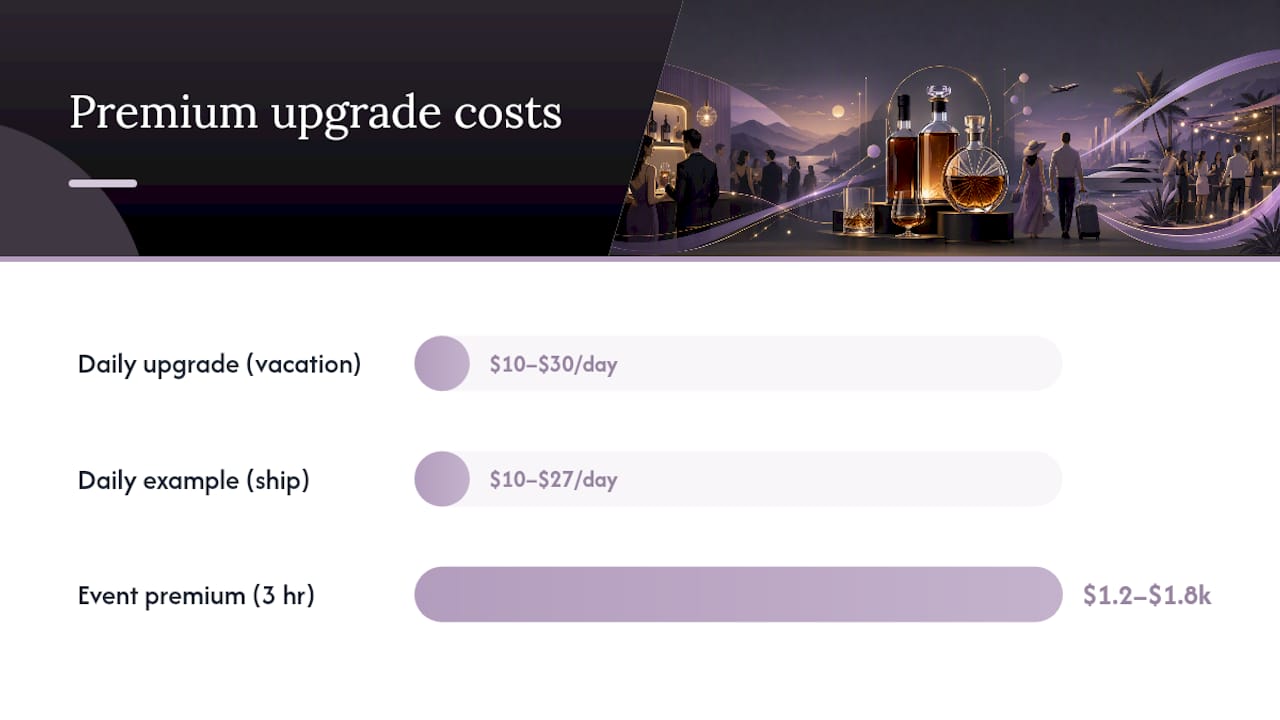
Vacation and cruise packages price the upgrade as a flat daily add. The gap between a standard drink package and its premium tier typically runs $10 to $30 per person per day, though the exact number swings based on the provider, the season, and how far in advance you buy. One well-documented example: a classic package with a $12 per-drink ceiling versus a premium package with a $19 ceiling, producing daily upgrade gaps commonly between $10 and $27 depending on the ship or provider.
Event bars work differently. Instead of a daily fee, you’re paying a per-event premium tied to guest count and hours of service. In the US mid-market, signature cocktail bars for a 3-hour event typically run within a mid-market price range, with premium presentations that add more cocktails and specialty garnishes pushing the range to $1,200 to $1,800.
What actually drives that spread? A handful of factors do most of the work:
- The per-drink ceiling. A higher cap means fewer restrictions on what guests can order without paying out of pocket.
- Included brands. House vodka versus a named top-shelf label changes the base cost before anything else gets calculated.
- Staffing level. More bartenders per guest means faster service but higher labor cost.
- Ingredient sourcing. Fresh juice, house-made syrups, and specialty bitters cost more than bottled mixers.
- Permits and compliance. Alcohol service at private events often requires an ABC permit, and signature cocktail bar arrangements frequently require the host to supply the alcohol directly.
- Buy-in timing. Locking in a package weeks ahead is usually cheaper than deciding onsite.
That last point matters more than people think. On cruise lines, buying a drinks package in advance is usually cheaper than purchasing it onboard, sometimes by a meaningful margin. The same logic applies to events: locking your bar package into the contract months out almost always beats a last-minute upgrade request two weeks before the date.
Providers also present the upgrade differently depending on the model. Cruise and resort packages tend to frame it as a ceiling increase, a bigger number you’re allowed to spend per drink before an upcharge kicks in. Event bartenders frame it as a discrete menu difference, a different list of what’s included rather than a cap you might exceed. Both get you to the same place, but reading a quote the wrong way is how people end up shocked at the final bill.
What’s Included in Premium vs. Standard Liquor Packages?
The sticker price only tells half the story. What actually changes between tiers is the ceiling and the brand list, not just a vague sense of “better.”
- Standard packages cover house-pour basics. Expect well vodka, gin, and rum, basic mixed cocktails, and house wine or domestic beer. Most standard packages cap the per-drink price somewhere in the $10 to $13 range before an automatic upcharge applies.
- Premium packages raise the ceiling and swap the brand list. You get named top-shelf spirits, signature cocktails built around them, and reserve-label wines. The per-drink ceiling typically jumps to somewhere in the $15 to $20 range, covering drinks that would trigger a surcharge under the standard tier.
- Certain items sit outside both tiers. Ultra-rare bottlings, tasting flights, and bottle service at a table almost never fall inside a package no matter which tier you buy. These get billed separately, and vendors rarely advertise that upfront.
- The “you pay the difference” mechanic is the real mechanism at work. If a drink’s menu price exceeds your package ceiling, standard or premium, you pay the gap out of pocket. Upgrading doesn’t eliminate that mechanic. It just raises the number where it kicks in.
That distinction explains a lot of the confusion in online reviews. Someone on the standard package who orders a $16 cocktail pays a $3 to $6 surcharge on the spot. Someone on premium ordering the exact same drink pays nothing, because it falls under their higher ceiling. Neither package includes unlimited top-shelf pours. It’s a math problem disguised as a menu, and bars quietly reinforce it: it’s common for venues to add upcharges specifically for requesting a name-brand premium liquor instead of the house pour, even outside formal package structures.
How Do You Calculate If a Premium Upgrade Pays Off?
The break-even question boils down to one formula, whether you’re on a beach vacation or hosting a wedding reception: how many premium drinks do you need to consume before the upgrade fee pays for itself?
For per-day vacation packages, the formula looks like this:
Daily upgrade cost ÷ (average premium drink price − package ceiling) = premium drinks per day to break even.
Say your upgrade costs $22 per person per day, the premium package raises your ceiling from $12 to $19, and the drinks you actually want to order average $19. Under the standard package, each of those drinks would cost you a $7 out-of-pocket surcharge ($19 minus the $12 ceiling). Divide $22 by $7, and you need roughly 3.1 premium drinks per day to break even. Order fewer than that, and the standard package plus paying occasional surcharges wins on cost.
For per-event hosted bars, the math shifts to a total-cost comparison:
(Per-person upgrade cost × guest count) + service charge = total extra cost. Divide that by expected total premium-drink spend to test value.
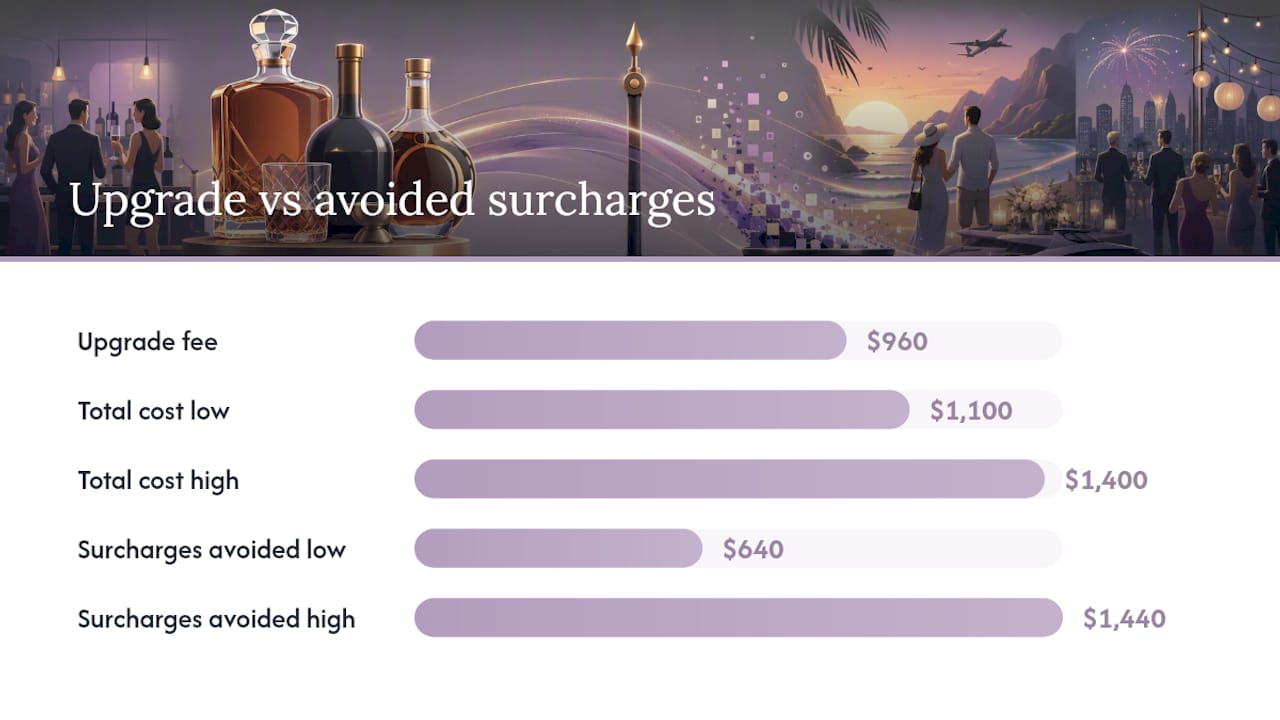
Here’s a worked example for a 3-hour wedding reception with 80 guests. That’s $960 in per-person upgrades, plus service charges layered on top of the alcohol cost itself, often landing the total incremental cost somewhere between $1,100 and $1,400 once everything is added in. If your guests are moderate drinkers averaging two to three drinks each over the reception, and the venue’s standard package would have triggered a $4 to $6 surcharge per premium drink ordered, you’re looking at roughly $640 to $1,440 in surcharges avoided, depending on how many guests actually order top-shelf drinks. That’s close enough to break-even that guest habits, not the sticker price, decide the outcome.
Pro Tip: Ask your caterer or bar vendor for their historical drink-per-guest average from similar events. A wedding with an open bar and a late reception behaves very differently from a corporate happy hour that wraps in two hours.
Run the same math on a 7-night cruise. If the daily upgrade runs $25 per person and the per-drink gap is $7, you need about 3.6 premium drinks daily, or roughly 25 drinks across the full week, to come out ahead. For most vacationers who order one or two drinks a day, that upgrade is a loss on paper. For someone ordering four rounds daily at the pool bar, it pays for itself by day three.
A few sensitivity checks matter before you commit to either formula. Gratuity is often calculated separately from the package price and can add 15% to 20% on top, which changes your break-even number meaningfully. Mandatory purchase rules, common on cruises where every adult in a cabin must buy the same package, can force an upgrade cost onto someone who wouldn’t otherwise buy in. And per-person pricing at events sometimes gets calculated against total headcount rather than expected drinkers, inflating the real cost per actual guest who drinks.
How Bartenders and Event Vendors Actually Price Premium Upgrades
Vendor quotes look like a single number, but they’re built from several line items stacked together. Knowing what’s inside each one tells you where there’s room to negotiate and where there isn’t.
Alcohol cost and sourcing markup forms the base of any quote. Vendors typically add a sourcing markup, often around 15% for procurement and transport, on top of the raw bottle cost. That covers the labor of sourcing specific brands, hauling cases to the venue, and absorbing the risk of leftover product.
Labor and staffing is usually the biggest variable on the invoice. A common industry guideline calls for one bartender per 30 to 50 guests for a VIP setup where speed and presentation matter. Drop below that ratio and lines form fast, which hurts the guest experience premium liquor is supposed to deliver in the first place. Staffing costs scale directly with that ratio: fewer bartenders per guest means lower labor cost, but slower service and longer waits at the bar.
Recipe development and prep labor show up as a separate fee on many signature-bar quotes. Custom cocktail menus need testing before the event, and that work isn’t free. It’s common for recipe development and pre-batch prep to add a modest one-time fee in one-time fees, with day-before prep labor often billed at moderate hourly rates. Specialty glassware rentals and fresh garnish sourcing add smaller amounts on top, usually a few hundred dollars depending on guest count.
Permitting, delivery, and service charges round out the invoice. Alcohol service at private events frequently requires a local permit, and delivery or setup fees are standard for mobile bar operations. Gratuity and service charges, typically 15% to 22%, get applied to the alcohol and labor lines and often surprise clients who only budgeted for the sticker price on the package itself.
Here’s how pricing on a cocktail itself actually gets set behind the scenes: most operators price a drink at 4.5 to 5.5 times its pour cost to land in an 18% to 22% pour-cost range. Add modifiers, house-made syrups, egg whites, specialty bitters, and that multiplier climbs fast, which is exactly why a “simple” upgrade to top-shelf spirits sometimes carries a bigger price jump than the base liquor cost alone would suggest.
When Should You Actually Upgrade? A Decision Checklist
Before signing off on a premium upgrade, run through a short list of questions. This takes ten minutes and saves you from a surprise line item on the final invoice.
Ask yourself first:
- How many drinks per guest do we realistically expect, based on event length and guest demographics?
- Are there specific brands guests will actually notice and care about, or is “premium” mostly for appearances?
- Can we buy or lock in the upgrade in advance, rather than paying a higher onsite rate?
- What’s the gratuity and service charge policy, and is it calculated before or after the upgrade fee?
Then push your vendor for specifics:
- Ask for a line-item breakdown separating alcohol cost, labor, permits, and service charges rather than one bundled number.
- Confirm the alcohol-sourcing policy: does the vendor supply it, or does the host need to purchase and provide it directly?
- Ask what happens to leftover alcohol, since corkage and leftover-bottle policies vary widely between vendors and can affect your effective cost per bottle.
And watch for warning signs in any quote:
- Mandatory all-adult purchase rules that force everyone in a group or cabin to buy the same package, inflating cost for light drinkers.
- Opaque per-drink caps that aren’t disclosed until you’re standing at the bar and get hit with a surcharge.
- Flat surcharges applied evenly across guest counts, ignoring the fact that a 40-guest reception and a 200-guest gala have wildly different economics per person.
If a vendor can’t answer the sourcing and permit questions clearly, that’s usually a sign their pricing is built to obscure margin rather than reflect real cost.
What Event Bartenders Say About Pricing Premium Bars
Practitioner pricing data backs up nearly everything in the break-even math above, and it’s worth seeing the actual numbers vendors work from when they build a quote.
In the US mid-market, a 3-hour signature cocktail bar typically lands in the $500 to $1,200 range for a straightforward setup: one or two signature drinks, standard glassware, a compact bar footprint. Push into the $1,200 to $1,800 tier and you’re adding more cocktail options, specialty garnishes, and often a second bartender to keep service moving.
Staffing follows the same guideline used across the VIP event space:
One bartender per 30 to 50 guests keeps a premium bar moving at the pace guests expect. Drop below that ratio for a busy signature-cocktail setup, and wait times climb fast enough to undercut the entire point of paying for an upgraded experience.
That ratio isn’t arbitrary. A bartender building a hand-crafted cocktail with fresh citrus and a specialty syrup takes longer per pour than someone free-pouring a vodka soda, so premium menus need more hands behind the bar to maintain the same service speed guests are used to at a standard setup.
A premium offering at this tier typically scopes in the signature cocktail selection, the staffing ratio needed to serve it well, and the ingredient sourcing to back it up. What it doesn’t typically include, unless specified upfront, is ultra-rare bottle service or open-ended top-shelf pours with no ceiling at all. That distinction is worth nailing down before you sign anything.
My Take: How I’d Advise Clients on This Decision
Weddings almost always justify at least a partial upgrade. Reception guests skew toward wanting a good cocktail hour, and a couple of signature drinks built around one or two premium spirits does more for the guest experience than raising every bottle on the bar to top-shelf. Small private parties are the opposite case: unless the guest list is genuinely craft-cocktail literate, standard packages with one or two premium additions cover it.
Vacation packages come down to honest math about your own habits, not vacation-mode optimism about how much you’ll drink once you’re there.
My practical tip: cap your premium spend at two signature cocktails plus a small top-shelf selection, maybe three or four named spirits instead of a full reserve bar. That gets you 80% of the perceived upgrade at a fraction of the full premium bar cost, and almost nobody notices the difference at the bar itself.
— Brennon
Get a Line-Item Quote Before You Commit to a Premium Bar
You can request bar upgrade quotes that are broken into alcohol cost, staffing, permits, and service charges before you sign anything. That’s the same line-item structure this article just walked through, applied to your actual guest count and event.
Some mobile bartending companies build signature cocktail bars and full mobile bartending setups around staffing ratios and sourcing costs, so the number in your contract matches what actually shows up at your event. When you request a proposal, ask for the same breakdown outlined in this piece: alcohol cost, staffing, permits, and a sample menu. If your event includes a custom cocktail hour, the team can also walk you through how alcohol catering for corporate budgets typically gets structured for Las Vegas venues. Ready to see real numbers instead of estimates? Request a sample bar proposal and get a quote built around your guest count, not a generic package tier.
Sources
The price ranges and formulas in this article draw from published pricing guides for signature cocktail bars and cruise beverage packages, along with cocktail-pricing methodology used across the bar industry. For deeper detail, see the signature cocktail bar pricing guide, the cocktail pour-cost breakdown, the cruise beverage package comparison, and the note on common bar upcharges. Prices shift by season, region, and provider, so treat every range here as a starting point for your own quote comparison, not a fixed number.
- Signature Cocktail Bar Pricing (2026 Guide) | Quotably
- Celebrity Classic vs Premium Beverage Package — Which One Is Actually Worth It? | AllAboardDeals
- 10 Cocktail Upcharges Bars Slip Into Your Check | Just Dip Recipes
FAQ
How much does it cost to upgrade to a premium drink package?
Vacation and cruise upgrades typically run $10 to $30 per person per day, while event-based premium bars run $500 to $1,800 per event depending on guest count and hours of service.
How many drinks a day do you need to break even on a premium package?
Divide your daily upgrade cost by the gap between the premium drink price and your standard package’s per-drink ceiling; most travelers need roughly 2 to 4 premium drinks per day to break even, depending on the specific package.
Is it worth upgrading to premium drinks for an event or vacation?
It depends on your actual drinking habits: if you or your guests will order top-shelf cocktails regularly, the math often favors upgrading, but light drinkers usually come out ahead paying occasional surcharges on a standard package instead.
What’s the average markup on liquor at bars and events?
Alcohol sourcing markups for events commonly run around 15% for procurement and transport, while finished cocktails are typically priced at 4.5 to 5.5 times their pour cost to hit an 18% to 22% pour-cost target.
Does Liquid Courage offer premium liquor upgrade packages for events?
Yes, Liquid Courage builds signature cocktail bars and premium bartending packages for weddings, corporate events, and private parties in Las Vegas and Henderson, with line-item quotes covering alcohol, staffing, and permits.