

Drinking in your own fenced backyard is legal for adults in most parts of the country, and no federal law bans it. Three things change that answer fast: your state’s specific statutes, whether local ordinances treat your yard as publicly accessible, and how much liability you take on as the host. Federal open-container rules only govern vehicles on public roads, so your patio isn’t their problem. Your city code and your homeowner’s insurance policy might be.
TL;DR:
- Most backyard drinking remains legal if the yard is fenced and not openly accessible to the public, but local ordinances and liability risks vary.
- Hosting large or charge-based events often requires permits, event insurance, or proprietary liquor-liability coverage, especially when involving public spaces or street closures.
- Social-host liability laws in many states can hold homeowners financially responsible for injuries or damages caused by over-serving guests, particularly minors or intoxicated individuals.
- Federal open-container laws do not apply to private yards, but enforcement depends on whether the area is considered publicly accessible, especially for front yards or open areas near sidewalks.
- Hiring licensed bartenders with proper insurance significantly reduces legal and insurance risks, particularly for larger gatherings or events where alcohol is sold or ticketed.
Table of Contents
- Backyard Drinking Guidelines: A Pre-Party Checklist
- Which Laws Govern Backyard Drinking: State, Local, and Federal Layers
- Civil Liability: Social-Host Rules Versus Dram-Shop Laws
- When Your Backyard Party Needs a Permit
- Practical Steps That Actually Lower Your Risk
- What Years of Event Bartending Teach You About Host Risk
- A Licensed Bartender Handles the Risk You Shouldn’t Carry Alone
- Where to Verify the Rules for Your Own Address
- Sources
Backyard Drinking Guidelines: A Pre-Party Checklist
Before you buy a keg or hire a bartender, run through this list. It takes ten minutes and can save you a legal headache later.
- Check your state’s open-container and underage consumption exceptions for private residences, since rules on serving minors at home vary by state.
- Look up local ordinances covering public access, front-yard visibility, and noise or curfew restrictions in your municipal code.
- Read your HOA covenants or lease agreement if you’re renting, especially anything about common-area gatherings or events.
- Decide whether you need event insurance or dedicated liquor-liability coverage, particularly if you’re charging admission or expecting a large crowd.
- Weigh hiring a licensed bartender or catering vendor who carries a certificate of insurance (COI) and liquor-liability protection.
Pro Tip: Call your homeowner’s insurance agent before the party, not after. Ask directly whether your policy excludes alcohol-related injury claims. Many standard policies do, and you don’t want to find that out during a claims dispute.
Which Laws Govern Backyard Drinking: State, Local, and Federal Layers
No single national rulebook covers backyard alcohol rules. The 21st Amendment handed alcohol regulation to the states, and every state built its own system from there. Some states run “control” models where the government handles distribution, others use “license” models with private retailers, and that split shapes everything from purchase age to how permits get issued, according to the National Alcohol Beverage Control Association’s overview of U.S. regulatory structure.
That state-level variation shows up clearly in underage drinking rules. Some states allow minors to drink in a private residence with parental permission, while others allow no exception at all, per WebMD’s summary of state alcohol laws.
Whether your backyard gathering is legal often comes down to one question local officials keep asking: is this space “open or accessible to the public”? A fenced yard almost never qualifies. A porch that opens straight onto a sidewalk sometimes does.
Federal law stays mostly out of your yard. 23 USC §154 requires states to ban open containers in motor vehicles on public highways, and it ties federal highway funding to state compliance. It says nothing about your patio. Local reporting on Ohio’s rules illustrates the real gray zone: enforcement there hinges on whether an area counts as publicly accessible, which is exactly why an unfenced front lawn carries more risk than a backyard behind a six-foot fence. If you’re staffing the event yourself, bartender age requirements vary by state too, so check before you put a teenage relative behind the cooler.
Civil Liability: Social-Host Rules Versus Dram-Shop Laws
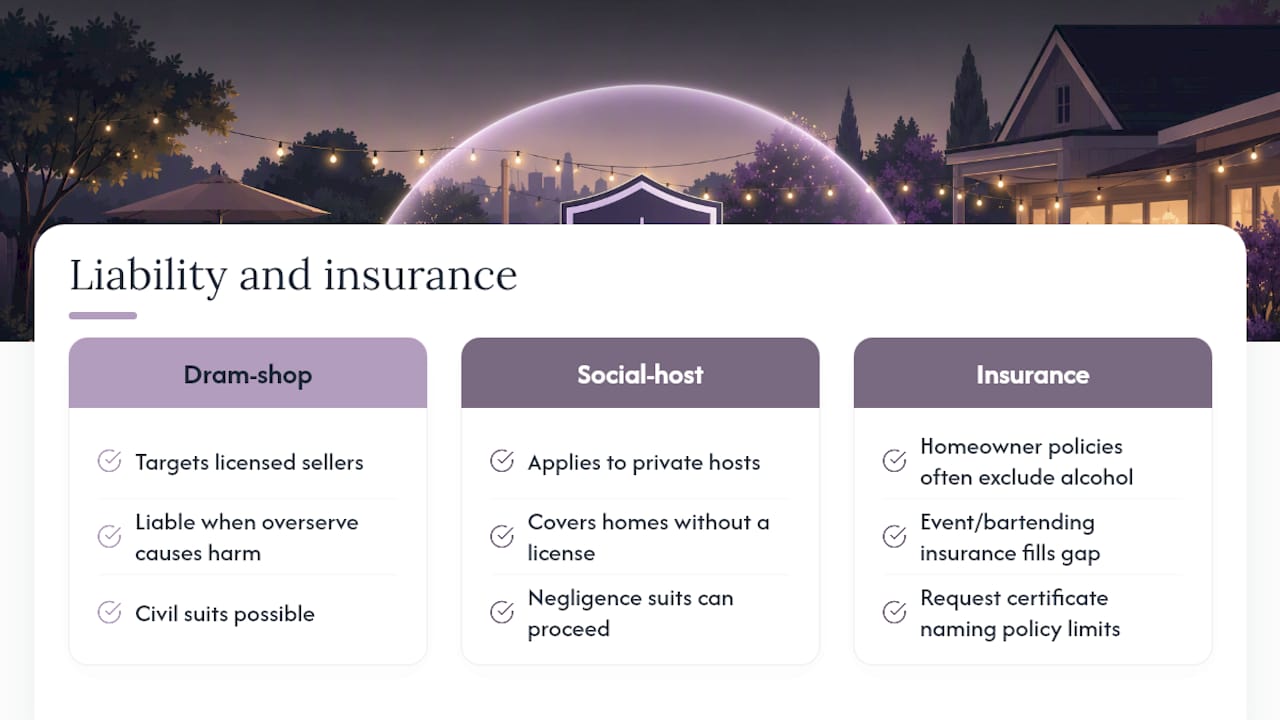
Dram-shop laws hold bars, restaurants, and licensed sellers responsible when they overserve a customer who then causes harm. Social-host liability is the residential version of that idea, and it applies to you as a private party host in many states, even without a liquor license.
You don’t need a criminal charge for a lawsuit to land on your doorstep. Ordinary negligence claims can proceed on their own if a guest gets hurt, or hurts someone else, after drinking at your house. A few situations raise your exposure sharply, such as serving alcohol to a minor, continuing to serve a guest who is visibly intoxicated, charging admission which can change the legal status of the gathering, or allowing an impaired guest to drive home without intervening.
Homeowner’s insurance frequently excludes alcohol-related injury claims outright, or caps them well below what a serious injury lawsuit demands. Event insurance built for bartending services closes that gap. If you’re hiring outside help, ask for a certificate of insurance naming policy limits, not just a verbal assurance that “we’re covered.”
When Your Backyard Party Needs a Permit
Most private backyard gatherings need zero permits. A few situations flip that switch:
- You’re hosting on public park land or a public right-of-way rather than your own property.
- You plan to sell alcohol or charge any kind of admission fee, which usually triggers a temporary liquor license requirement.
- Your event falls inside a mapped Designated Outdoor Refreshment Area (DORA), which relaxes some open-container rules but comes with its own boundaries and hours.
- Your celebration requires closing a street or using shared common-area space in an HOA community.
Front yards, porches, and unfenced areas connected directly to a sidewalk get treated as publicly accessible more often than homeowners expect, which can pull them under open-container ordinances that a fenced backyard would never face, as explained in detail by Experiencebylocals on hosting invite-only Denver house concerts. Federal land carries its own separate rules, and renters should check lease restrictions before assuming their landlord’s silence means permission. When in doubt, a call to your municipal clerk or parks department beats a guess.
Practical Steps That Actually Lower Your Risk
A handful of habits do more to protect you legally than any amount of worrying. Start with identification: check government ID at the door and use wristbands or colored cups to flag which guests are old enough to drink.
- Set out visible food and water stations, and cut off alcohol service 30 to 60 minutes before the party ends.
- Designate one sober person, whether that’s you or a hired coordinator, to handle any guest who’s had too much.
- Document it when you refuse to serve someone. A simple mental note of the time and reason can matter later.
- Consider drink maximum policies that cap how many drinks a guest can order, especially at larger events.
Pro Tip: Assign the “cutoff” job to someone other than yourself. Hosts are notoriously bad at policing their own guests once they’re a few drinks in themselves.
Hiring professional bartenders or caterers who carry their own liquor-liability coverage and trained staff removes a lot of this burden from your shoulders. An outdoor bar checklist built for weddings works just as well for a big backyard birthday party.
What Years of Event Bartending Teach You About Host Risk
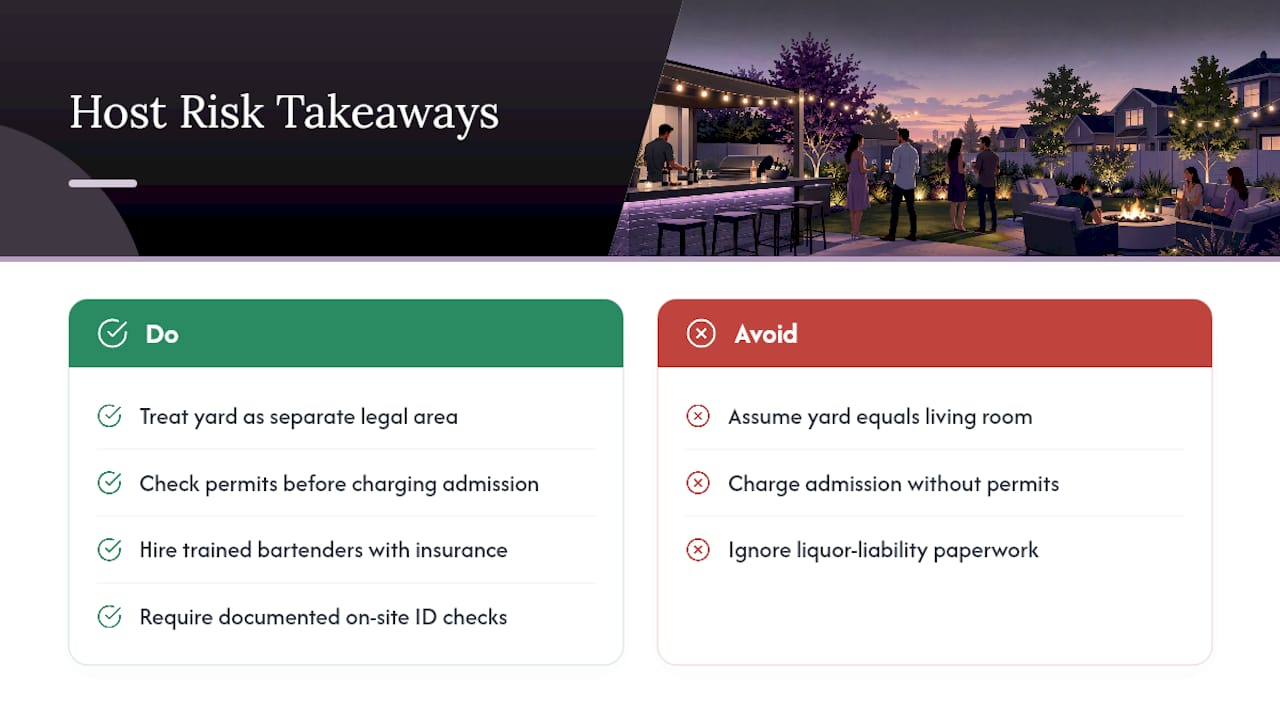
Most legal trouble at private parties doesn’t come from the drinking itself. It comes from hosts assuming their yard is treated the same as their living room, when a front lawn open to the sidewalk gets judged by very different standards. Permit surprises usually hit people charging admission for a “casual” fundraiser, not realizing that fee changes their legal category entirely.
A trained bartending team documents ID checks and carries its own liquor-liability coverage, which shifts a real slice of exposure off the homeowner’s shoulders. That paperwork rarely gets a second thought until someone actually needs it.
— Brennon
A Licensed Bartender Handles the Risk You Shouldn’t Carry Alone
Mobile bartending services provide hosts with a certificate of insurance, ID-trained staff, and controlled pouring practices that put a buffer between you and a lawsuit. Instead of hoping your homeowner’s policy stretches to cover an alcohol claim, you get a vendor whose liquor-liability coverage already accounts for it.

That matters most at events where the stakes climb: a backyard wedding with 80 guests, a corporate mixer with an open bar, or any private party where you’re charging admission and technically running a commercial event without realizing it. Our servers check IDs at the door, pace service, and know when to cut someone off, so you’re not the one making that call mid-party.
If you’re planning an outdoor gathering in Las Vegas or Henderson, start with our event bartending hiring guide to see what documentation and packages to expect, or go straight to booking a mobile bartender for your event and get a quote before your guest list locks in.
Where to Verify the Rules for Your Own Address
- 23 USC §154 for federal open-container scope, and NABCA’s regulatory overview for how your state’s system works.
- Your state liquor control division’s website and your city’s municipal code or parks department for permit rules.
- Your insurance agent and HOA board for policy limits and event-specific requirements.
This article is general information, not a substitute for advice from a qualified lawyer. Consult a qualified legal professional about your own circumstances before acting on anything here.
Sources
- Alcohol Laws: Drinking Age and More — WebMD
- 23 USC 154: Open container requirements — U.S. Code
- Structure of U.S. alcohol regulation — NABCA