
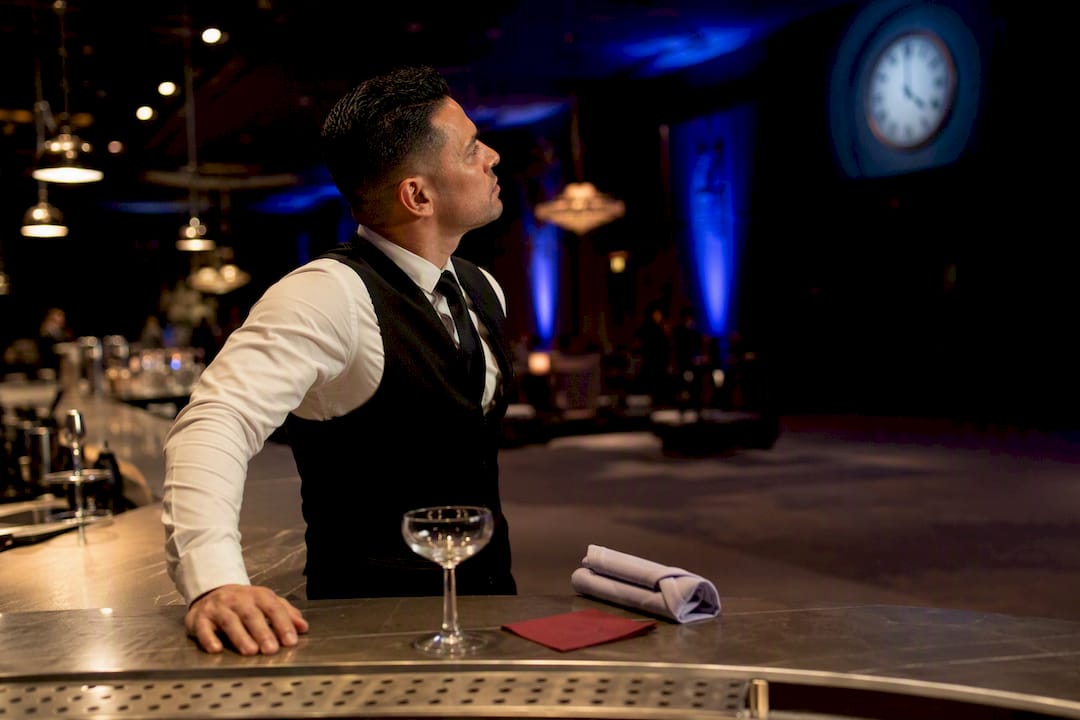
Alcohol service hours are not uniform. They’re set by state statute, license type, and local ordinance, and the range is enormous: Nevada permits alcohol sales and service at all hours without a mandatory statewide closing time, while Washington state law prohibits liquor sale and service during the early morning hours. The only safe approach is to verify the venue’s specific license and local regulations before planning event timing.
TL;DR:
- Most states set alcohol service hours through specific licenses, with Nevada being the main outlier offering 24/7 service under no statewide restrictions.
- Local jurisdictions often have stricter rules, so verification of venue-specific licenses and ordinances is essential, especially for outdoor or event-based extensions.
- Clear communication of service and clearance periods in writing prevents last-minute disputes and ensures compliance during the event.
- Missing permit applications or relying on verbal assurances are common errors that can lead to violations or service disruptions.
- Planning should consider holiday or special event exceptions, which may temporarily extend or restrict alcohol service hours beyond standard rules.
Table of Contents
- Alcohol Service Hours by State: Seven Examples Worth Knowing
- How Alcohol Service Hours Actually Get Set
- Holidays, Events, and the Clearance Period Trap
- A Step-by-Step Checklist for Confirming Alcohol Service Hours
- What Permissive Hours Actually Look Like on the Ground in Las Vegas
- Where Planners Actually Get This Wrong
- Book Compliant Bar Service for Your Las Vegas Event
- Sources
Alcohol Service Hours by State: Seven Examples Worth Knowing
Alcohol service hours vary widely between states and even between local jurisdictions within a state. Here’s how seven jurisdictions handle it, drawn from statute language and agency guidance rather than secondhand summaries.
| State | Governing rule | Headline hours | Local variation |
|---|---|---|---|
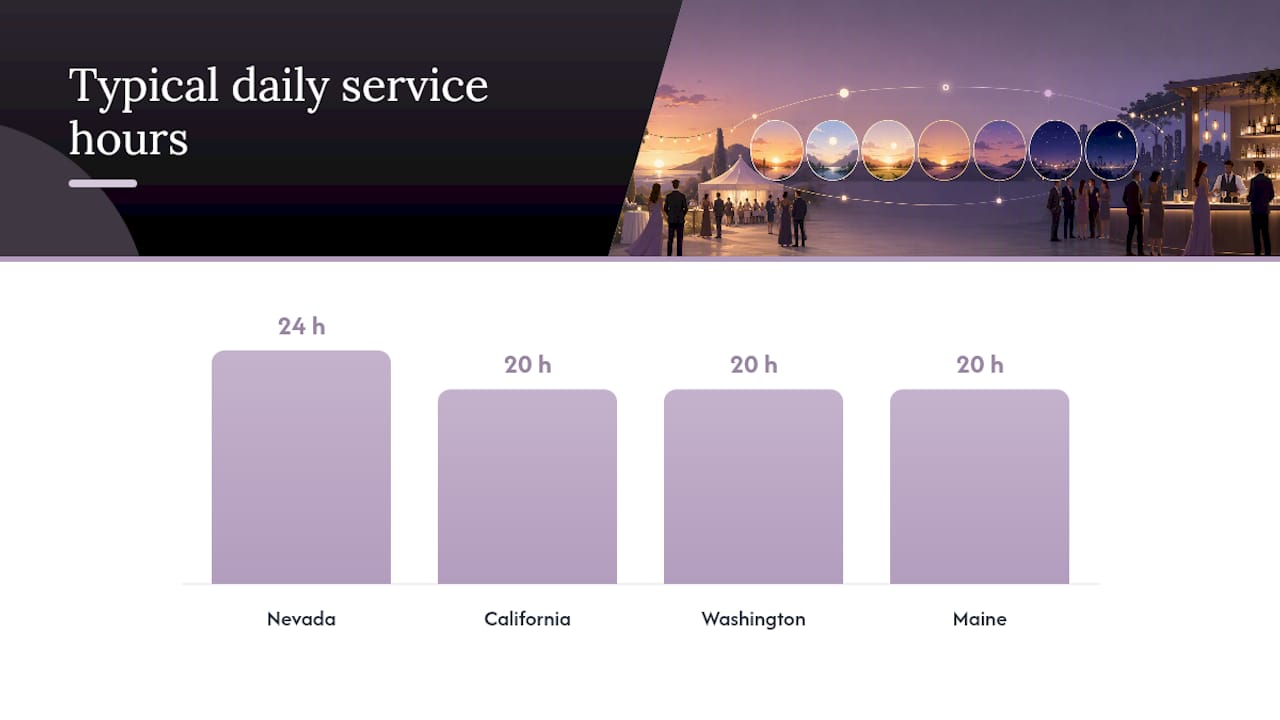
| Nevada | NRS Chapter 369 | No statewide closing time; sales and service permitted 24/7 | Venue policy, not law, often sets practical last call |
| California | CA ABC guidance | On-sale licenses generally cut service between 2:00 a.m. and 6:00 a.m. | Cities can set earlier local cutoffs |
| Texas | TABC FAQ guidance | Standard hours vary by permit type, with common cutoffs around midnight to 2:00 a.m. depending on the day | Local option elections can restrict or expand sales in specific counties |
| Washington | WAC 314-11-070 | Sale, delivery, and service prohibited 2:00 a.m. to 6:00 a.m. | Applies statewide with limited local carve-outs |
| Minnesota | Minn. Stat. § 340A | Statute sets specific on-sale windows with municipal authority to shorten them | Cities and counties can adopt stricter local hours |
| Maine | Bureau of Alcoholic Beverages and Lottery Operations licensee guide | Sales generally run 5:00 a.m. to 1:00 a.m., with New Year’s Eve extensions | Municipalities retain some local-option control |
| District of Columbia | D.C. Code § 25–723 | Weekday and weekend cutoffs differ, with statutory allowances for event-based extensions | Inaugural Week and special permits can extend hours citywide |
Nevada stands apart because Nevada liquor laws impose no mandatory closing time on bars, casinos, restaurants, or retail stores. That’s a genuine outlier. Most states instead draw a line somewhere in the 1:00 a.m. to 2:00 a.m. window and back it with a “no sale” buffer that stretches until early morning.
California illustrates why reading past the headline number matters. California ABC’s hours-of-sale guidance separates the act of selling alcohol from the act of allowing someone to keep drinking it, which changes how a caterer or bar staff should plan the final hour of an event. Texas works similarly. The TABC FAQ page lays out example hours for restaurants and bars but flags that local precinct votes can tighten or loosen those defaults, so a permit that works in one county might not translate three miles over.
Washington’s rule is the cleanest to memorize because it’s a flat window. WAC 314-11-070 blocks sale, delivery, and service of liquor from 2:00 a.m. to 6:00 a.m., full stop, with no meaningful local escape hatch. Maine adds a wrinkle worth flagging for anyone planning a New Year’s event: the Bureau’s licensee guide spells out an extended service window for that one night, on top of its usual 5:00 a.m. to 1:00 a.m. schedule.
How Alcohol Service Hours Actually Get Set
Every state hours rule traces back to a license type, and hours attach differently depending on what that license permits. An on-premises license (bars, restaurants, casinos) typically governs when a patron can be served a drink to consume on-site. An off-premises license (liquor stores, grocery retailers) governs when a bottle can leave the building. A temporary or special-event permit sits on top of both and can carry its own start and stop times, often narrower than the venue’s standing license.
Local option authority is where things get genuinely confusing for planners working across state lines. A state statute sets a default, but counties and cities frequently have the power to shorten that window, and sometimes to extend it for specific zones or events. Background reporting on liquor regulation consistently notes that the municipal code, not the state default, ends up being the decisive document for a given address.
Statutory language also splits several concepts that planners tend to lump together:
- Sale: the transaction of exchanging money for alcohol.
- Service: physically pouring or handing a drink to a patron.
- Consumption: the act of drinking, which can legally continue after service stops.
- Clearance: a short grace period after the cutoff during which patrons may finish an already-served drink.
Mixing these up is how event contracts end up with the wrong end time written into them.
Pro Tip: Never assume “last call” and “must be off the premises” mean the same thing. Ask the venue to define both times separately, in writing, before you finalize staffing hours.
Holidays, Events, and the Clearance Period Trap
Standard hours are the baseline, not the whole story. Most states carve out exceptions for specific dates or event types, and missing one of these carve-outs is one of the more common ways a private event runs into a compliance problem.
- New Year’s Eve extensions are common; Maine’s licensee guide allows extended hours for alcohol sales and consumption on New Year’s Eve.
- Washington, D.C. authorizes event-based extensions under D.C. Code § 25–723, including allowances tied to Inaugural Week and other citywide occasions.
- Clark County, Nevada, restricts open-container glass in certain outdoor zones regardless of how permissive the underlying liquor law is.
- Independence Day and other high-traffic dates sometimes trigger temporary permit conditions layered on top of a venue’s normal license.
The clearance period deserves its own line item on any event checklist. A venue that stops service at 1:00 a.m. isn’t necessarily requiring everyone out the door at 1:00 a.m.; most jurisdictions build in a short window, often 15 to 30 minutes, for patrons to finish what’s already in their hand. Enforcement tends to focus on two things: did service actually stop at the stated cutoff, and did the venue make a reasonable effort to clear glasses afterward. Getting that second part wrong, more than the first, is where a lot of citations happen.
Event-based extensions aren’t automatic. Filing for one typically means submitting a permit application and proof of insurance within a lead time set by the city, so build that paperwork into your planning calendar well before the event date, not the week of.
A Step-by-Step Checklist for Confirming Alcohol Service Hours
Guessing costs money. Here’s the sequence that actually holds up when a licensing officer or insurance adjuster asks how you confirmed a venue’s hours.
- Pull the venue’s license number and license type directly from the state agency’s public database rather than relying on what the venue tells you verbally.
- Cross-check the state statute against the municipal code for that specific address, since city rules frequently override the state default.
- Request written confirmation from the venue, including copies of any temporary permits or special-condition endorsements tied to your event date, using the information for venues guidance to know exactly what to ask for.
- Write the exact service window and clearance period into the vendor contract, not just “standard bar hours,” so there’s no ambiguity if something runs long.
- Confirm server training or permit requirements for anyone pouring drinks, since some states tie serving hours to whether staff hold current certification.
- File for any needed event-based extension early, allowing time for permit processing and insurance documentation.
- Keep every confirmation in the event operations binder and bring a copy on-site, since verbal assurances don’t hold up if a question comes up mid-event.
Pro Tip: Ask the venue for their liquor license copy and attach it to your signed contract. If there’s ever a dispute about what hours were promised, you want a document, not a memory.
A wedding liquor catering contract checklist is a useful template for turning this sequence into something you can hand to a vendor and expect back, signed, before the event date.
What Permissive Hours Actually Look Like on the Ground in Las Vegas
Nevada’s lack of a statewide last call gets treated online like it means anything goes. It doesn’t. Liquidcouragelv has staffed enough weddings, corporate events, and private parties around Las Vegas and Henderson to know that the Nevada liquor laws that permit 24/7 sales sit on top of venue policy, county rules, and lease terms that can be far stricter than the state allows.
A resort ballroom, a private residence, and a public park each carry their own end-time reality even under the same state law. Planners booking outdoor space should confirm park permit rules well ahead of the date, since permits carry their own hours regardless of what NRS Chapter 369 allows elsewhere. Corporate events add another layer worth checking against a conference bartending service guide before locking staffing hours to a contract.
Where Planners Actually Get This Wrong
Three mistakes show up again and again. First, planners assume state law equals venue policy, when the venue’s lease, insurance, or HOA rules are often the real limiting factor. Second, they wait too long to request a permit extension for an outdoor or late-running event, then scramble when the city’s lead time doesn’t match their timeline. Third, nobody puts the clearance policy in writing, so when the bar stops pouring at the contracted time, there’s a confused ten-minute standoff about whether guests can finish what’s in their glass.
The fix for all three is the same: get it in writing, get it early, and never assume the address you’re renting inherited the state’s most permissive rule. A venue two blocks from another can run on a completely different clock. If you’re planning something specific to Las Vegas or Henderson, that’s exactly the kind of detail worth a direct conversation before you sign anything.
— Brennon
Book Compliant Bar Service for Your Las Vegas Event
This service is the alternative to guessing at venue rules for planners: the team builds service-window language directly into your contract, so the end time on paper matches what actually happens at the bar. That single detail is where most disputes start, and it’s the one thing a mobile bartending team can lock down before the event, not during it.
Licensed bartenders can help document venue permission, confirm permit conditions for park events, and set a clearance policy your guests and your venue both understand ahead of time. If you’re planning a wedding, corporate event, or private party, request a quote for mobile bartending and get your service hours written into the contract before your date fills up.
This article is general information, not a substitute for advice from a qualified lawyer. Consult a qualified legal professional about your own circumstances before acting on anything here.
Sources
- Nevada liquor laws — 702Defense
- WAC 314-11-070 — Washington Administrative Code
- Hours of Sale — California Department of Alcoholic Beverage Control
- FAQs — Texas Alcoholic Beverage Commission (TABC)
- Licensee liquor law guide — Maine Bureau of Alcoholic Beverages and Lottery Operations