
A bar menu for wedding receptions needs four things to work: clear category headings (signature cocktails, wine, beer, non-alcoholic), one-line drink descriptions, a visible price or “open bar” note, and a spot near the bar entrance where guests can actually read it before they order.
3-minute checklist:
- Pick your service type (open, limited, cash, or dry) and label it plainly at the top
- List 1 to 3 signature cocktails by name, with a 3 to 6 word description each
- Add wine, beer, and at least one non-alcoholic drink
- Print or write it large enough to read from six feet away, and post it at the front of the bar
Cap each category at 3 to 5 items. Fewer choices means faster pours and shorter lines, which matters more once many guests hit the bar right after the ceremony.
Key Takeaways
A functional wedding bar menu needs clear categories, one-line descriptions, correct per-guest quantities, and a service type that matches your budget and guest count.
| Point | Details |
|---|---|
| Pick your format first | Choose open, limited, cash, or dry bar before writing any menu copy. |
| Limit items per category | Cap cocktails, wine, and beer at 3 to 5 options each to keep lines moving. |
| Batch what you can | Pre-batch non-carbonated cocktail ingredients up to 48 hours ahead to cut labor and waste. |
| Match staffing to menu breadth | Plan roughly one bartender per 50 to 100 guests depending on how many items you offer. |
| Consider a turnkey provider | Liquidcouragelv designs the menu, staffs the bar, and handles permits for Las Vegas and Henderson weddings. |
Table of Contents
- Four Bar Menu Templates You Can Copy Today
- What Belongs on Every Wedding Bar Menu?
- How Many Signature Cocktails Should You Serve?
- Which Bar Service Type Fits Your Reception?
- How Much Alcohol Should You Order?
- How Should the Menu Look and Where Should It Go?
- When Should You Hire a Professional Bar Team?
- Bar Menu for Wedding: What Couples Get Wrong
- Get Your Wedding Bar Menu Handled Start to Finish
- Sources
Four Bar Menu Templates You Can Copy Today
Every wedding bar menu format solves a different problem: budget, guest count, or how hands-off you want to be. Here are four you can lift directly.
Open bar + signature cocktails. List 2 named cocktails, wine (red/white), 3 beers, and mixers/spirits available on request. Best for guest counts under 150 with a full liquor budget.
Limited/signature-only. List exactly 2 cocktails, 1 wine, 1 beer, water and soda. No full liquor menu. Works well for tighter budgets or venues with pour restrictions, and it’s a common cost-saving compromise that still covers most guest preferences.
Cash bar. Same categories as the limited template, but add prices next to each line (“Signature Margarita, $8”). Note “cash or card” clearly at the top.
Dry / mocktail bar. List 2 to 3 named mocktails, sparkling water, soda, and coffee/tea. Good for religious or sober-friendly receptions.
What Belongs on Every Wedding Bar Menu?
Order matters more than most couples realize. Guests scan top to bottom, so put your signature cocktails first, then wine, then beer, then spirits or mocktails last. This ordering keeps the highest-interest items visible without anyone having to hunt.
- Section headers in bold or larger type: Signature Cocktails, Wine, Beer, Spirits, Non-Alcoholic
- One short line per drink (“Bourbon smash with fresh mint and lemon”) instead of full recipes
- A price or “included in open bar” note directly under each section header, not buried in fine print
- A small line noting “must be 21+ with valid ID” near the bottom, plus any allergen flags (nuts, gluten, dairy) next to relevant cocktails
Caterers who design bar menus for a living consistently group drinks by type and keep descriptions to one line, because it’s what actually keeps lines moving once service starts.
Pro Tip: Put the age-verification line in the same font size as your drink names, not a tiny footnote. Bartenders will thank you when they don’t have to explain the policy to every table.
How Many Signature Cocktails Should You Serve?
One or two named cocktails is the standard for most weddings. Add a third, lower-alcohol option only if you’re hosting a large event and want to give guests more control over their intake, an approach wedding bar guides recommend for exactly that reason.
Stick to bartender-friendly bases: a Margarita, a gin and tonic, or a Moscow Mule. Rename them for personality (“The Mr. Right” gin fizz, “Aisle Be There” mule) without changing the build, since classic bases are what your bartender can execute fast and consistently under pressure.
Six easy options to build from:
- Espresso Martini (vodka, coffee liqueur, espresso) — batch the vodka and coffee liqueur, add espresso fresh
- Classic Margarita (tequila, lime, triple sec) — fully batchable, shake to order
- Moscow Mule (vodka, lime, ginger beer) — batch vodka and lime, top with ginger beer at service
- Aperol Spritz (Aperol, prosecco, soda) — build to order, do not pre-batch the bubbles
- Old Fashioned (bourbon, sugar, bitters) — fully batchable and holds well
- Berry Mocktail (muddled berries, soda, lime) — batch the berry syrup ahead
Keep ABV in a moderate, familiar range and always include one non-alcoholic signature drink alongside the alcoholic ones, since seasonal cocktail guides point out that spirit-free options are now standard, not an afterthought. Check out these signature wedding cocktail ideas for more inspiration, or browse craft cocktail menu examples for copy-ready wording.
Pro Tip: Pre-batch every non-carbonated ingredient (spirits, juices, syrups) up to 48 hours ahead and refrigerate. Top with soda or bubbles only when you pour. It cuts bartender labor dramatically and keeps waste down.
Which Bar Service Type Fits Your Reception?
Your service type determines how your menu is written and how many bartenders you need. The Knot’s Real Wedding Study found open bars remain the most popular option among couples, but that doesn’t mean it’s right for every budget.
- Open bar — everything included, no prices listed, just category headers
- Limited bar — beer, wine, and 1 to 2 cocktails only, labeled “beer, wine & cocktails only”
- Cash bar — every item priced, “cash or card accepted” noted clearly
- Self-serve — pre-poured or single-serve stations, no bartender required, but check venue permits first
- Drink tickets — guests get a set number of free drinks, then switch to cash; note the ticket policy directly on the menu
A broader menu means more staff. A single signature-only limited bar can run with one bartender per 75 to 100 guests, while a full open bar with a mixed spirits menu usually needs one per 50. Self-serve setups work fine for small backyard weddings, but public venues often require a permit and pre-portioned servings to limit over-pouring, a point worth confirming with your venue before setup.
How Much Alcohol Should You Order?
Plan for approximately one drink per guest per hour, with wine, beer, and spirits divided across common preferences, adding a small buffer for a multi-hour reception.
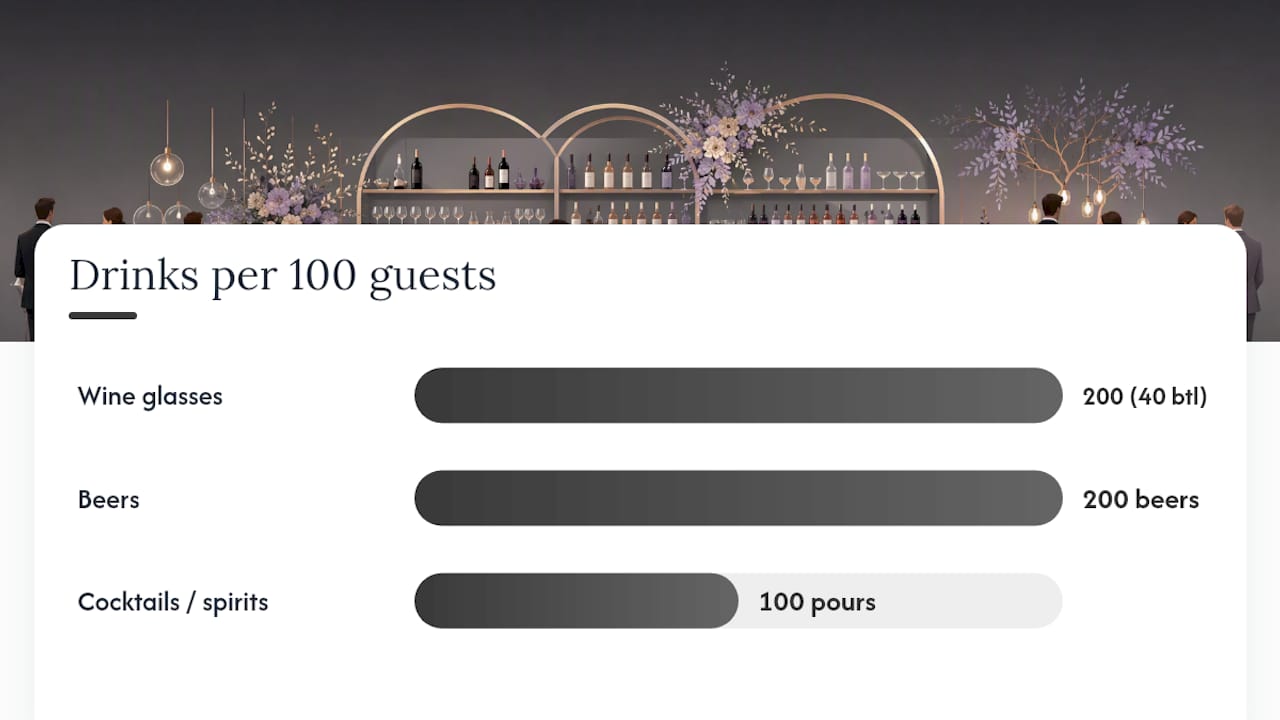
For 100 guests over 5 hours: budget around 500 total drinks. That breaks down to roughly 200 glasses of wine (about 40 bottles), 200 beers, and 100 cocktails or spirit pours, plus mixers and garnishes to match. Logistics guides for wedding bar setup recommend confirming these numbers with your caterer or bartender before finalizing your order, since ice, glassware, and garnish quantities scale right alongside the liquor.
Pro Tip: Give your bartender the finished menu, not just a liquor list. They’ll convert your drink names into actual bottle and case counts faster than you can. For a deeper breakdown on wine and beer volumes specifically, see how to select wine and beer for your reception.
How Should the Menu Look and Where Should It Go?
Readability beats decoration every time. Use a font size guests can read from six feet away, high contrast (dark text on light background or vice versa), and lines short enough to scan in two seconds.
- Chalkboard signs work well for rustic themes and are easy to update last minute
- Acrylic or glass signs with vinyl lettering hold up outdoors and photograph cleanly
- A simple framed print is the cheapest option and looks sharp at any venue
Post your main menu at the front of the bar, facing the line, not behind the bartender. Hand your bar staff a laminated copy of the same menu so their pours match what’s advertised, and consider small table cards if guests are seated far from the bar itself.
Pro Tip: Avoid script fonts for anything beyond the drink names. Guests squinting to read “Old Fashioned” in cursive slows down the whole line.
When Should You Hire a Professional Bar Team?
A turnkey mobile bartending service handles far more than pouring drinks. A full-service provider typically manages menu design, liquor purchasing, staffing ratios, liability coverage, and any local permits your venue requires.
Before you sign with anyone, run through this checklist:
- How many hours of service are included, and what’s the overtime rate?
- Do they pre-batch cocktails, and how do they handle carbonated toppers?
- What’s the staff-to-guest ratio for your headcount?
- Are they insured, and do they carry liquor liability coverage?
A wedding bar menu is only as good as the team executing it. The best-written menu still falls apart if the bartender pouring it doesn’t have a batching plan or enough hands behind the bar.
For couples in Las Vegas or Henderson planning a full-service setup, wedding beverage catering covers exactly these logistics from planning through the last call.
Bar Menu for Wedding: What Couples Get Wrong
Most bar menu advice online focuses on cocktail names and Pinterest-worthy signage. That’s the easy part. What actually determines whether your bar runs smoothly is the stuff nobody photographs: batching schedules, staff ratios, and whether your menu breadth matches your headcount.
The biggest mistake I see is couples building an ambitious six-cocktail menu because it looks impressive on a chalkboard, then wondering why the line stretches past cocktail hour. A tight two-cocktail menu with proper batching will out-perform a sprawling list every single time, because your bartender isn’t reinventing drinks on the fly for 150 people.
The conventional wisdom says “give guests options.” The better rule is “give guests good options, fast.” Prioritize a menu your bartender can execute without hesitation over one that reads well on paper. Write your menu with service speed in mind first, then layer in personality through naming and design.
Get Your Wedding Bar Menu Handled Start to Finish
Liquidcouragelv is the alternative to piecing together a DIY bar setup for your Las Vegas or Henderson wedding. Instead of writing menu copy, hunting for a bartender, and figuring out permits separately, you get one team that designs the menu, sources the liquor, staffs the bar, and handles the paperwork.
That matters most on the day itself, when the couple planning everything else shouldn’t also be tracking whether the beer ran out. Liquidcouragelv builds the signature cocktail list around your taste and guest count, batches what can be batched, and brings staff sized correctly for your headcount instead of guessing.
If you’re ready to stop building spreadsheets and start locking in a date, check the wedding liquor catering contract checklist and request a quote for your reception.
Sources
- Signature Cocktails: Complete Wedding Bar Guide & Recipes
- 8 Wedding Bars To Consider for Your Reception
- 25 top signature wedding cocktails, recipes & insider tips | Prezola
- Wedding Bar Menu San Diego – Cocktail & Bar Inspiration, Drink Options