

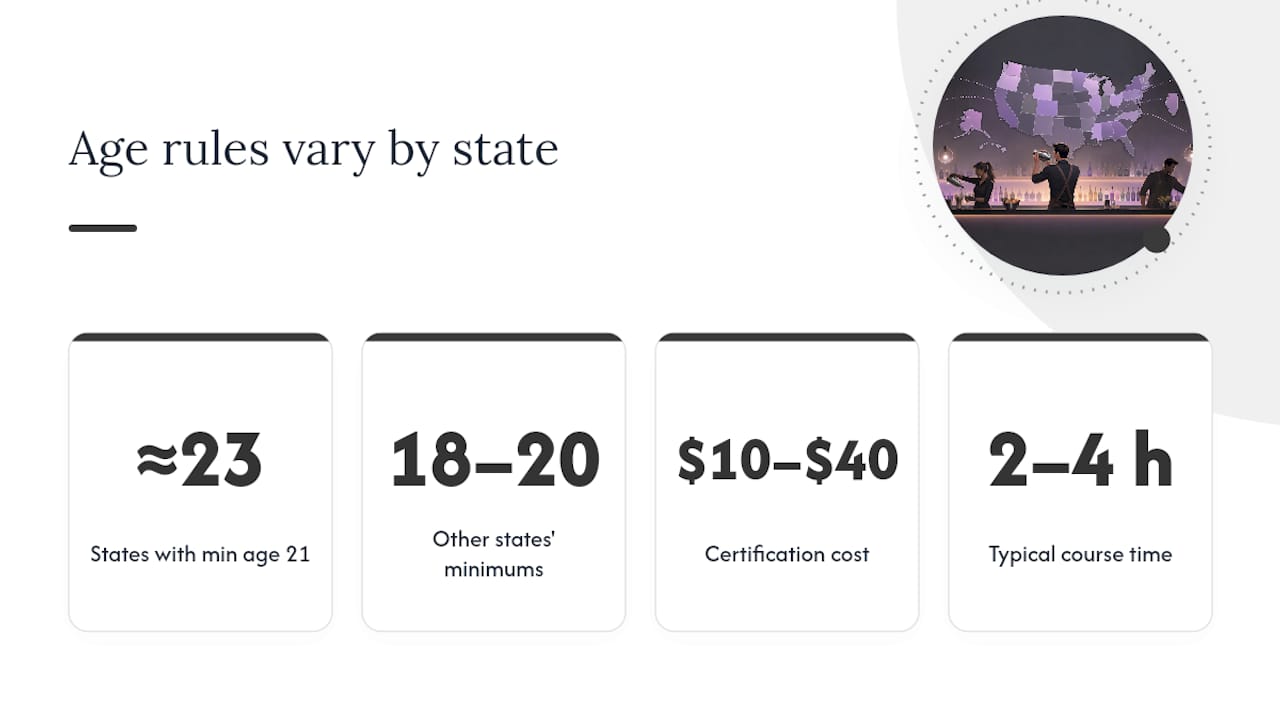
The minimum age to bartend in the United States is not one number. It’s set entirely by states and, in some cities, local ordinances, and it currently ranges from 18 to 21 depending on where you’re standing behind the bar. There is no federal minimum age for bartending. Roughly 23 states require bartenders to be 21, while the remaining states let younger workers pour, usually with strings attached: supervision requirements, beer-and-wine-only limits, or specific license classes.
Here’s the fast version before the full breakdown:
- A number of states plus D.C.-style jurisdictions hold the line at 21 for anyone mixing or pouring drinks.
- The rest allow 18, 19, or 20-year-olds to bartend, but usually only under a beer-and-wine license, with a manager on-site, or after completing an approved training course.
- Your employer’s internal policy might be stricter than your state’s law. A restaurant group’s HR handbook can set a 21+ floor even in a state that legally allows 19.
That last point trips up more people than the actual statutes do. You can be legally eligible to bartend in your state and still get turned down because the venue’s insurance carrier or license type demands an older hire. The state-by-state table below breaks down the legal floor everywhere in the country, and the sections after it explain why the number moves around so much and what actually determines whether you (or someone you’re hiring) can legally work the bar.
Key Takeaways
The minimum age to bartend depends entirely on your state and license type, with no federal standard, and employer policy is frequently stricter than the law requires.
| Point | Details |
|---|---|
| Check your state ABC first | Confirm the current minimum age directly through your state’s alcoholic beverage control agency, not a general search result. |
| Know your license class | On-sale general, beer-and-wine, casino, and club licenses often carry different age floors within the same state. |
| Get RBS certification | Programs like TIPS, ServSafe Alcohol, and TABC typically cost $10 to $40 and take 2 to 4 hours to complete. |
| Employer floors can exceed state law | Many venues require 21+ regardless of state minimum to reduce dram-shop and insurance exposure. |
| Save your proof | Screenshot the agency page and note the date checked; local ordinances can override state minimums. |
Table of Contents
- What Is the Minimum Bartending Age in Each State?
- Why Do Bartending Age Laws Vary by State?
- Can You Bartend Under 21 With Restrictions?
- What Training or Certification Do Bartenders Need?
- Why Do Employers Require Bartenders to Be 21?
- How Do You Verify Your State’s Bartending Age Law?
- What Should Event Planners Know About Hiring Bartenders?
- A Mobile Bartender’s Take on Age and Compliance
- Where Can You Verify Bartending Age Laws?
- Frequently Asked Questions
- Sources
What Is the Minimum Bartending Age in Each State?
Alcohol law in the United States is a patchwork by design. The 21st Amendment handed regulatory control back to individual states after Prohibition ended, and states have run with that authority ever since, each writing its own rules for who can sell, serve, and pour. That’s why a bartender who’s legal in Louisiana at 18 would be breaking the law doing the same job in Utah.
The table below reflects the minimum age listed for on-premises bartending (mixing and pouring behind the bar) in each state, along with common restrictions tied to license type. Local ordinances can tighten these numbers further, so treat this as your starting point, not your final answer.
Table last verified for accuracy in 2026. Because local ordinances change independently of state statutes, always confirm with your state’s alcohol control agency before scheduling or accepting a shift. A city like Chicago can enforce rules stricter than Illinois’s statewide minimum, and casino-district cities like Las Vegas frequently carry separate gaming-license age floors that override the general state number.
- Save a screenshot or PDF of your state’s official page the day you check it. Agency guidance pages get updated without notice.
- If you’re comparing multiple states for a job search or multi-market hiring, Bartending Age Requirements by State offers a useful cross-check against the table above.
Why Do Bartending Age Laws Vary by State?
There’s no federal minimum age for bartending because alcohol regulation was deliberately left to states after Prohibition. Congress never stepped back in to standardize it, so each state’s Alcoholic Beverage Control (ABC) agency, or its equivalent, writes and enforces its own age floor. That’s the entire explanation for why the number bounces between 18 and 21 depending on where you cross a state line.
Two role definitions matter more than most people realize:
- Serving means bringing a drink someone else poured to a customer’s table. Many states let 18-year-olds do this.
- Bartending means mixing, pouring, and dispensing alcohol directly. States frequently set a higher age floor here, or require training certification the serving role doesn’t demand.
Several states allow 18-year-olds to serve beer and wine tableside
while reserving spirits pouring behind the bar for workers who are 21 or under direct supervision. That single distinction, serving versus pouring, is responsible for most of the confusion job seekers run into when a job posting says “bartender” but the actual duties described sound more like server work.
License class adds another layer. A restaurant with a beer-and-wine license operates under different age rules than one with a full on-sale general license, and a casino or private club license frequently imposes its own stricter floor regardless of what the state’s baseline statute says.
Pro Tip: Start every verification at your state’s ABC or liquor control board website, not a general search engine. Pennsylvania’s Bureau of Liquor Control Enforcement, for example, explicitly states that minors may perform food-service tasks but cannot dispense alcoholic beverages, a distinction that would be easy to miss reading a generic third-party summary.
Can You Bartend Under 21 With Restrictions?
Most states that allow under-21 bartending attach a condition to it, not a blank check. The three most common carve-outs are beer-and-wine-only service, supervision by a manager or older employee, and event-specific permits tied to a single date or venue.

A beer-and-wine-only allowance means an 18 or 19-year-old can legally pour those two categories but not spirits or mixed drinks. Supervision rules typically require a 21+ manager physically present on the premises during the younger employee’s shift, not just on call. Event-specific permits show up most often at festivals, fairs, and one-off private functions where a local jurisdiction issues a temporary license with its own age terms separate from the venue’s standing license.
Barback, server, and tasting-room roles sit in a different legal category entirely. A barback restocks ice, garnishes, and glassware; they generally don’t handle the pour, so many states let them start younger than the bartending floor allows. Tasting-room staff at breweries or wineries often fall under a separate statute built around sampling rather than full bar service, which can carry its own age threshold distinct from a bar’s minimum.
The trap scenario that trips up the most workers and employers alike: an 18-year-old server clearing a half-full cocktail glass from a table isn’t “serving alcohol” in the legal sense, but that same 18-year-old pouring a refill at the bar might be. The fine-grained line between carrying, serving, and pouring is enforced in many states, and it’s the single most common source of confusion for both new hires and the managers scheduling them.
If you’re not sure which category a job actually falls into, ask the hiring manager to describe the exact tasks, not just the job title. “Bartender” on a schedule can legally mean very different things depending on the license and the state.
What Training or Certification Do Bartenders Need?
Most states either require or strongly expect completion of a Responsible Beverage Service (RBS) course before someone pours a drink professionally, regardless of the minimum age. This isn’t universal law everywhere, but it’s close enough to standard practice that skipping it will cost you job opportunities even in states that don’t legally mandate it.
The most recognized programs are:
- TIPS (Training for Intervention ProcedureS), widely accepted across most states and often required by insurance carriers even where state law doesn’t mandate it.
- ServSafe Alcohol, run through the National Restaurant Association, common in food-service-heavy states.
- TABC seller-server training, specific to Texas and required for anyone selling or serving alcohol in the state.
- State-specific RBS courses, run directly through the state’s ABC agency in places like Oregon (OLCC permit) and Washington (MAST permit).
These programs generally run two to four hours and cost somewhere between $10 and $40, which makes them one of the cheapest barriers to entry in the entire hospitality industry relative to what they unlock. Most certifications stay valid for two to three years before requiring renewal, though the exact window depends on the state and program.
Before you pay for a course, confirm it’s actually recognized where you plan to work. A TABC certificate won’t help you in Oregon, and a course that’s fine for a beer-and-wine restaurant might not satisfy the requirements for a casino floor position. Your state ABC website will usually list approved providers directly.
Why Do Employers Require Bartenders to Be 21?
Many employers set an internal hiring floor of 21 even in states where the law allows younger workers, and the reason comes down to risk, not preference. A bar or restaurant that hires an underage bartender in violation of state law can face fines, temporary license suspension, or in repeat cases outright license revocation, on top of the insurance and civil exposure that follows.
The liability doesn’t stop at the fine. Dram shop laws in most states allow injured third parties to sue an establishment if an intoxicated patron they served causes harm, and a licensing violation involving underage staff makes that lawsuit significantly harder to defend. Insurance carriers know this, which is why many employers set a 21+ internal minimum specifically to simplify dram-shop exposure and keep premiums manageable, even when state law would technically permit hiring someone younger.
Typical consequences of noncompliance include:
- Fines ranging from a few hundred to several thousand dollars per violation, depending on the state.
- Temporary suspension of the liquor license, which halts alcohol sales entirely during the suspension window.
- Permanent license revocation for repeat or egregious violations.
- Higher liability insurance premiums following any documented violation.
- Increased dram-shop exposure if an underage-staffing violation coincides with an incident involving an intoxicated guest.
Before scheduling a younger employee behind the bar, a hiring manager should verify four things: a valid photo ID confirming age, a copy of the required training certification, any state-mandated worker permit for minors, and the exact license class the venue operates under.
Local case reports consistently show that liquor board enforcement actions tied to underage staffing tend to escalate quickly once a violation is documented, moving from a warning to a suspension far faster than most other licensing infractions.
How Do You Verify Your State’s Bartending Age Law?
Confirming your exact legal floor takes four steps, and skipping any of them is how people end up relying on outdated or third-party information that doesn’t match current law.
- Go directly to your state’s ABC or liquor control website. Search “[state name] alcoholic beverage control bartender minimum age” and look for the .gov domain specifically, not a blog result.
- Identify the exact license class of the venue you’re checking against. On-sale general, beer-and-wine, private club, and casino/gaming licenses can each carry different age rules even within the same state.
- Check city and county ordinances separately from the state statute. Municipalities in states like Illinois, Colorado, and Nevada have historically layered additional restrictions on top of the state floor.
- Call the local licensing office if anything is ambiguous. A five-minute phone call beats guessing wrong on a compliance question.
A simple script for that call: “Hi, I’m trying to confirm the minimum age to bartend at a [license type] establishment in [city/county]. Is that governed by the state statute, or does the city have a separate ordinance?”
Once you get an answer, save the statute number, the agency page URL, and the date you checked it. Laws get amended, and having a dated record protects you if a rule changes six months after you verified it.
What Should Event Planners Know About Hiring Bartenders?
Event planners hiring bartenders directly, rather than working through a staffed provider, should require proof of age and state-approved training certification in writing before signing any contract, and should build indemnity language around alcohol service into the agreement itself.
A practical hiring checklist for planners covers four items:
- ID verification on file, dated, confirming the bartender meets the state’s minimum age for the specific license class involved.
- Certification copies showing an active, unexpired RBS or seller-server credential recognized in that jurisdiction.
- Liquor liability insurance confirmation, either from the bartender’s employer or the event’s own event insurance policy.
- Worker permit documentation, where the state requires one for employees under 18 performing any food-and-beverage role.
Contract language worth requesting includes an age-verification clause, a certification-compliance clause tied to the specific state’s RBS requirements, and language confirming the staffing provider assumes responsibility if a scheduled worker doesn’t meet the jurisdiction’s legal age or training standard. Requiring copies of certification and a dated ID on file, along with a clause shifting liability for mis-scheduled underage staff back to the staffing provider, closes most of the gaps that create liability for the planner.
Pro Tip: For a private party with a relaxed, beer-and-wine-only bar setup, an 18–20-year-old certified server can often handle the job fine. For a wedding reception, corporate gala, or anything involving full spirits and cocktail service, staff a 21+ bartender by default. It removes an entire category of legal risk from an event you can’t afford to have go sideways.
Reviewing a wedding liquor catering contract checklist before your event date gives you a template for exactly which clauses to request, and confirms your provider handles age and certification verification as part of standard booking, not as an afterthought.
A Mobile Bartender’s Take on Age and Compliance
Compliance and staffing needs pull in opposite directions more often than people expect. A planner wants a bartender who can work a Friday night wedding in Henderson; the law wants proof that whoever’s behind that bar meets Nevada’s age and licensing rules for the specific venue and permit type involved. Balancing both isn’t complicated once you build it into your hiring process from day one, but it’s the step a lot of smaller operators skip until something goes wrong.
Nevada sets its bartending floor at 21 for gaming and casino-adjacent venues, which covers a large share of the events booked around Las Vegas and Henderson. That’s not a rule to work around. It’s the reason Liquid Courage LV verifies age and certification documentation before a single bartender gets scheduled to a client’s event, regardless of how relaxed the venue or occasion seems. A private backyard party and a casino-district corporate gala can have very different licensing exposure, and treating them the same is how planners end up with a compliance problem they didn’t see coming.
The practical upside for clients is straightforward: requiring proof of age and training upfront means fewer surprises on event day and a lot less exposure if something does go wrong.
Where Can You Verify Bartending Age Laws?
This guide reflects state bartending age data current as of 2026, but statutes and local ordinances change, so cross-check anything time-sensitive against these sources directly.
- NIAAA Alcohol Policy Information System (APIS), the federal government’s own alcohol policy database and the most reliable single source for state-by-state statutory minimums.
- Usa, useful as a starting point for locating your state’s specific ABC or liquor control agency contact information.
- TIPS training, one of the most widely recognized seller-server certification programs across states.
- Pennsylvania BLCE guidance, a model example of how state enforcement agencies clarify the food-service-versus-dispensing distinction for minors.
- NationalBartenders’ state-by-state list and 360training’s server/bartender certification programs, both useful for cross-referencing training requirements against your specific state.
This information is general guidance, not legal advice. Confirm current rules with your state’s alcoholic beverage control agency or a licensed attorney before making hiring or employment decisions.
If you’re planning an event in Las Vegas or Henderson and want bartenders who already meet Nevada’s age and certification standards, Liquid Courage LV’s mobile bartending services handle that verification before your event date, not after.
Frequently Asked Questions
What is the minimum bartender age requirement in the U.S.?
There’s no single national minimum. The bartender age requirement ranges from 18 to 21 depending on the state, with about 23 states setting the floor at 21 and the rest allowing 18, 19, or 20-year-olds under specific license types or supervision rules.
What’s the difference between the minimum age to bartend and the minimum age to serve alcohol?
Serving usually means delivering a drink someone else poured; bartending means mixing and pouring it directly. Several states let 18-year-olds serve beer and wine tableside while requiring bartenders behind the bar to be 21 or supervised.
Can an 18-year-old work as a bartender anywhere in the U.S.?
Yes, in states like California, Florida, Texas, and roughly two dozen others, 18-year-olds can legally bartend, though license type and local ordinances can still raise that floor for specific venues like casinos or private clubs.
Is there a federal minimum age to bartend?
No. Alcohol regulation authority sits with states and local jurisdictions, not the federal government, which is why the minimum age varies so widely from state to state.
Do bartenders need certification even if their state doesn’t require it?
Most employers expect it regardless of state law. TIPS, ServSafe Alcohol, and state RBS courses typically cost $10 to $40 and take 2 to 4 hours, making it a low-cost way to become more hireable even where it isn’t legally mandatory.
Why do some bars require bartenders to be 21 even in states that allow 18?
Insurance costs and dram-shop liability drive most of it. Employers frequently set an internal 21+ floor to reduce legal exposure, even when state law would technically permit hiring someone younger.
This article is general information, not a substitute for advice from a qualified lawyer. Consult a qualified legal professional about your own circumstances before acting on anything here.
Sources
- Minimum Ages for On-Premises Servers and Bartenders | APIS
- Bartending Age Requirements by State
- What’s the Age Requirement to Bartend? | TIPS
- Bartending Age Requirements: Every State Rule Explained
- Pennsylvania BLCE guidance on minors on licensed premises