
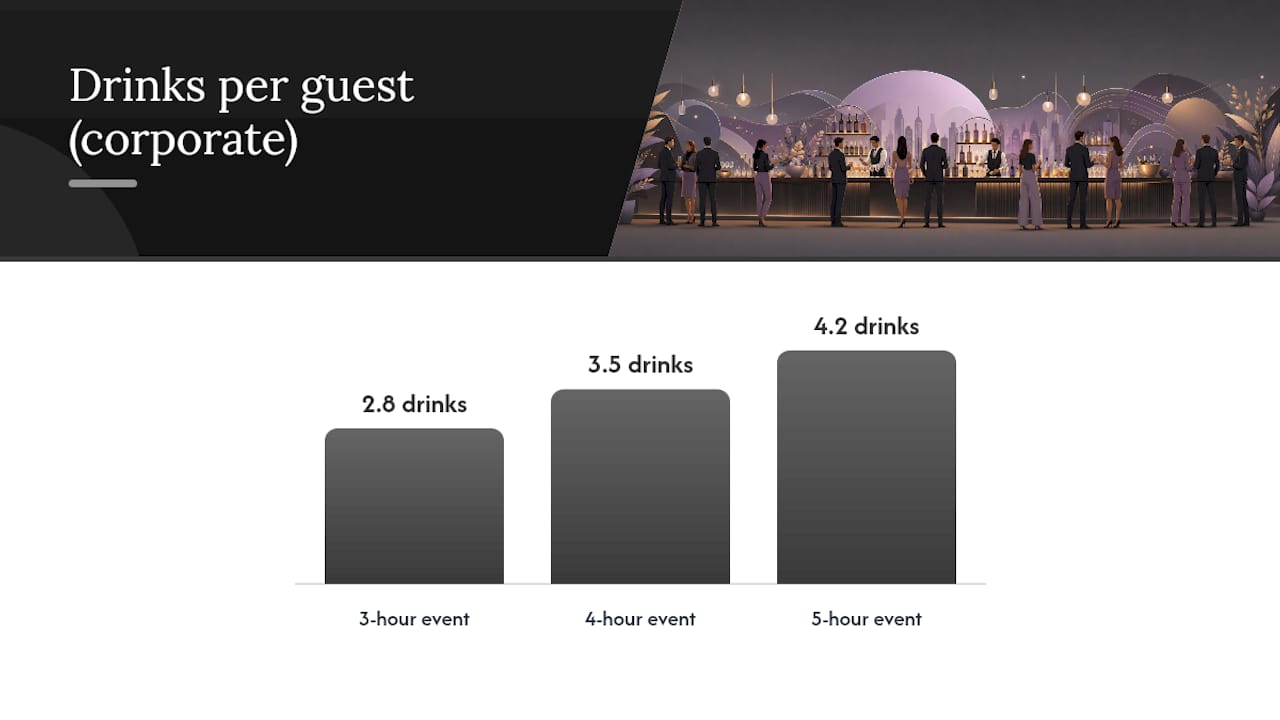
For a full open bar, start with 1 bartender per 50 guests. Beer and wine only? You can stretch that to 1 per 75. On the drink side, corporate events average 2–3 drinks per person over a 3-hour event, which is notably lower than a wedding or gala. That single number drives everything downstream: how many bottles you order, how many staff you schedule, and how many bar stations you need on the floor.
Corporate event guest count bar planning comes down to three formulas you can run in under a minute:
- Bartenders needed: Guest count ÷ ratio (50 for full bar, 75 for beer/wine) — round up always.
- Total drinks: Guest count × drinks per person per hour × event hours (add 1 extra drink for the first hour).
- Bottles needed: Total drinks ÷ average pours per bottle (roughly 5 pours per 750ml wine bottle, 16 pours per 750ml spirit bottle).
Quick examples to anchor the math:
- 50 guests, full bar, 3 hours: 1 bartender (50÷50=1); 50 × 2.5 drinks = 125 total drinks.
- 150 guests, full bar, 4 hours: 3 bartenders (150÷50=3); 150 × 3.5 drinks = 525 total drinks.
- 300 guests, beer and wine, 4 hours: 4 bartenders (300÷75=4); 300 × 3.5 drinks = 1,050 total drinks.
The variables that shift these numbers most:
- Event duration: Each additional hour adds roughly 1 drink per guest after the first.
- Crowd drinking profile: Daytime corporate crowds drink less than evening receptions; tech conferences drink differently than sales kickoffs.
- Service points: Multiple bar stations change throughput per bartender, not the ratio itself.
- Service model: A pre-batched cocktail station moves faster than a made-to-order full bar.
Key Takeaways
Accurate corporate event bar planning starts with guest count and service model, then builds outward to staffing, quantities, layout, and compliance.
| Point | Details |
|---|---|
| Start with the right ratio | Use 1 bartender per 50 guests for a full bar, or 1 per 75 for beer and wine only. |
| Plan 2–3 drinks per person | Corporate events average 2–3 drinks per guest over 3 hours; apply a 0.7 modifier to social-event totals. |
| Buffer stock by category | Add 10–15% to alcoholic quantities and 20–30% to non-alcoholic; ice runs higher outdoors in Las Vegas. |
| Require a bar captain at 300+ guests | Multi-station events need a dedicated supervisor for real-time redeployment, not just more bartenders. |
| Liquidcouragelv for Las Vegas events | Liquidcouragelv provides staffed, stocked, and coordinated corporate bar service across Las Vegas and Henderson. |
Table of Contents
- How does your bar service model change staffing and quantities?
- What staffing roles do you need beyond the bartender headcount?
- How do you convert guest count into bottles, cases, and mixer needs?
- How should you lay out bar stations to keep lines moving?
- What supplies and logistics do you need to confirm before event day?
- When should you staff up and when can you scale back?
- What U.S. compliance basics apply to corporate bar service?
- How do you plan for surprises on event day?
- How Liquidcouragelv applies these rules at Las Vegas corporate events
- What the standard bar planning guides get wrong
- Liquidcouragelv handles the math and the execution for Las Vegas planners
- Useful resources for corporate bar planning
- Sources
How does your bar service model change staffing and quantities?
The service model you choose affects pour speed, drink complexity, and ultimately how many staff you need. Getting this wrong in either direction costs money: over-staff a beer-and-wine reception and you’re paying idle bartenders; under-staff a premium cocktail event and guests wait six minutes for a drink.
Full open bar
Gives guests the most freedom and generates the highest drink volume. It also requires the most skilled bartenders, since spirit-forward cocktails take longer to build. For corporate events, this model works well for evening receptions and award dinners, but it carries the highest liability exposure if guests overindulge.
Beer and wine only
Is the workhorse of daytime corporate events. The ratio stretches because a bartender can open a bottle of wine or crack a beer in seconds. Inventory planning is simpler, waste is lower, and compliance risk drops considerably.
Signature or pre-batched cocktails
Are worth serious consideration for corporate events with a branded theme. Pre-batching a signature drink the night before means your bartender is pouring, not building. That speed advantage lets one bartender handle more guests without sacrificing the premium feel. See the branded cocktail planning guide for batch ratios and yield math.
Ticketed or consumption-based bars
Give finance teams a hard cost ceiling, which is why they show up frequently in budget-conscious corporate settings. The trade-off is a slightly clunkier guest experience at the bar, since staff must validate tickets before pouring.
- Full open bar pros: Premium guest experience, flexible ordering, high satisfaction.
- Full open bar cons: Highest cost, highest liability, most complex inventory.
- Beer and wine pros: Fast service, lower cost, easier compliance.
- Beer and wine cons: Limited for guests who prefer spirits; can feel understated at premium events.
- Ticketed bar pros: Predictable cost, built-in consumption control.
- Ticketed bar cons: Adds friction; guests may feel nickel-and-dimed.
Pro Tip: Pre-batch your signature cocktail only when the recipe holds well for 4+ hours without separation or flavor loss. Citrus-heavy drinks oxidize quickly; spirit-forward batches (Negroni, Manhattan) hold beautifully. Keep made-to-order for anything with fresh juice.
What staffing roles do you need beyond the bartender headcount?
Bartender count is just the start. The roles around the bar determine whether a well-staffed event actually runs well or just looks staffed on paper.
Core roles and what they actually do:
- Bartender: Builds and pours drinks, manages the speed rail, handles guest interaction. The throughput bottleneck at every event.
- Barback: Restocks ice, bottles, and glassware; empties trash; keeps the well organized. One barback per 2–3 bartenders is a reasonable starting point.
- Runner: Moves supplies between cold storage and the bar. Critical for multi-station setups where the bar is far from the staging area.
- Floater: A cross-trained staff member who can jump in at any station, assist with bussing, or handle a sudden rush at one bar while another is quiet.
- Bar captain/supervisor: Manages the whole bar operation, handles staff redeployment, communicates with the venue and event coordinator, and makes real-time calls on opening extra stations or cutting service.
Scaling is non-linear: the roles that work at 100 guests are different in kind from what you need at 300 or 500. At 100 guests, a single experienced bartender with one barback can often manage. At 300 guests across two stations, you need a bar captain whose only job is coordination, not pouring.
When to require a bar captain: Any event at or above 300 guests, any multi-station setup, or any event where the bar is more than 50 feet from the primary guest circulation area. A captain who isn’t pouring can see the whole floor and redeploy staff before a line forms, not after.
Staffing roles
Sample 4-hour shift structure for a 150-guest corporate reception:
- T-90 min (setup): 3 bartenders + 1 barback arrive. Stock wells, check ice, confirm glassware count, test POS.
- T-0 (doors open / cocktail hour): All 3 bartenders active. Barback on continuous restock. Peak demand window.
- T+60 min (transition to dinner/program): Reduce to 2 active bartenders. Third bartender on break, available to return.
- T+180 min (post-dinner reception): Return to 3 bartenders as guests return to the bar. Floater assists with bussing.
- T+240 min (last call / closeout): 2 bartenders handle last call. Third begins breakdown. Barback consolidates ice and returns bottles.
For conference-style events with scheduled service windows, the peak demand pattern is compressed: guests hit the bar hard during 15-minute breaks, then disappear into sessions. Staff accordingly, with all bartenders active during break windows and reduced coverage during sessions.
Throughput math: A skilled bartender making cocktails can realistically pour 60–80 drinks per hour. Beer and wine pours push 100–120 per hour. If your 150-guest event expects 525 total drinks over 4 hours, that’s roughly 131 drinks per hour at peak. Two bartenders at cocktail speed handle that; three gives you a comfortable buffer.
How do you convert guest count into bottles, cases, and mixer needs?
The drinks-per-person method is the most reliable starting point: plan roughly 1 drink per guest per hour, with 2 drinks in the first hour. For a 4-hour corporate event, that’s approximately 3.5–4 drinks per guest total. Corporate crowds skew toward moderation, so the lower end of that range is usually right for daytime events; evening receptions trend higher.
Formula:
Total drinks = Guest count × [(hours − 1) × 1 drink + 2 drinks for hour 1]
For 150 guests at a 4-hour event: 150 × [(3 × 1) + 2] = 150 × 5 = 750 drinks. That’s the social-event ceiling. For a corporate crowd, apply a 0.7 modifier: 750 × 0.7 = 525 drinks. That aligns with the corporate planning default of 2–3 drinks per person for a 3-hour event.
| Beverage Category | Per 100 Guests (3-hour event) | Approximate Unit |
|---|---|---|
| Beer | 60 drinks | 5 cases |
| Wine | 60 drinks | 12 bottles (750ml, 5 pours each) |
| Spirits/cocktails | 30 drinks | 2 bottles per spirit type |
| Non-alcoholic (water, soda, juice) | 150 drinks | 12–15 cases (12-oz cans/bottles) |
Scale linearly for 150 or 300 guests, then add a buffer:
- 150 guests: Multiply table values by 1.5, then add 10–15% for walk-ups and VIPs.
- 300 guests: Multiply by 3.0, then add the same buffer.
Worked example for 300 guests, 4-hour evening reception:
Total drinks (corporate modifier): 300 × 4.5 = 1,350 drinks.
- Beer: 540 drinks = 23 cases.
- Wine: 540 drinks = 108 bottles.
- Spirits: 270 drinks = roughly 17 bottles (750ml, 16 pours each).
- Non-alcoholic: 1,350 drinks = 113 cases (12-oz units).
Ordering tips:
- One 750ml wine bottle yields 5 standard pours (5 oz each). One 750ml spirit bottle yields approximately 16 standard pours (1.5 oz each).
- Ice: plan 1–1.5 lbs per guest for a full bar; 0.75 lbs per guest for beer and wine only. Double that for outdoor Las Vegas events in summer.
- Mixers: for every bottle of spirits, plan 2 liters of primary mixer (soda water, tonic, cola) and 1 liter of secondary mixer (juice, simple syrup).
- Non-alcoholic allocation for corporate events should be generous. Quality sparkling water, flavored sodas, and mocktails reduce alcohol consumption and lower your liability exposure simultaneously.
For beverage station ideas that work well in Las Vegas venues, a dedicated non-alcoholic station separate from the main bar reduces congestion and signals to non-drinking guests that they’re equally considered.
How should you lay out bar stations to keep lines moving?
Physical layout is where planning meets reality. A well-staffed bar in the wrong location creates lines just as surely as an understaffed one.
Equipment per station (minimum):
- Portable bar unit with at least 6 feet of frontage (8 feet preferred for two bartenders)
- Speed rail with primary spirits and mixers within arm’s reach
- Dedicated ice bin (minimum 40-lb capacity per bartender)
- Refrigeration access or insulated cooler within 10 feet
- POS terminal or ticket validation point at the end of the bar, not the center
- Garnish tray, cutting board, and bar tools at each station
Distribution logic for common venue types:
In a ballroom or large reception space, place bars at opposite ends of the room rather than side by side. Guests naturally gravitate toward the nearest bar, so two bars at opposite ends split traffic evenly without requiring signage. A central bar in a large room creates a single congestion point regardless of how many bartenders are behind it.
For hub-and-spoke setups at larger events (300+ guests), anchor one full-service bar as the hub and add satellite stations for beer, wine, and non-alcoholic drinks only. Satellites need just one staff member each and dramatically reduce load on the main bar during peak windows.
Queue-reduction tactics that actually work:
- Dedicate one lane at the main bar to wine and beer only. Guests who want a simple pour skip past the cocktail queue.
- Position a pre-batched signature cocktail station as a standalone pickup point, not behind the main bar. Guests grab a pre-poured drink and move on in seconds.
- For bottled beer and canned beverages, a self-serve cooler with a staff member nearby for payment or ticket validation moves faster than any bar.
- During plated-to-reception transitions, open satellite stations 10 minutes before the program ends so guests don’t all hit the main bar simultaneously.
Pro Tip: Keep every bar station within direct sightline of the bar captain. If the captain has to walk around a pillar or through a crowd to see a station, they can’t manage it effectively. Sightline is a staffing tool, not just a design preference.
What supplies and logistics do you need to confirm before event day?
Getting the quantities right means nothing if the supplies aren’t staged correctly on the day. This is where events that look good on paper fall apart.
Compact supplies checklist:
- Glassware: wine glasses, rocks glasses, highball glasses, and champagne flutes (if applicable). Plan 2.5 glasses per guest for a full bar to account for breakage and guests who set down and forget their glass.
- Disposable option: premium plastic stemware for outdoor or high-traffic events reduces breakage risk without sacrificing appearance.
- Bar tools: shakers, jiggers, strainers, bar spoons, bottle openers, and corkscrews — at least one full set per bartender, plus one backup set per station.
- Speed rails stocked and labeled before guests arrive.
- POS hardware: terminals, receipt printer, and backup card reader. Test connectivity at the venue before setup is complete.
- Garnish trays: citrus wheels, olives, cherries, and cocktail napkins. Restock plan confirmed with barback.
- Trash and recycling bins behind the bar, not just in guest areas.
Numeric rules of thumb:
- Ice: 1–1.5 lbs per guest for a full bar; 0.75 lbs per guest for beer and wine. For outdoor Las Vegas summer events, add 50% to both figures.
- Spare glassware: keep 25–30% more than your calculated need on hand, staged in a back-of-house area accessible to the barback.
- Backup stock: hold 10–15% of your alcohol order in sealed cases in cold storage. Don’t open backup until the primary supply drops below 20%.
Important Venue Logistics and Resupply Path
Confirm the resupply path from cold storage to the bar before the event. A 200-foot walk through a crowded ballroom with a case of wine is a liability and a bottleneck. Mobile bar setups need a clear loading path from the vehicle to the service area, ideally within 50 feet. For multi-station events, assign one runner whose only job is moving supplies between storage and stations.
Contract tip: Put ice delivery responsibility, resupply timing, and cold storage access in writing in your vendor contract. “We assumed the venue had a walk-in” is a conversation that happens at 7 PM when it’s too late to fix.
Stat to know: For outdoor events in Las Vegas, ice consumption can run 50–100% higher than indoor estimates due to ambient temperature. Build that into your order, not your contingency buffer.
When should you staff up and when can you scale back?
Staffing isn’t a flat number across an event. Demand peaks and valleys are predictable if you plan for them.
Sample timeline for a 4-hour corporate reception (150 guests):
- T-90 min: Full setup crew arrives. 3 bartenders + 1 barback. Stock, test POS, confirm ice delivery.
- T-30 min: Final walkthrough with bar captain and venue coordinator. Confirm guest count update from registration.
- T-0 (doors open): All bartenders active. Cocktail hour is peak demand. Barback on continuous restock.
- T+60 min (transition to dinner or program): Reduce to 2 active bartenders. Third on break with a 10-minute return window. Service slows significantly during seated portions.
- T+150 min (post-program / dessert / networking): Return to full staffing. Second peak, typically shorter than cocktail hour but still significant.
- T+210 min (30 min before end): Last call announced. Begin consolidating one station. Two bartenders handle final service.
- T+240 min (event end): Breakdown begins. One bartender manages any remaining guests while others consolidate.
Decision checkpoints:
- Add a floater if the observed queue at any bar exceeds 8–10 people for more than 5 minutes.
- Reduce service points when fewer than 30% of guests are actively at or near the bar.
- Call last call 30 minutes before the contracted end time, not at the end. This gives guests time to get a final drink without a rush at closing.
Scheduling tips:
- Build a 15-minute overlap between any shift handover so the incoming bartender is briefed before the outgoing one leaves.
- Schedule breaks during the dinner or program lull, never during cocktail hour or post-program networking.
- For events over 5 hours, plan formal 20-minute breaks for each bartender staggered so coverage never drops below 75% of peak staffing.
For networking events where the program is less structured, demand is more continuous and the dinner lull may not exist. In those cases, keep full staffing throughout and plan breaks in 10-minute windows during natural conversation lulls.
What U.S. compliance basics apply to corporate bar service?
Compliance isn’t optional, and the consequences of getting it wrong at a corporate event are worse than at a private party. Your client’s employer brand is on the line alongside your license.
State-check action items:
- Confirm the venue holds a valid liquor license that covers your event type (banquet permit, catering license, or on-premises license). This is the venue’s responsibility, but verify it yourself.
- Confirm your bartending staff holds current server training certification. TIPS (Training for Intervention ProcedureS) is the most widely recognized program in the U.S. and covers responsible alcohol service, ID verification, and intervention techniques. Some states require it by law; all corporate clients should require it by contract.
- Check your state’s ABC (Alcoholic Beverage Control) rules on service limits, hours of service, and any restrictions on open bar formats. Rules vary significantly by state and sometimes by county.
- Establish a clear age-verification protocol. Every guest who appears under 30 should be carded. Assign this responsibility explicitly to one staff member per station, not to “whoever is available.”
Liability Controls and Safety Measures
- Drink ticketing limits consumption without requiring staff to cut off guests directly, which reduces confrontation.
- Visible, high-quality non-alcoholic options give guests a face-saving alternative to a second or third alcoholic drink.
- Coordinate with the event organizer on rideshare or shuttle arrangements before the event. Having a Lyft or Uber code available for guests is a simple, documented safety measure.
- Brief your bar captain on the intervention protocol before service begins. A captain who knows exactly what to say and do when a guest has had too much is worth more than any policy document.
For TIPS certification, visit TIPS training directly. For state-specific ABC rules, search “[your state] ABC” or “[your state] Alcoholic Beverage Control” for the relevant government agency.
How do you plan for surprises on event day?
Even the best pre-event math gets tested by reality. The question isn’t whether something will deviate from the plan; it’s whether you’ve built in enough buffer to handle it without the client noticing.
Stock buffer recommendations:
- Alcohol: add 10–15% above your calculated need. For corporate events where consumption is lower and predictable, 10% is usually sufficient.
- Non-alcoholic beverages: add 20–30% above calculated need. Non-alcoholic demand is harder to predict and the cost of running out of sparkling water is disproportionate to the cost of the extra cases.
- Ice: add 20% above your calculated need indoors; 40–50% for outdoor Las Vegas events.
Float staff rules:
- For events under 150 guests, have one cross-trained floater available by phone within 20 minutes of the venue.
- For events of 150–300 guests, have one floater on-site from the start, assigned to a non-bar role until needed.
- For events over 300 guests, two on-site floaters is the baseline. At these scales, the logistics are different in kind, not just in degree.
Decision rule for opening an extra station:
If the queue at any bar exceeds 10 people and the average wait exceeds 4–5 minutes, open an additional service point. Don’t wait for the bar captain to feel uncomfortable; set the trigger in advance and make it automatic.
Rapid resupply checklist:
- Identify the nearest ice supplier to the venue before event day. In Las Vegas, most convenience stores and grocery chains carry bulk ice, but confirm hours and stock capacity.
- Stage refrigerated backup stock in a venue-accessible area, not in a vehicle parked outside.
- Assign one runner whose sole job during peak service is moving supplies. Don’t pull a bartender off the bar to carry cases.
- Keep the bar captain’s phone charged and confirm they have the venue coordinator’s number, the client’s number, and the supply contact’s number before service begins.
Real-time attendance data, such as badge scans or door counts, gives your bar captain an early signal when actual attendance is running above or below the RSVP count.
How Liquidcouragelv applies these rules at Las Vegas corporate events
Here’s how these principles look in practice at a real corporate event in Las Vegas.
Event context: A 200-person corporate reception at a Henderson conference center, 4-hour evening event, full open bar with one pre-batched signature cocktail.
Initial staffing math: 200 ÷ 50 = 4 bartenders. Add 1 barback per 2 bartenders = 2 barbacks. One bar captain. Total: 7 staff.
Drink quantity baseline: 200 guests × 4.5 drinks (4-hour corporate modifier) = 900 total drinks. Apply 50/50 alcoholic/non-alcoholic split: 450 alcoholic, 450 non-alcoholic.
The bar captain pulled the on-site floater to barback duties and called the runner to bring forward one case of beer and two wine bottles from backup stock. No line formed. The client never knew there was a deviation.
Process steps Liquidcouragelv follows at every corporate event:
- Confirm RSVP count and request a final headcount update 14 days before the event.
- Plan baseline staffing using the ratios above, then stage one floater on-site for events of 150+ guests.
- Brief the bar captain on the trigger rules for opening extra stations before service begins.
- Use door count or badge data in the first 30 minutes to validate attendance against the plan.
- Resupply path confirmed with venue coordinator before setup is complete.
Pro Tip: Adding a barback early, before lines form, costs far less than the client goodwill you lose when guests wait 8 minutes for a drink. A barback added at T+30 minutes based on early attendance data is one of the highest-ROI staffing decisions you can make.
For corporate cocktail reception best practices specific to Las Vegas venues, Liquidcouragelv has published a detailed operational guide covering venue coordination, digital tools, and service sequencing.
What the standard bar planning guides get wrong
Most bar planning content treats guest count as a simple multiplier. Plug in your number, get your answer, done. The problem is that corporate events don’t behave like social events, and the math that works for a wedding reception will leave you with too much alcohol, too many bartenders during the program, and not enough non-alcoholic options for the guests who don’t drink.
The more useful frame is this: corporate event bar planning is a capacity problem, not a quantity problem. You’re managing flow, not just volume. A bartender-to-guest ratio tells you how many people you need.
The planners who get this right treat the bar captain as a real-time operations manager, not a senior bartender. They set trigger rules before the event starts. They build their non-alcoholic allocation as generously as their alcoholic one, because corporate guests notice when the sparkling water runs out faster than the Chardonnay. And they confirm their guest count with vendors at least 14 days out, because the difference between 150 and 180 guests isn’t just 30 more drinks; it’s a different staffing model entirely.
Speed, safety, and guest experience are the three things that matter at the bar. Everything in this guide, from the ratios to the timeline to the buffer rules, is in service of those three outcomes.
Liquidcouragelv handles the math and the execution for Las Vegas planners
That’s the standard Liquidcouragelv holds for every corporate event in Las Vegas and Henderson.
Liquidcouragelv provides full-service event bartending for corporate receptions, conference bartending with scheduled service windows, multi-station setups with dedicated bar captains, and liquor catering packages that include quantity planning, staffing, and on-site coordination. Coverage spans Las Vegas and Henderson, with mobile bar units that can be positioned anywhere your venue allows.
If you’re building a staffing and stock plan for an upcoming corporate event, request a free staffing estimate. Liquidcouragelv will confirm your guest count, recommend a service model, and give you a staffed-and-stocked proposal before you commit to anything.
Useful resources for corporate bar planning
These are the sources and tools worth bookmarking before you finalize your staffing and order plan.
Quantity calculators and drink planning:
- Sipulus Corporate Event Drink Calculator: Free calculator built specifically for corporate events, with non-alcoholic split defaults and per-guest conversion tables. Use this to validate your quantity math before placing orders.
- Event Drinks Quantity Guide (Czech Drinks): Covers the drinks-per-person method with hourly breakdown and category splits. Useful for cross-checking your total drink estimate.
Staffing ratios and bar planning guides:
- The Perfect Pour: Ultimate Event Bar Planning Guide: Covers bartender-to-guest ratios, service model comparisons, and pre-event locking of event details. Good reference for ratio validation.
- Make It a Double: Bar Service for 100, 200, and 500+ Guests: Explains the non-linear scaling logic at common guest-count breakpoints. Read this before planning any event over 150 guests.
Compliance and server training:
- TIPS Training (gettips.com): The primary U.S. responsible alcohol service certification program. Confirm your bartending staff holds current TIPS certification before any corporate event.
- Your state’s ABC (Alcoholic Beverage Control) agency: Search “[state name] ABC” for licensing requirements, service hour restrictions, and open bar regulations specific to your jurisdiction.
Real-time operations:
- Bizzabo Onsite Event Operations Guide: Covers using badge scans and real-time attendance data to redeploy staff dynamically. Relevant for any event using digital registration or badge check-in.
Liquidcouragelv planning resources:
- Corporate Cocktail Reception Best Practices: Operational guide for Las Vegas corporate receptions, including venue coordination and service sequencing.
- Conference Bartending Service Guide: Conference-specific planning notes covering scheduled service windows and quick-pour station setup.
Sources
- Corporate Event Drink Calculator (Free) – Alcohol & Beverage Planner | Sipulus
- Event Drinks Quantity Guide — How Much Per Guest
- How to Plan Bar Service for 100, 200, and 500+ Guests in Denver
- The Ultimate Event Bar Planning Guide — The Perfect Pour
- Onsite event operations guide