

When you hire a mobile bartending service, you pay for labor, supplies, equipment, insurance, and service fees. In fact, alcohol itself is typically purchased separately. This is because in most U.S. jurisdictions, vendors cannot legally sell alcohol on your behalf. Therefore, here is exactly what lands on a professional invoice:
- Labor: Per-bartender hourly rate or flat service fee
- Setup and teardown: Usually 1–2 hours beyond live service
- Mixers, garnishes, and ice: Often $2–$4 per guest
- Equipment rental: Portable bar, glassware, coolers
- Travel and mileage: Flat fee or per-mile charge
- Overtime: Typically 1.5x the base rate
- Gratuity: Sometimes pooled and distributed among staff
- Taxes and service fees: Jurisdiction-dependent
Liquidcouragelv, a Las Vegas and Henderson mobile bartending company, carries general and liquor liability insurance and employs TIPS-certified staff — two line items that explain why professional packages cost more than a staffing-only hire.
Table of Contents
- How Does Bartending Service Billing Work? The Four Pricing Models
- What belongs on a professional bartending invoice?
- The U.S. regulatory rule every planner needs to know
- How billing differs for weddings, corporate events, and private parties
- Deposits, payment schedules, and what your contract must include
- Why vendor total cost matters more than the hourly rate
- Red flags and the exact questions to ask before signing
- Three billing scenarios with example invoice snapshots
- Key Takeaways
- The part of bartending billing most planners get wrong
- Get an itemized quote from Liquidcouragelv in Las Vegas and Henderson
- Useful sources and further reading
How Does Bartending Service Billing Work? The Four Pricing Models
Understanding billing procedures for bartending starts with knowing which model your vendor uses, because the structure changes what you can predict and what you cannot.
Hourly billing
Charges per bartender, per hour, usually with a minimum (commonly 4 hours). National averages run from moderate to higher hourly rates, with Las Vegas and Henderson rates tending to be on the higher side during peak weekends. It suits backyard parties and shorter events where the timeline is flexible, but the final total can creep if the event runs long.
Flat-fee or package pricing
Bundles labor, setup, teardown, mixers, and insurance into one number. Flat fees often fall within a mid-range for standard events, with premium or multi-bartender setups costing significantly more. Weddings and multi-hour corporate events almost always benefit from this model because the cost is locked before the first drink is poured.
Per-person pricing
Works best when you have a confirmed headcount. Expect roughly $10–$30 per guest for larger events, with the rate covering labor and standard supplies. It gives clean per-guest budgeting and is common for weddings of 100 or more.
Consumption-based billing
(Host bar, cash bar, or limited consumption) tracks actual beverage usage and reconciles at the end of the event. The final invoice reflects what guests actually consumed, which can save money at a low-turnout event but creates uncertainty in advance.
Quick model-to-event map:
- Backyard party, 30–50 guests → hourly
- 150-guest wedding → flat-fee package or per-person
- Corporate cocktail hour, 200 guests → per-person or consumption-based with a cap
What belongs on a professional bartending invoice?
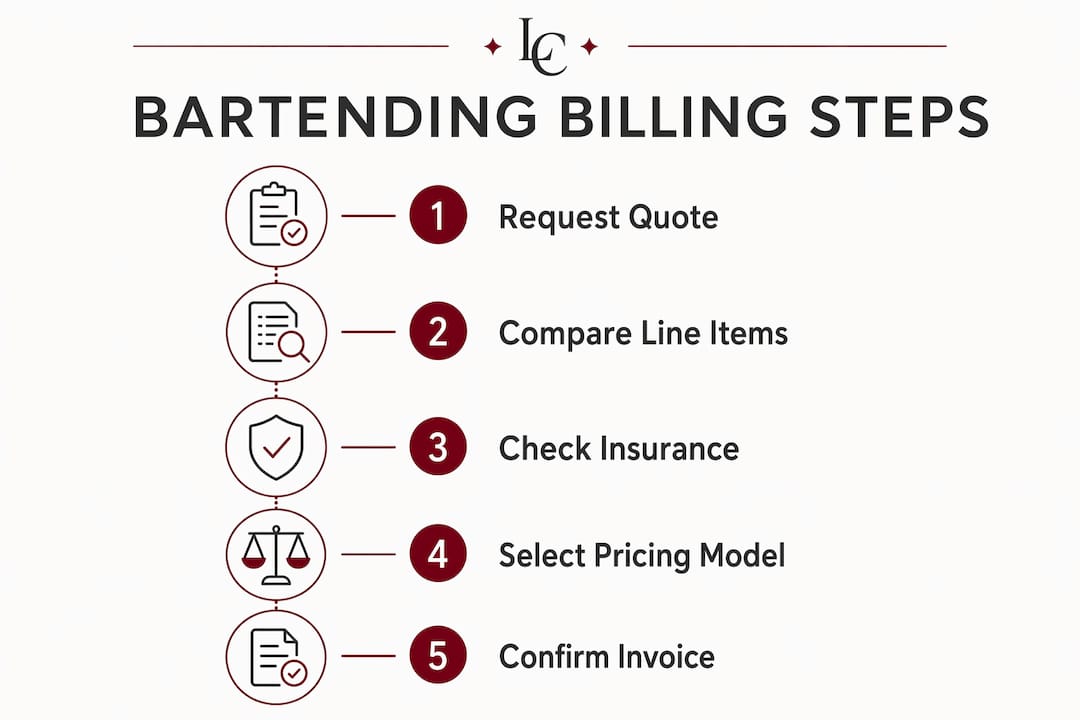
Transparent, itemized invoices prevent disputes and satisfy corporate accounting requirements. Every quote you receive should break down to this level:
| Line Item | Unit | Typical Rate |
|---|---|---|
| Bartender labor | Per person/hr | $35–$65 per hour |
| Barback labor | Per person/hr | Less than bartender rate |
| Setup and teardown | Flat or hourly | 1–2 hrs at labor rate |
| Ice | Per event | $50–$150 |
| Mixers and garnishes | Per guest | $2–$4 |
| Glassware rental | Per piece or flat | Varies |
| Portable bar rental | Per event | Varies |
| Travel and mileage | Flat fee or per mile | Varies by distance |
| Overtime | Per hour | ~1.5x base rate |
| Gratuity | % or flat | Stated separately |
| Insurance fee | Flat | Included or itemized |
| Taxes and service fees | % | Jurisdiction-dependent |
Items most often bundled into packages: setup, teardown, basic mixers, ice, and insurance. Items most often charged as add-ons: premium mixers, glassware, barback labor, travel, and overtime.
Pro Tip: When comparing quotes, check for four things on every line: unit (hours, guests, flat), quantity, rate, and whether it is a surcharge or included. A quote missing any of those columns is incomplete.
The U.S. regulatory rule every planner needs to know
Mobile bartending vendors in most U.S. states cannot sell alcohol to the host or guests. They may only charge for labor, supplies, and non-alcohol services.
What this means for your invoice:
The Michigan Liquor Control Commission makes this explicit for private events — bartending services and food trucks may not charge for alcohol products. The practical effect is the same across most jurisdictions: you purchase alcohol from a licensed off-premises retailer, and the vendor invoices for everything else.
Always ask your vendor how alcohol procurement is handled and make sure the contract states it clearly.
Before signing, request the vendor’s Certificate of Insurance (COI) and confirm their licensing guidance. If a vendor’s quote includes a line item labeled “alcohol” with a markup, that is a red flag worth investigating in your local jurisdiction.
How billing differs for weddings, corporate events, and private parties
The event type shapes which line items dominate and which billing model makes sense.

Weddings
Almost always use flat-rate packages. A 150-guest wedding typically requires two bartenders, a barback, multiple bar stations, and a 5–6 hour service window. Common add-ons: extra ice, a second portable bar, and a cocktail-hour setup separate from the reception bar. The wedding liquor catering contract should spell out each service window and staffing level explicitly.
Corporate events
Carry stricter invoicing requirements. Accounting departments need line-item detail, a COI naming the venue as additional insured, and clear gratuity handling. Gratuity at corporate events is often handled outside the invoice or added as a flat service charge, since tipping culture varies by company policy.
Private parties
Are the most flexible. A 40-person backyard party can work fine with one bartender on an hourly rate. The incidentals to watch: glassware (if the host does not own enough), travel fees if the venue is outside the vendor’s standard service area, and cleanup time that may not be included in the base rate.
- Two bartenders for a 100-guest wedding: expect a package covering 5–6 hours of service, setup, teardown, and mixers
- One bartender for a 40-person private party: hourly billing with ice and mixer add-ons is common
Deposits, payment schedules, and what your contract must include
A non-refundable deposit representing a substantial portion of the estimated total is standard. It protects the vendor’s reserved date and gives you a clear starting balance.
- Deposit (at signing): 20%–50% of estimated total, non-refundable, applied to final balance
- Final payment: Typically due 7–14 days before the event, or at event close
- Post-event reconciliation: Overtime, consumption overages, or incidentals invoiced within 48–72 hours
- Accepted payment methods: Credit card payments may incur a small processing fee charged by some vendors., ACH, or check
Cancellation tiers to require in your contract:
- Cancellation more than 60 days out: deposit forfeited, no further obligation
- Cancellation 30–60 days out: deposit plus 25%–50% of remaining balance
- Cancellation fewer than 30 days out: full balance may be owed
Contract clauses every planner should demand:
- Scope of service (hours, staffing levels, specific duties)
- Itemized price list attached as an exhibit
- Overtime rate and billing increment (30- or 60-minute blocks)
- Travel and mileage policy
- Gratuity policy (included, excluded, or pooled)
- COI clause naming venue as additional insured
- Alcohol procurement statement
- Cancellation and refund tiers
- Signature and effective date
Why vendor total cost matters more than the hourly rate
Professional mobile bartending packages include general and liquor liability insurance, TIPS-certified staff, bar equipment, and setup logistics. In contrast, a staffing-only hire might run $35–$65 per hour, but that number completely excludes every one of those protections.
- Liquor and general liability insurance: Covers alcohol-related incidents, which is why many venues strictly require it.
- TIPS certification: Essential server training that actively reduces over-service liability and satisfies venue requirements.
- Equipment provisions: Portable bar, tools, coolers, and glassware sourced and transported directly by the vendor.
- Detailed COI documentation: Names the venue as an additional insured, thereby satisfying corporate and venue requirements.
- Strong supplier relationships: Vendors with established accounts can expertly advise on alcohol purchasing.
Red flags and the exact questions to ask before signing
Add-ons like ice, premium mixers, and travel can significantly increase the final invoice beyond the initial base fee. Most surprises are avoidable if you ask the right questions upfront.
Common billing pitfalls:
- Vague “supplies” line with no unit or quantity
- Travel fees not disclosed until the final invoice
- Gratuity handling left undefined
- Overtime rate missing from the contract
- Ice and mixer charges buried in fine print
- Non-itemized final invoice after the event
Questions to ask every vendor:
- What is your minimum booking (hours and total)?
- What is included in the base rate versus charged separately?
- How is overtime billed, and in what increments?
- Who purchases the alcohol, and how should I source it?
- How is gratuity handled and distributed among staff?
- What insurance do you carry, and can I see the COI?
- Do you carry TIPS or equivalent server certification?
- Is travel included, or is there a mileage fee?
- How are incidentals (extra ice, mixer overages) invoiced after the event?
- What is your cancellation policy?
Three billing scenarios with example invoice snapshots
These ranges reflect national benchmarks and Las Vegas market conditions.
Scenario 1: Small private party, 40 guests
| Line Item | Amount |
|---|---|
| Ice and mixers | $100–$150 |
| Travel fee | $50 |
| Estimated total | $465–$575 |
Scenario 2: Mid-size wedding, 120 guests
| Line Item | Amount |
|---|---|
| Estimated total | $1,490–$2,230 |
Scenario 3: Corporate cocktail hour, 200 guests
| Line Item | Amount |
|---|---|
| COI naming venue as additional insured | Included |
| Consumption reconciliation (post-event) | Varies |
| Estimated total | —+ |
For context, mobile vendor packages typically run $500–$2,500 or more depending on services included.
Key Takeaways
Bartending service billing works by separating labor and service fees from alcohol costs, with packages covering insurance, certified staff, and equipment that a staffing-only rate never includes.
| Point | Details |
|---|---|
| Itemize every invoice | Demand unit, quantity, and rate for each line; vague “supplies” lines hide the biggest surprises. |
| Confirm alcohol procurement | In most U.S. jurisdictions, vendors cannot charge for alcohol; you buy it from a licensed retailer. |
| Require COI and TIPS proof | General and liquor liability insurance plus server certification protect you and satisfy venue requirements. |
| Plan for add-ons like ice, mixers, travel, and overtime to routinely push the final invoice above the initial quote. | |
| Liquidcouragelv for Las Vegas events | Liquidcouragelv provides insured, TIPS-certified mobile bartending with itemized quotes for weddings, corporate events, and private parties in Las Vegas and Henderson. |
The part of bartending billing most planners get wrong
Get an itemized quote from Liquidcouragelv in Las Vegas and Henderson
If you are planning a wedding, corporate event, or private party in Las Vegas or Henderson, Liquidcouragelv handles the details that protect your budget and your event. Specifically, every booking includes a fully itemized quote, general and liquor liability insurance, TIPS-certified bartenders, and complete setup and teardown. Consequently, you will see no vague line items and no surprise fees after the event.
Useful sources and further reading
- Michigan LCC: Private events, bartending services, and food trucks — regulatory guidance on what mobile bartending vendors may and may not charge for
- LegalClarity: Bartender invoice template, fields, pricing, and taxes — invoice structure, deposit norms, and cancellation language
- Thumbtack: 2026 bartender cost estimates — national pricing benchmarks and add-on ranges
- SellerServer: What do bartenders charge for private events? — billing model breakdowns and formula examples
- Liquidcouragelv: Conference bartending service guide — COI requirements, invoice itemization, and TIPS certification guidance for Las Vegas planners
- Liquidcouragelv: What does event insurance cover for bartending? — explanation of COI coverage and why liquor liability insurance matters
Therefore, always verify current liquor licensing rules with your local jurisdiction. Additionally, request a COI and proof of server certification from any vendor before signing a contract.